Acid rain and the effect it has on our environment
"Acid Rain," or more precisely acidic precipitation, is the term used to describe
rainfall that has a pH level of less than 5.6--a pH of 7 being neutral. This form of air
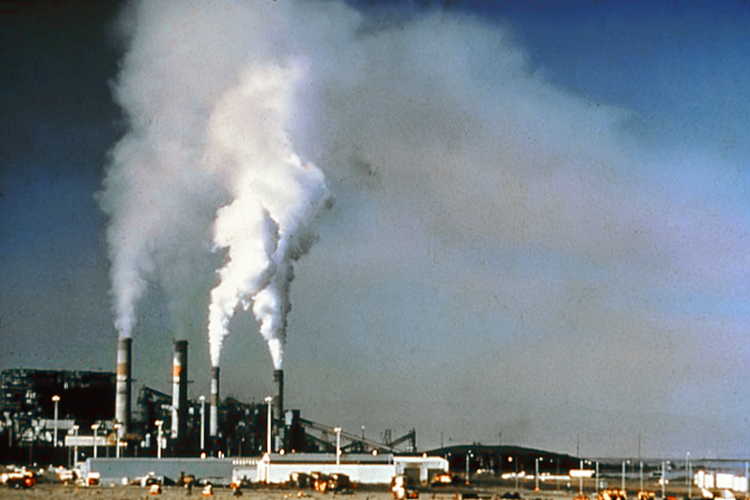
pollution is currently a subject of great controversy because of the damage it does tot he environment and property worldwide. For the last ten years, this occurrence has brought destruction to thousands of lakes and streams in the United States, Canada, and parts of Europe. It also leads to the deterioration of buildings and statues by reacting with several minerals. Acid rain is formed when oxides of nitrogen and sulfite combine with moisture in the atmosphere to make nitric and sulfuric acids. These acids can be carried away far from its origin. The two primary sources of acid rain are sulfur dioxide (SO2), and oxides of nitrogen (NOx). Sulfur dioxide is a colorless gas released as a by-product of combusted fossil fuels containing sulfur. A variety of industrial processes, such as the production of iron and steel, utility factories, and crude oil processing produce this gas. Sulfur dioxide can also be emitted into the atmosphere by natural disasters or means. This accounts for ten percent of all sulfur dioxide emission, coming from volcanoes, sea spray, plankton, and rotting vegetation. Overall, 69.4 percent of sulfur dioxide is produced by industrial combustion. Only 3.7 percent is caused by transportation . The other chemical that is also chiefly responsible for the make-up of acid rain is nitrogen oxide. Oxides of nitrogen is a term used to describe any compound of nitrogen with any amount of oxygen atoms. Nitrogen monoxide and nitrogen dioxide are all oxides of nitrogen. These gases are by-products of firing processes of extreme high temperatures (automobiles, utility plants), and in chemical industries (fertilizer production). Natural processes such as...
More Environmental Science
essays:
Problems Associated With Fossil Fuel Powered Transportation
... engine fuel but does include oxides of nitrogen, sulphur and carbon, as well as soot, tarry particulates and heavy metals. The oxides mentioned above affect the environment in a number of ways. Sulphur oxides, nitrogen oxides and carbon dioxide are ...
Air Pollution: Reasearch Report
... from industrial processes and or the burning of fuels. Emissions That Contribute Towards Air Pollution Primary pollutants emitted directly to the atmosphere, including nitrogen oxides, sulphur dioxide, carbon ...
Air pollution
... Most air pollution comes from human activities: burning fossil fuels, natural gas, coal, and oil to power industrial processes and motor vehicles. Among the harmful chemical compounds this burning puts into the atmosphere are carbon dioxide, carbon monoxide, nitrogen oxides, sulfur ...
This is a term paper on AIR pollution. It has some causes and effects, etc. It mainly has to do with how and why the pollution is occurring.
... high level of ozone in the smog, it is very likely that there is a great amount of other pollutants as well. Once in smog, sulfur dioxide transforms into droplets of pure floating acid. This acid harms ...
Air Pollution's Effects on Human Health & Mortality
... development of cumulative respiratory tract injury in people who are repeatedly exposed to mixtures of air pollutants containing oxidants, acids, and ... the air and rain and wind scatter the particulates. The atmosphere consists of nitrogen, oxygen, and small amounts of carbon dioxide and ...
Acidic Oxides: Environmental Peril?
... acid deposition. The 2 forms of acidic oxide which form acid rain are called sulfur dioxide (SO2) and nitrogen oxide (NOx). The way these acids ... burning fossil fuels are the Renewable Energy sources. These ...
How Fossil Fuels Affect The Environment
... The pollutants involved in acid rain are sulphur dioxide, oxides of nitrogen, ozone and various volatile organic vapours given off from gasoline stations. Fossil fuels contain ...
Improving Air Quality - Government of Canada
... and industry leaders involved in the implementation of the Clean Air Agenda, linkages with climate change programs can be- made. The various substances we introduce to the atmosphere interact in complex ways producing effects we label as acid rain, air pollution ...