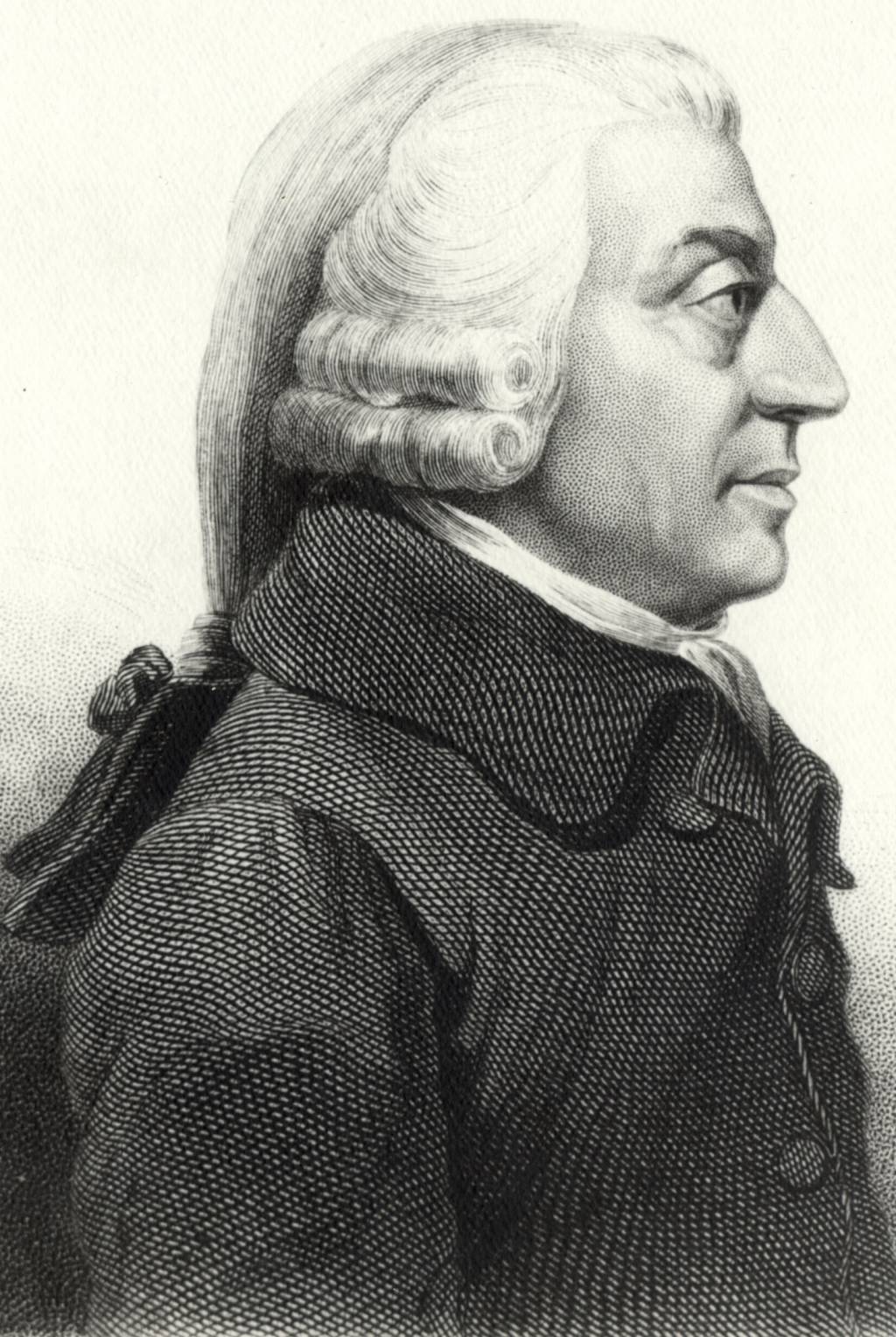
Adam Smith
After two centuries, Adam Smith remains a towering figure in the history of economic thought. Known primarily for a single work, An Inquiry into the nature an causes of the Wealth of Nations (1776), the first comprehensive system of political economy, Smith is more properly regarded as a social philosopher whose economic writings constitute only the capstone to an overarching view of political and social evolution. If his masterwork is viewed in relation to his earlier lectures on moral philosophy and government, as well as to allusions in The Theory of Moral Sentiments (1759) to a work he hoped to write on "the general principles of law and government, and of the different revolutions they have undergone in the different ages and periods of society", then The Wealth of Nations may be seen not merely as a treatise on economics but as a partial exposition of a much larger scheme of historical evolution.
Early Life
Unfortunately, much is known about Smith's thought than about his life. Though the exact date of his birth is unknown, he was baptised on June 5, 1723, in Kikcaldy, a small (population 1,500) but thriving fishing village near Edinburgh, the son by second marriage of Adam Smith, comptroller of customs at Kikcaldy, and Margaret Douglas, daughter of a substantial landowner. Of Smith's childhood nothing is known other than that he received his elementary schooling in Kirkcaldy and that at the age of four years he was said to have been carried off by gypsies. Pursuits was mounted, and young Adam was abandoned by his captors. "He would have made, I fear, a poor gypsy", commented his principal biographer.
At the age of 14, in 1737, Smith entered the university of Glasgow, already remarkable as a centre of what was to become known as the Scottish...
More Economic History
essays:
History of Industrial Democracy.
... the general position and prospects of the enterprise ·The right to offer advice or to be consulted on economic matters ·The right to joint decision making in a range of social and ...
The Federal Reserve System: Principles and Practices, History of
... The principles and practices upon which it was founded has remained the same, and continues to adapt to the world economic climate. The relatively conservative planning has provided the United States economy with ...
A History of Modern Europe
... A History of Modern Europe: From the French Revolution to the Present, Publisher: W. W. Norton & Company (March 1996), ISBN-13: 978-0393969283, 110-114R. Lim and D. K. Smith, The ...
This work is basically a critical review of Bergen's book: Holy War Inc. but it is also a good source to aid a student in his/her research of US international policies, oil, etc.
... the economic control the US exercises over the entire global economy by continuing to preside in Saudi Arabia: "The US is strongly committed to the protecting Gulf oil, although only 10% of oil ...
Discussion starter for 'The Wealth of Nations'
... Adam Smith was a philosopher but is also accredited to creating the market economy, supply, and demand. Smith's book, "The Wealth of Nations," not only explained how his new way of economics would ... stayed the same but few places today are under that simple of a system. I fear what Smith did not take ...
COUNTRY X ECONOMY REPORT OF 2ND QUARTER 2007.
... production of crude oil and national gas have also provide a positive economic growth in 2007, also oil production had decline in 2007, refer to figure 8 ... percent growth in 2006. Despite a slow growth in US economy especially in the stock market, high demand in domestic consumption ...
Adam Smith and the Major Concepts in the Wealth of Nations Describe the ideas of Adam Smith in detail
... price of the goods bartered for was actually the amount of labor put into creating the good itself you are bartering with. Smith, Adam. The Wealth of Nations. 1863 ... a general good. Regulating the system would interfere with the preferable ideal outcome. Smith distrusts the ability of government to ...
An Analysis of the theories of Neoclassical and Political Economy and the practicality of each.
... to economic occurrences. There are, to more specifically illustrate these variables, four "C's" of Political Economy. These are: Context, Collective Behavior, Conflicting Interests, and Change. These contexts are important because, "...political economists perceive important social groups ...