Though affirmative action is far from new but remains a controversial issue today. Most believe it originates from amendments 13-15, the series of amendments that outlawed slavery, guaranteed equal protection under the law, and forbid racial discrimination when voting, respectively (Sykes 1). In the case of Plessy vs. Ferguson the Supreme Court made a decision in 1896 that mandated separate but equal treatment for African Americans (Sykes 1). Then, in 1954 the Supreme Court made a decision in the Brown vs. Board of Education trial that replaced the one from the Plessy vs. Ferguson trial. Lyndon Johnson, President at the time, was the first to coin the term "Affirmative Action" in an Executive Order (Sykes 1). This order required all federal contractors to use the new Executive Order of affirmative action to make sure people were treated equally, "without regard to their race, creed, color, or national origin" (Cahn 1).
 Lord Dahrendorf Deutsch: Ralf Dahrendorf 2003 Sven...
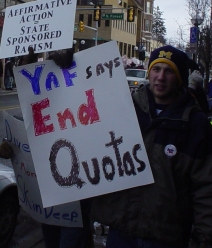 Members of the University of Michigan YAF Chapter ...
 Under the Malaysian New Economic Policy, Bumiputra...
Two years later Johnson amended the Executive Order to include protection based on gender, now allowing women to have the same rights (Cahn 1). By 1971, President Nixon signed an additional amendment that required contractors to adopt an "acceptable affirmative action program" (Cahn 1). Over the past several decades, many debate as to whether or not affirmative action still belongs in America.
Affirmative action is an ongoing issue that evokes strong emotions for both supporters and non-supporters. Those in opposition to affirmative action argue that it does not help minorities but rather degrades them, that it sends minorities the message that they can only succeed if they are given extra benefits. This in turn results in damaged credibility and integrity. Often cited as examples of affirmative action victims are that of Clarence Thomas and Colin Powell. Critics of affirmative action say that when Clarence Thomas was nominated by former President...