Afican-American
generally, persons living in the western hemisphere who are descendants of Africans, especially black Africans. African immigration to the Americas may have begun before European exploration of the region. Blacks sailed with Christopher Columbus even on his first voyage in 1492, and the earliest Spanish and Portuguese explorers were likewise accompanied by blacks--Africans who had been born and reared in Iberia. In the following four centuries millions of immigrants from sub-Saharan Africa were brought to the New World as slaves. Today, their descendants form major ethnic minorities in the U.S. and several Latin American countries, and they are the dominant element in many Caribbean nations. Over the centuries, African-Americans have contributed to the cultural mix of their respective societies and thus exerted a profound influence on all facets of life in the western hemisphere.
The term African-American is especially used to refer to blacks living in North America. Other terms are sometimes used to refer to African-Americans from a particular locality, such as Afro-Brazilian or Afro-Jamaican.
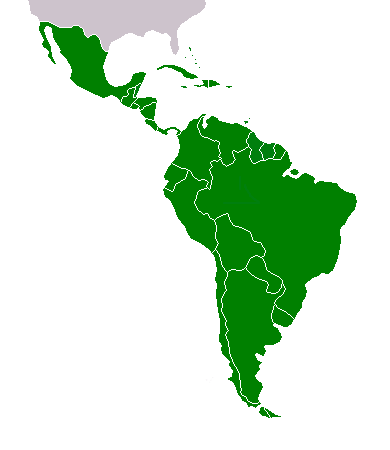
LATIN AMERICA AND THE CARIBBEAN
The Latin American and Caribbean regions were the first areas of the Americas to be populated by African immigrants, and the majority of their descendants still live in those regions.
EARLY IMMIGRATION AND SLAVERY
Most of the earliest black immigrants to the Americas were natives of Spain and Portugal--men such as Pedro Alonso Niño (1468-1505), a navigator who accompanied Columbus on his first voyage, and the black colonists who helped Nicolás de Ovando (1460?-1518) form the first Spanish settlement on Hispaniola in 1502. The name of Nuflo de Olano (b. 1490?) appears in the records as that of a black slave present when Vasco Núñez de Balboa sighted the Pacific Ocean in 1513. Other blacks served with Hernán Cortés when he conquered Mexico and with Francisco Pizarro when he...
Reviews of: "Afican-American"
:
More African Studies - History
essays:
"The African-American Struggle Against Slavery: A timeline of the African-American experience
... Some African-Americans favored a return to Africa and even succeeded in reaching Sierra Leone. Soon, however, return to Africa was discouraged. In subsequent years, blacks continued to discuss the option of immigrating to Canada, Latin America ...
Treatment of the African American, Native American and Immigrant Population in America in the late 1800s.
... own country. Being an African American in this time was terrible because you were caught in between being a slave and being free. Whether you were Indian, African American, or any other immigrant in ...
A Study of the African-American Mosaic: A Library of Congress Resource Guide for the Study of Black History and Culture
... nation called Liberia in west Africa. By retaining the American manners, dress, architecture, and government style, a "pseudo America" was reconstructed in Liberia by the African-Americans. An American-like government was formed by having Joseph Jenkins Roberts as the first ...
Why African americans should not be given any reparations for slavery.
... this country as a free person and stay free is because of people who have risked their lives during the civil war to liberate the African American slaves and ... this century). 4. Not all African Americans actually ... their descendants? III. Satisfaction A. The African American community ...
It's about songs that were sung by african americans back in the 19th century. they were slave songs that helped africn americans to communicate
... by slaves, the fact that most spirituals had biblical allusions proves that African American Slaves were greatly influenced by ... by the time the latter spirituals came spirituals were greatly influence by the European culture. Spirituals were made to help the world respect and ...
The Effects of AIDS in Africa
... in Sub-Saharan Africa has orphaned an estimated eleven million children (HIV and Aids Statistics for Africa 1)." The African country with ... 1998. African Americans have the highest AIDS case rate per 100,000 population of all ethnic/racial ...
This essay takes a close look at he african american tradition of quilt making
... the country to freedom ("African American Quilting"). African America quilts range in different patterns, colors, and meanings but all still having an African influence. Harriet Powers, one of the most phenomenal African American quilt makers, was born a slave in ...
African Americans have suffered and struggled throught history.
... non slave society. However, the South saw Reconstruction as a humiliating imposition and did not welcome it. During this time period of Reconstruction, white dominance groups were establishing in the South in the efforts to remove African Americans from ...
African American
well describe the slavery era and the contribution of famous people its good
1 out of 2 people found this comment useful.