Alcohols
Alcohols
Introduction
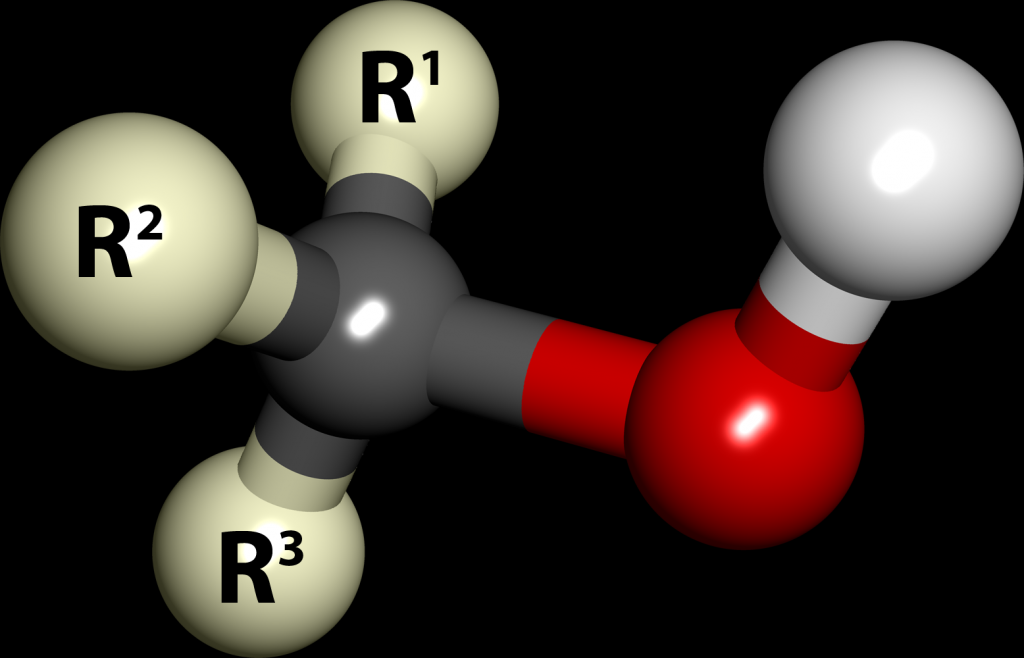
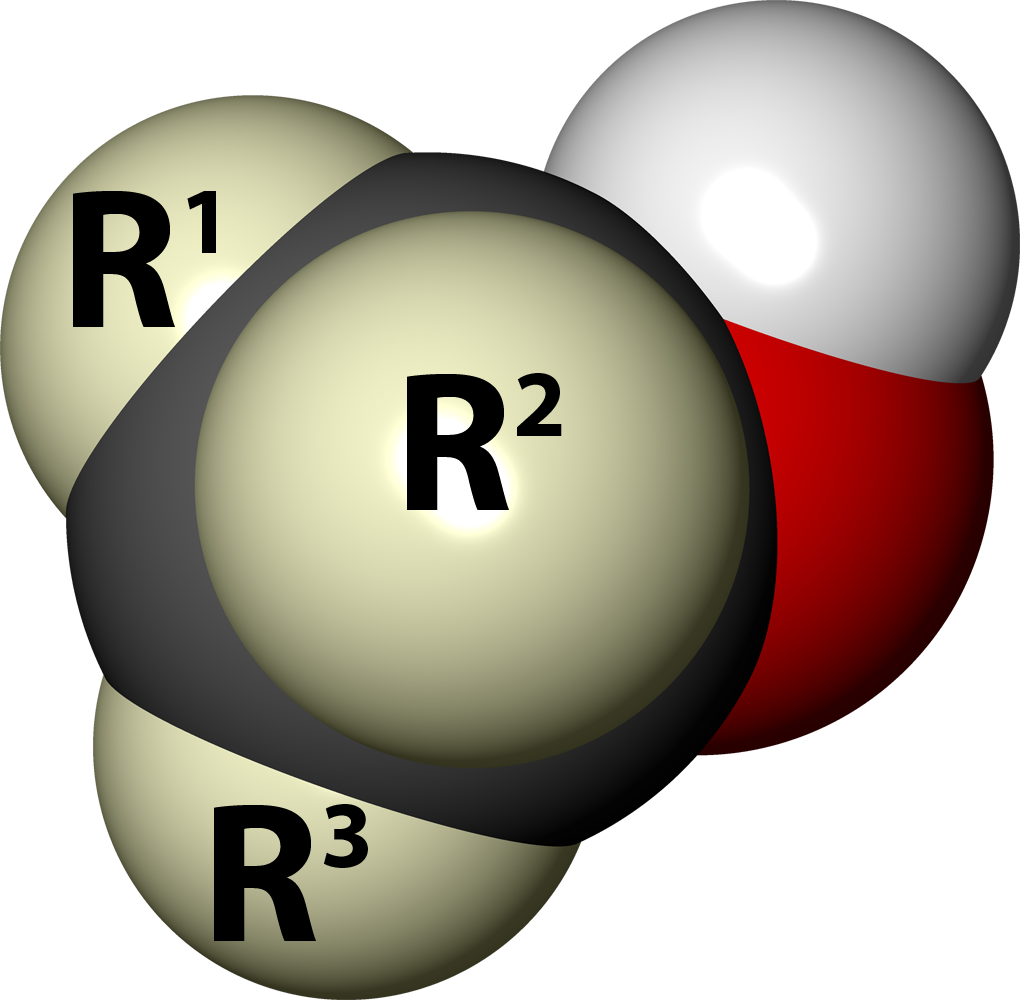
Alcohols are a group of compounds which have a hydroxyl group joined to either an alkyl group or a cycloalkyl group. A hydroxyl group is an OH joined to a carbon atom and a cycloalkyl group is a ring of six carbon atoms that is arranged in a hexagonal shape.
Naming alcohols
Naming alcohols is not difficult. Basically, you identify the longest chain of carbon atoms. Then you take the name of the 'alkane' or 'alkene' (as if the hydroxyl group weren't there). Taking the name of the 'alkane' or 'alkene', you add to the end of the name the 'position numbers' of the carbon atoms to which the hydroxyl groups are attached to, using commas to separate the different numbers. Then, you add the suffix -ol, which is the suffix of all alcohols. If there are more than one hydroxyl group present, then -di or -tri, and so on, is put just before the suffix -ol.

Homologous series
A homologous series is a group of compounds which have a certain pattern in their structures, therefore have similar chemical properties and a trend in physical properties. The alcohol is one such homologous series. Increasing the chain length causes an increase in boiling and melting points. This is due to the fact that as the molecule increases in chain length, each molecule has larger temporary dipole-dipole interactions, causing larger Van de Waal's forces per molecule. Therefore, more energy is needed to break these increased Van de Waal's forces, hence the increase in boiling and melting points. An increase in chain length also causes the solubility in water to decrease. This is due to the fact that only the hydroxyl group causes the molecule to have an overall dipole. The rest of the molecule remains non-polar. Therefore, as you increase...
More Chemistry
essays:
The enthalpy change of combustion for the alcohol homologous series.
... Homologous series- a series of organic molecules with the same functional group §Molar mass- the mass of one mole of a substance, calculated from its formula §Molecular formula - shows the total number of atoms present in a molecule of a compound ...
To investigate the factors that affect a chemical reaction: Calcium Carbonate + Hydrochloric Acid Calcium Chloride + Carbon Dioxide
... slightly differs to my proposed method in the Plan. Instead of using a Gas Syringe I used a Measuring Cylinder to measure the amount of carbon dioxide ... that holds them together. Solids can only vibrate in their fixed positions. The particles are slightly further apart in liquids than they are ...
How can we decide how to make the best use of our limited oil supplies
... the compounds with different boiling points will remain in separate levels. Most of the hydrocarbons from crude oil are alkanes, saturated compounds from the same homologous series. Alkanes contain only carbon and ...
Albert Einstein: The man of the Century. Breif biography of Albert Einstein, then a sumarization of his main points of work. The Theory of Reletivity, General Theory of Reletivity,and the paradoxes.
... makes the electrons present in the metals atoms will be "knocked out". Thus admitting a light (different in color depending on the elemental metal used). However ... . He was a unique child even from birth, due to the unusual shape of his head. The cranium was so immense; doctors thought that Einstein ...
Study notes for Chemistry test. Basic definitions and notes on group structure and chemical bonding. For year 10 these achieved a level 6+ or an A+ (The spaces are for atomic drawings).
... an atom Group- Number of electron in the valence shell Compounds Compounds result when two or more different elements chemically combine. Some common compounds Water H2O Methane CH4 Carbon Dioxide CO2 Group 1 ...
Independent Study Assignment Chemistry (SCHOA1)
... are used extensively as petrochemical building blocks in the manufacture of pharmaceuticals, dyes, plastics, and many other chemicals. Alcohols: Alcohols are aliphatic carbon compounds with one or more hydroxyl-groups (-OH) bound directly to a carbon atom. a ...
Everything About Organic Compounds
... are used to separate numbers from prefixes. 4. Name alkyl functional groups alphabetically, ignoring the prefixes. v A homologous series is a "family" of compounds which contain: o A common functional group (a distinguishing group of atoms that ...
Carbon and its allotropes
... the Atomic Number 6 in group IV, period II. Carbon is not very plentiful, it only makes up 0.025% of the Earth's crust, but it still forms more compounds than ...