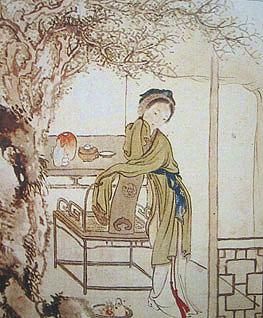
Analysis of Bao-yu's dream in Cao Xueqin's 'Story of the Stone'
The Story of the Stone by Cao Xueqin is an animated, lively account of life
in a large Chinese household in the mid-18th century Qing dynasty. It
remains a fascinating novel for modern readers with its vivid and detailed
descriptions of the minutiae of daily life - from clothing, food and
interior design to education, marriage and death.
For all its realism however, The Story of the Stone is not set entirely in
reality. The very premise of the whole tale, that of a single rock left out
of the goddess Nu-wa's repairing of the sky, is one based on a
magico-religious dream world. The rock is found by a Buddhist and a Taoist
who take it down to the mortal world where it lives out a human life, that
of Jia Bao-yu, before attaining Nirvana. Once a rock again, a Taoist copies
the inscription on its surface ''from beginning to end and took it back
with him to look for a publisher''.

Cao Xueqin's emphasis on dreams can be seen in the alternative titles for
his masterpiece. A Dream of Red Mansions is the title by which the book is
perhaps most commonly known. Twelve Young Ladies of Jinling is also a title
suggested in chapter one. Both of these titles refer to the same dream. As
David Hawkes explains, 'hong lou', red mansion, has the more specialised
meaning of the residences of the daughters of rich men and thus, the young
ladies themselves.
The dream alluded to in these appellations occurs in the fifth chapter of
volume one, The Golden Days. Cousin Zhen's wife, You-shi, has invited the
women of the Rong-guo house, accompanied by Bao-yu, round for a flower
viewing party. Needless to say, Bao-yu soon tires and asks to take a nap.
Rather than going back...
More Asian History
essays:
This essay describes women in china during the Qing dynasty
... early Qing dynasty, the idea that a woman should never remarry regardless of any adverse consequences was a well-entrenched moral precept among elite Chinese. In such a case, if her husband's death left a woman impoverished and she ...
17th Century China: An Influential and Powerful Empire This essay was to be one that compared two major empires from the 17th-18th century and how significant they were to the west and the world.
... on the edge of the West, Russia had become an important location with many technological, economic, and commercial advancements in the 1600s. Russia in the 17th century was a country that was greatly influenced by the Western world, which ...
Women's Movement in Korea and China
... values and beliefs. Work Korean and Chinese women, similar to the women in other parts of the world, work constantly and continuously. There was continuous work as mothers and household workers ...
Mao Zedong and him as a leader
... his account with the Chinese people is very finely balanced. In judging Mao's role as the leader of the Chinese revolutionary movement and in the subsequent governing of the country ...
"The Genius That was China" This essay is about the wonderful technological developments of Ancient China and how they influenced the development of the West.
... one Chinese invention would give power to the Knights, another earlier one would begin to take it away. During the period of civil war after the fall of the Zhou dynasty in the 7th century BC ...
Discuss and evaluate what part Eastern philosophy and religion play in George Lucas's conception of Star Wars?
... me of the Chinese philosophy of the Yin and the Yang. In the time of greatest Jedi-hood, there is still the seed of the Dark Side of the Force. To really understand the Zen philosophy, imagine lives as ...
Chinese History - Opium wars, Taiping rebellion, boxer rebellion and the long march.
... stronger dynasty. The notion of the Mandate of Heaven was also invoked by Mencius. b. Explain the causes of the Opium wars. How did these wars affect China? Foreign trade in China expanded during the late 18th century and early ...
The impact of World War 1 on Japanese development in the early 20th century
... intellectual, and urban consciousness. (Jansen 496)World War 1 caused many changes in the nation of Japan, both positive and negative. The whole infrastructure of the country altered immensely during the early 20th century, even ...