Analysis of Fayol's 14 Principles
1. Introduction
Management in organizations is a dynamic discipline. Many had been trying means and ways to improve or invent management methods for the betterment and ease of managers. Old ideas are revisited and new ideas are churned out to come out with more effective management concepts and practices.
Many of these current management concepts and practices, in fact, can be traced back to early management theories. One prominent management pioneer behind the general administrative approach was Henri Fayol. He was the key figure in the turn-of-the-century Classical School of management theory with his own development of a universal set of four management functions thats consist of Planning, Organizing, Leading (Commanding and Coordinating) and Control, which is seen very much applicable in today's business world.
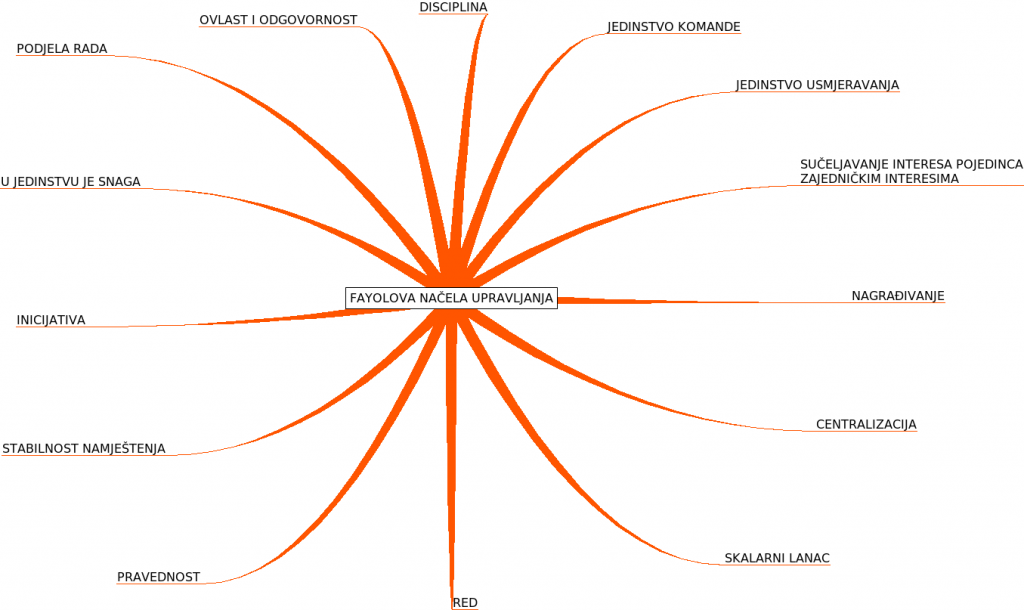
Fayol's 14 principles of management are also linked to his four functions to assist managers to manage effectively. His principles of management are as follows:

1. Division of work
2. Authority and responsibility
3. Discipline
4. Unity of command
5. Unity of direction
6. Subordination of individual interest to general interest
7. Remuneration of personnel
8. Centralization
9. Scalar chain
10. Order
11. Equity
12. Stability of tenure of personnel
13. Initiative
14. Esprit de corps.
Although there is still a great deal of validity of Foyal's principles in current management practices, there are still some principles which might be too general and thus become inapplicable to certain cases, in other words, it is not tailored to suit every businessmen's management strategy. Four principles (Authority, Division of work, Unity of Direction, and Unity of Command) will be elaborated and discussed in further details to examine how relevant or irrelevant Fayol's management principles are in today's business world.
2. Four Principles to Illustrate the Relevancy Today
2.1 Authority
"Authority is the right to give orders and...
More Management
essays:
Explain and analyze Henri Fayol's principles of management
... s 14 principles of management then and now: a framework for managing todays organizations effectively, Management Decision ...
With the use of the principles pioneered by Henry Fayol, explore the relevance of those principles that are still valid. Your exploration can be on any company or companies of your choice.
... colleagues "manage better" in the face of unprecedented change in business and commerce. One of Fayol's famous contributions was his 14 principles of management, namely Division of Labour ...
Describe a manager's morning using Fayol's and Mintzberg's theories.
... managerial functions: planning, organising, commanding, co-ordinating and controlling (Lammond, 1998: 4). Fayol also identified 14 principles of management which ...
This document clearly summarizes the subject of Management.
... the management functions as planning (forecasting), organising, co-ordinating, commanding and controlling. The principles of the classical management theories are; unity of command ...
What was Frederick Taylor's most significant contribution to management?
... application of their theories and techniques. For instance, he provided many of the ideas for the conceptual framework later adopted by the administrative management theorists, including Fayol's 14 principles of management: clear delineation of authority ...
Explain how the managerial ideas of Taylor and Fayol differ from Mayo. Assess the relevance of Classical Management theorists to the management of contemporary organisations
... down 14 principles of management to be applied in any situation: 1. Specialization of labour. Specializing encourages continuous improvement in skills and the development of improvements in methods. 2 ...
Project Management Function
... communicate effectively, resolve conflict, lead team members and motivate project stakeholders. Team dynamic main features techniques for dealing with difficult people and easy-to-use skills to increase the performance of a project team. Management Function We ...
To manage is to forecast and plan, to organize, to command and to control. Critical Review on Henri Fayol's work.
... his 14 principles of management. Fayol's writings on organising were broad in scope and are still followed in most of the organisations. III.To command: 'The organisation, having been formed, must be set going ...