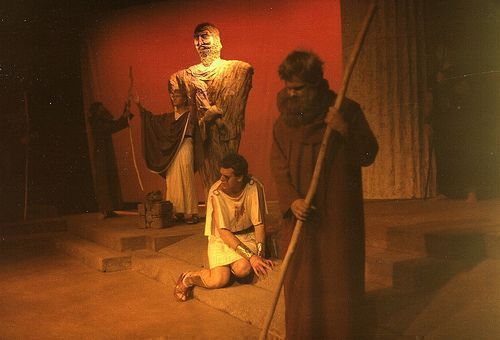
Antigone, a play written by Sophocles in the 5th century B.C. Antigone somehow shows how good people can do evil things based on Creon
Antigone in a sense is about the evil that good people do.
Antigone, a play written by Sophocles in the 5th century B.C., is a play enclosed by conflict and problems. Conflicts are evident from the beginning of the play, to the end. Even before the play has even begun, these problems are already evident in the history of the characters in the play. Oedipus for instance had killed his own father and married his mother. Although he was not aware of that fact, this results in Jacasta hanging herself, and Oedipus blinding himself. Their two twin sons, Eteocles and Polynices agree to rule in alternate years, but Eteocles refused to relinquish his rule of Thebes, and as a result Polynices fled to Argos to gain the aid of the Argive army. Polynices and the Argive army attacked the seven gates of Thebes, and the two twins ended up in killing each other. Also, evil is a common factor in this play. If it were not for the evil within Eteocles, then the brothers would not have slayed one another. Furthermore, when Creon gains royal power he refuses to give Eteocles, his nephew, a proper burial and leaves him unburied to rot and get eaten by the animals. As for Polynices, he shall receive all the proper burial rituals. This makes Antigone very mad, as they are both her brothers, and she believes they both should be buried. Although Creon is royalty and is seen to be a good person and respected ruler, when he is angered, his anger blinds him, and the actions he takes portray some evil.
When Creon gains power over Thebes, as closest relative to the dead King, he proves to be a great ruler who cares about the right being of his city and townspeople.
More Drama
essays:
Sophocles Theban plays on oedipuis rex and antigone.
... and conflict Sophocles' Antigone, in its later phases is no longer about the conflict of ... social order which the shocking news of Jocasta's and Oedipus's incest had fractured, and which the civil war between ...
Using Irony in a Play. An essay about Sophocles' Antigone and the usage of irony throughout the play,
... Antigone had committed the crime. This reveals Creon's thinking that no one but a man would commit a crime like that. This hints further conflict ... types of irony, but have many of the same impacts. Sophocles' use of irony is what makes up this classic tragedy ...
Antigone Analysis Book:Antigone Author:Sophocles
... play Antigone, Sophocles uses the conflict between the written laws of man and the unwritten laws of the gods to bind both Antigone and Kreon together. Antigones ... be obeyed, in all things great and small.(35) telling the people of Thebes that he is the king and even if his laws are wrong, everyone ...
Antigone. Summary of the Greek play Antigone and why its titled after her
... playwrite, Sophocles, wrote many exceptional plays. One of these is Antigone. The play is named after Oedipus's daughter, ... and punishable with death. He calls Polynices a traitor to Thebes because he had fought on the opposite side. Yet, Antigone loves her brother dearly and did indeed bury him. She ...
Antigone Study Guide.
... recounts the events leading to Antigone's tragedy. Oedipus, Antigone and Ismene's father, had two sons, Eteocles and Polynices. Upon Oedipus' death, it was ... himself only to the order of the kingdom. Antigone's marriage is worth more to Thebes than her death. Antigone insists that he cannot save her. ...
Analysis of the play 'After the Ball' by David Williamson.
... the play has a relationship with their ideas and beliefs. The common factor found in all of these beliefs is that they are about Australia and all are in direct conflict with each other. For instance, during the play we see ...
The Missing Dialogue in "Antigone" by Sophocles
... gods. By not including a dialogue between Antigone and Haimon, Sophocles is able to present his political issues in a clear manner. Works Cited Sophocles. The Oedipus Cycle: Oedipus Rex, Oedipus at Colonus, Antigone. trans. Fitts, Dudley and Fitzgerald, Robert. Harcourt ...
"Oedipus Rex" by Sophocles
... when Oedipus sees her body dangling he cuts her down and stabs out his eyes with her brooch. Having disgraced his country he is banished and he and his daughter Antigone leave Thebes. He ... story. 'Oedipus Rex' by Sophocles is one such story. In the story Oedipus has ...