Application of Robotic Technology.
Application of Robotic Technology
Robotic technology is used in many operations and its demand is very high. In 1999, the growth rate of robotic industry was 20% worldwide and in America, it was 60% compared to 1998. In the last 20 years robotic industry has become multi billionaire industry and its growth rate is very high due to its many applications in manufacturing and automotive industry (Jan Karlsson, 2001. p119, 124.). Robots perform many industrial operations and they are used to increase production, improve quality, and reduce labor. Although the function of robots are very complicated and need good skills, they are used in many in industrial operations to perform different operation in the following ways: welding, painting, presswork, and heat treatment. To understand the robotic technology we have to know about the robots its functions and different applications of robots. Finally, we need to learn about how much robots are economical in different industrial operations and their future developments in different fields.
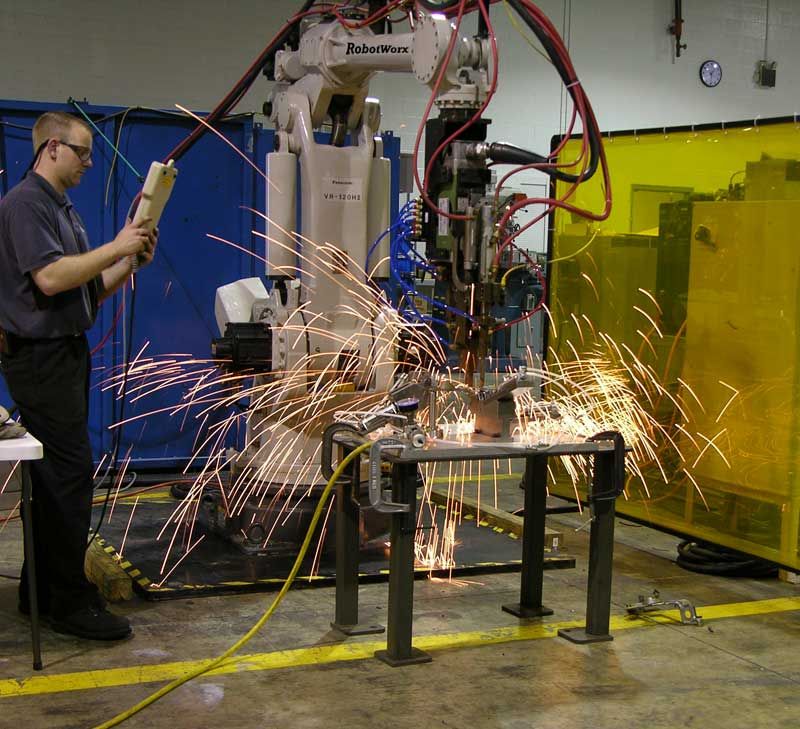
The word robots derived from robota means forced labor. According to the definition of the robot institute of America, " a robot is a reprogramable multifunctional manipulated design to move materials parts tools or specialized devices through variable programmed motion for the performance of variety of tasks" (James A. Rehg, 1985 p7). The basic system of robots consists of a pneumatic or hydraulic operated mechanical arm working as a human arm and is controlled by computer. At the end of the arm a tool is mounted which is doing all the operations. An Electric servomotor, pneumatic or hydraulic aculator, drives the robotic arm and provides with linear or rotational motion (James. p8, 9). The combination of linear and rotational motion describes the geometry of the robotic arm. The arm geometry tells the form of the space in...
More Manufacturing Engineering
essays:
Expanded Definition: Quality Control. It can be used in Idustrial Enineering related classes or for entry level English Classes for small assignments.
... Expanded Definition: Quality Control Quality control is a component of Industrial Engineering encompassing the operational techniques and activities used to fulfill requirements for quality (ASQ-FAQ). According to Webster.com the phrase 'Quality Control' is dated back to 1935. Separately the ...
Process manufacturing tecnology.
... industrial equipment, in extraction of metals and for numerous other purposes. Hydrochloric acid may occur in workroom air as a gas or mist. The mean concentration of hydrochloric acid during pickling, electroplating and other acid treatment ...
Performance of Nylon Climbing Ropes
... will degrade to various degrees from the exposure to ultraviolet light. Although heavy industrial fiber products such as nylon ropes, degrade at a much slower rate. ... half of the non-abraded ropes were taken and subjected to brutal treatment. Rock Canyon dirt was used in the preparation of the ropes. ...
Applications of Silicon
... difficulties; and problems related to anesthesia and surgery. Infection can occur with any operation. If infection were to occur around a implant and did not clear up after treatment with antibiotics, the implant might have to be temporarily removed and replaced ...
What Do You Guys Have on Tap? about beer in general. teacher wanted to know what my preferences are.
... a big role in the beer's flavor and color. During one part of the malting process the barley is heated after germination. The higher the temperature, the darker the beer is going to be in the end (Goldammer). Hops are ...
Materials Selection and Testing. A description of the properties of various different materials.
... ideal for their low cost, reasonable strength and ductility. Due to low levels of carbon they do not respond to heat treatments. - Manganese metal - There is a natural desire to employ materials of high strength and satisfactory fracture toughness for pressure ...
Project Management Theory and practice
... or aggregate, steel, timber, water and diesel. IV. Construction materials that are prone to deterioration such as chemicals , sealants and paints to be kept in a appropriate temperature temperature controlled environment and where appropriate identified as toxic or dangerous. V. All ...