Aristophanes and Lysistrata
Aristophanes was a "craft" comedy poet in the fourth century B.C. during the time of the Peloponnesian War. Aristophanes' usual style was to be too satirical, and suggesting the outlandish. He shows little mercy when mocking Socrates and his "new-fangled ideas" which were most likely designed to destroy the cohesiveness of society and lead to anarchy, in his play The Clouds.
The most absurd and humorous of Aristophanes' comedies are those in which the main characters, the heroes of the story, are women. Smart women.
One of the most famous of Aristophanes' comedies depicting powerfully effectual women is the Lysistrata, named after the female lead character of the play. It portrays Athenian Lysistrata and the women of Athens teaming up with the women of Sparta to force their husbands to end the Peloponnesian War.
To make the men agree to a peace treaty, the women seized the Acropolis, where Athens' financial reserves are kept, and prevented the men from squandering them further on the war. They then beat back an attack on their position by the old men who have remained in Athens while the younger men are out on campaign. When their husbands return from battle, the women refuse to have sex with them. This sex strike, which is portrayed in a series of (badly) exaggerated and blatant sexual innuendoes, finally convinces the men of Athens and Sparta to agree to a peace treaty.
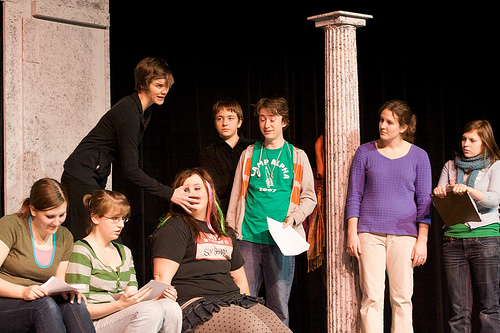
The Lysistrata shows women acting bravely and even aggressively against men who seem resolved on ruining the city-state by prolonging a pointless war and excessively expending reserves stored in the Acropolis. This in turn added to the destruction of their family life by staying away from home for long stretches while on military campaign. The men would come home when they could, sexually relieve themselves,
More Drama
essays:
Lysistrata -
... the Peloponnesian War. Aristophanes’ usual style was to be satirical, and suggesting the eccentric. The most absurd and humorous of Aristophanes’ comedies are those in which the main characters, the heroes of the story, are women. Smart women. One ...
Ancient Greek Theatre.
... New Comedy, whose main exponent was Menander. With its high-brow culture, Athens invited satire, and Aristophanes assumed the task with zeal, aiming his lampoonery at those who stuck their heads above the crowd: Warriors, in Lysistrata... First ...
Exploration notes: Plots and Sub-Plots of "Lysistrata".
... of "Lysistrata" depicts Athenian women who are fed up with the Peloponnesian War, so they barricade themselves in the Akropolis. They orchestrate a sex strike in order to force their husbands to vote for peace with Sparta. The ...
Lysistrata
... Reason Aristophanes’ Lysistrata is an excellent example of satirical drama in a relatively fantastical comedy. He proceeds to show the absurdity of the Peloponnesian War by staging a battle of the sexes in front of the Acropolis, worshipping ...
Euripides! master! how well yo
... Even Lysistrata herself later moans, "There's only one thing we can think of." Aristophanes does employ satire when he has the Comissioner say, "The idea of women bothering themselves about peace and war!" and ...
Does comedy know no boundaries?
... Ancient Comedy: The War of the Generations (New York, 1993), p.56. Political and social satires of Aristophanes in ... my opinion), which was getting people to laugh at the absurdity of rape. Carlin mentions that he saw in the newspaper ...
Tragedy: Fact or Fiction?
... The comedies often satirized the fops and gallants of society. Throughout all of literary history there have been two basic types of characters the protagonist, or hero, and ... non-specific, and view the world as alienating and incomprehensible. Absurdism was at its peak in the 1950s, but continued to ...
Reality, Illusion, and Foolish Pride in The Cherry Orchard by Anton Chekhov, A Doll's House by Henrik Ibsen, and Galileo by Bertolt Brecht
... have saved themselves. Unfortunately, once things got bad for them financially, they refused to accept that fact that circumstances had changed ... honor, even for the person he loves. Nora: Millions of women have done it. Helmer: Oh, you think and talk like ...