Arjuna and Krsna's relationship in the first chapter of the epic poem 'Bhagavad Gita'. How doe Krsna moraly justify Arjuna's decision to fight.
In the first chapter of the Bhagavad-Gita the character Arjuna faces a moral dilemma of Duty. The Character Krsna attempts to help Arjuna solve this moral dilemma. Krsna convinces Arjuna to fight in a bloody civil war by using the concepts of Samkhya Wisdom, Karma Yoga and bhakti yoga. In this essay an attempt will be made to prove that Krsna fails to morally justify the war in which he and Arjuna are about to fight. I will examine each concept and show how Krsna's use of these concepts fails to create a moral justification for the battle
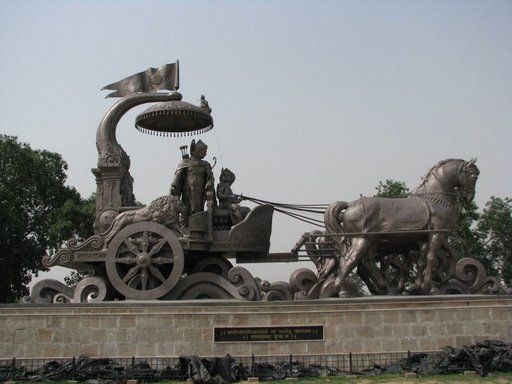
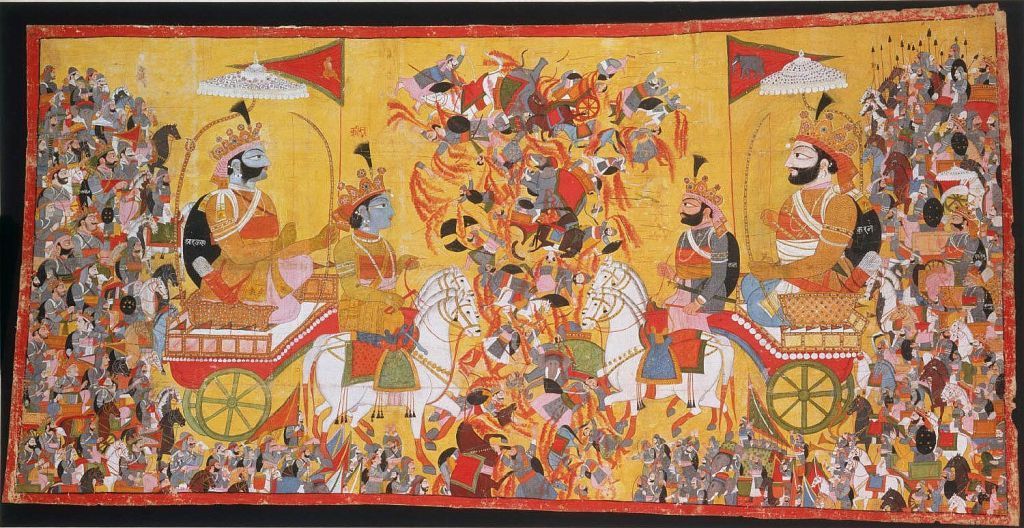
Arjuna is a mighty archer riding in a chariot piloted by Krsna. A battle is about to take place which will determine the fate of a nation. Three successive generations of the ruling family have been passed over for the crown for various reasons to a family of close relations. Arjuna's brother is the leader of the army trying to overthrow the current patriarch. Arjuna's cousin, the reining king, is fighting to hold onto the thrown which was passed down to him through both his father and grand father. Now the two sides of the same family are fighting to see who will rule the nation.
Arjuna questions the morality of a civil war in which he will have to kill friends and family. "Those for whose sake we desire kingdom, enjoyment and pleasures - they stand here in battle, renouncing their lives and riches:" (BG 1:33) "Teachers, fathers, sons, and also grandfathers; uncles and fathers-in-law, grandsons and brothers-in-law, and other kinsmen." (BG 1:34)
The archer then goes on to argue that the spoils to be won from such a battle are not worth the destruction which will need to take place for his army to emerge victorious. Arjuna argues that all...
More Philosophy
essays:
Characterise and assess Plato's theory of forms/essences in the first half of the Phaedo (up to 95e).
... cannot be found in this book. Rather, an analysis of Plato's other works with particular attention to oblique sections relating to Forms and a through analysis of Greek manuscripts may help resolve some of the ambiguity. This is, of course ...
Simonodes (via Polemarchus) argues in the first book of "The Republic" that justice is paying back what is due. Defend or argue against this position.
... should be put into reasonable and just action as a means to avoid wrong doings and to sustain a civil and moral society. Thirdly, Polemarchus' view of justice does not preserve goodness within society. Goodness is for the most part is ...
In Plato's Symposium, Socrates describes many aspects of the true nature of Love and the objects of Love's desires.
During his final speech to praise love in Plato's Symposium, Socrates describes many aspects of the true nature of Love and the objects of Love's desires. By systematically contradicting and invalidating the preceding arguments, Socrates establishes a contrast between the ideas of love and beauty; ...
Compare and contrast the concepts of eudaimonia and happiness, and their respective roles in the ethical philosophies of Aristotle and Mill
... Nicomachean Ethics. Oxford J. Mill, 1861. Utilitarianism. R. Norman, 1998. The Moral Philosophers. Oxford University Press J. Urmson, 1988. Aristotle's Ethics. Blackwell ... is a fundamental difference between them though, and this is related to the consideration of others in their doctrines. From the ...
A response to Francis Schaeffer' book "Back to Freedom and Dignity" This essay discusses Schaeffer's christian view on B.F. Skinner
... environment." (p.34-35). Also Schaeffer goes on the question "who is going to control the controllers?" (p.47). Without morality personal freedom can be destroyed. In conclusion I feel that I agree with what Schaeffer is saying in response to ...
Just some notes on Socrates and the Trial of the Generals.
... justification that each man steered a course that ended with a fatal termination from the power structure of the time. It was Jesus' destiny. It was Socrates' choice. Both philosophers and theologians, by defining proper moral ...
When people say "emotion just gets in the way", what do you think they mean? Why does or doesn't it make sense to refer to emotion as an obstacle?
... partial to absolutely none at all. The magnitude of the influence of emotion on one's choices depends on how closely one is connected with the issue at hand, the after-effects of the decision that the choice-maker considers, and ...
The Allegory of the Cave of Plato. In this essay I will attempt to apply the cave concept to some aspect of today's world.
... seek out the truth just like he did. Another example can be used to further illustrate this analogy: The current war in Iraq. The majority of the public was lead to believe that there were weapons of mass destruction in Iraq ...