We as readers have too often become one-sided on a particular topic and failed to consider other possibilities. Even today, over fifty years after Arthur Miller's essay Tragedy and The Common Man; we still associate tragedy with the highborn and their plights. However, Arthur Miller stimulates our minds by explaining that a tragic hero can and should include the common man. He defines a tragic hero as one who attempts to "gain his 'rightful' position in his society" and in doing so, struggles for his dignity. Arthur Miller's Death of a Salesman gives a perfect example of tragedy in the common man with the character Willy Loman, who, in his fear of being displaced, his struggle to fix his problems, and in his death as a plea for dignity, can be considered a modern tragic hero.
"...From this total onslaught by an individual against the seemingly stable cosmos...from this total examination of the unchangeable environment comes the terror and the fear that is classically associated with tragedy."
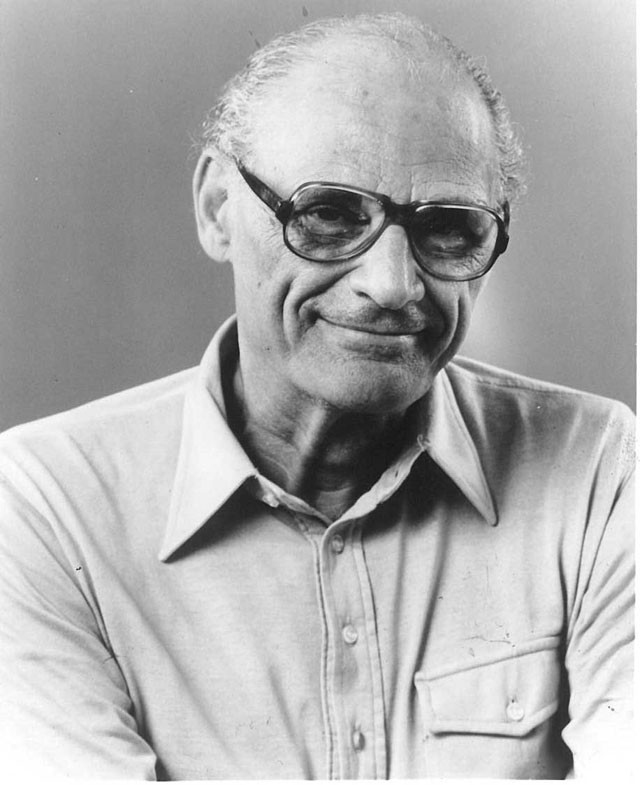 Arthur Miller, American playwright
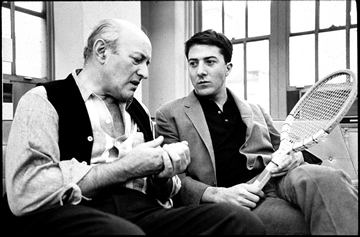 Actor Dustin Hoffman with Lee J. Cobb, who origina...
 The Hero Trilogy (Funker Vogt)
Miller explains that a tragic hero is created when he begins to observe the harmonious universe and realizes that he cannot change this balance, because he starts to panic and worry about what his purpose is in life. Willy Loman, a formerly popular and successful salesman, realizes that he cannot change his son Biff early in the play, although he still attempts to make Biff realize that success is all about popularity. He says to his wife Linda, "I won't fight with him any more. If he wants to go back to Texas, let him go." (p. 18) It is in this realization that Willy fears being torn away from his chosen image of what he is in this world. We see that he is concerned because he has flashbacks of when his life was much better. On page 33, we get a glimpse of his theory in one of his memories: "Be liked and you will never want. You take me, for instance. I never have to wait in line to see a buyer. 'Willy Loman is here!' That's all they have to know and I go right through."
By fearing displacement, the next step taken by the tragic hero according to Miller would be a struggle to "evaluate himself justly". Willy measures his success with Biff's and we can see that towards the end of act one. He agrees to see Howard (his boss) about the raise only after Biff promises to attempt to get his life back in order. At the end of the first act, we see that Willy has struggled to gain his position in the world through his son's popularity, now that he realizes he could never be a successful salesman again. Even Linda tries to convince the reader of Willy's effort when she explains to him about Biff, "I think if he finds himself, then you'll both be happier."(P 15) Willy then confronts Howard about his need for more money and reminding him of his once winning personality, "Howard, I never asked a favor of any man...Your father came to me the day you were born and asked me what I thought of the name Howard..." (p 80). He starts to show his need for his dignity, which is an important aspect of a tragic hero according to Miller's definition.
He shows embarrassment when Howard criticizes him. He refuses a job offer from his friend Charley. All these factors lead to his downfall, as the reader can now clearly understand why Willy Loman has failed as a salesman as well as a father and husband. Yet still, after he is fired Willy does not accept failure as he believes there is still a chance because Biff might have gotten a new job to fix everything. He finds out that Biff's old employer did even recognize him, and instead of seeing that his son has grown into someone more mature and capable to leading a happy life because of this incident, he gets into an argument with him. The play ends with his son's confrontation with the flaws in their relationship. Hearing that his son loved him, his suicide was an opportunity to secure his sense of personal dignity. The problem with Willy Loman was what Arthur Miller explains as the tragic flaw--he was reluctant to "remain passive in the face of what he conceives to be a challenge of his dignity, his image of his rightful status".
In that definition of the tragic flaw lies a sense of optimism, an adjective not usually given to tragedies. Arthur Miller feels that they should be considered optimistic in that a tragedy "reinforces the onlooker's brightest opinions of the human animal". His essay is the perfect accompaniment to one of his greatest works. Truly, Willy Loman is a tragic hero despite Aristotle's definition of a tragic hero being of royal status and "arouses our pity" through his pitfalls. It didn't seem that the common man could also be a tragic hero because his misfortunes would not be too extreme and should be expected. But Arthur Miller points out that considering the noble's hardships does not seem to excite the modern audience. Perhaps better understanding a true tragic hero would soon make up for the lack of tragedies written in this age, as Miller complains.
 Biff Henderson
 Cover for the album version of When Love Met Destr...
 Fear and Trembling