Australian economic and social difficulties brought about by the 1930s depression
Notes on the effect the Depression had in Australia
During the Great Depression, Australia's economy collapsed, unemployment figures soared, sugar/wheat and wool prices fell and society was forced to experience the physical and tormenting effects of it first hand. The Depression caused political and social upheaval in all the western countries it affected, but Australia was hit the worst.
The structure of Australia's entire economy was based on overseas dependence of imports, exports and loans. The country had relied too much on its unstable primary industry and hadn't developed its own sources.
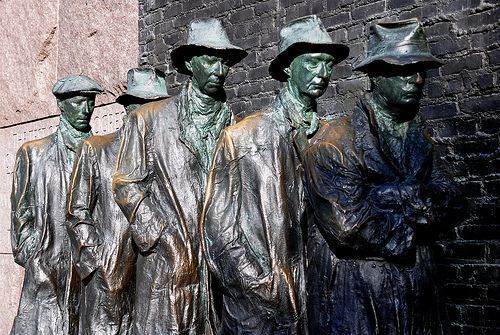
Society was damaged, as more people lost their jobs, couldn't find employment, or those who had jobs had to work less money and longer hours. Men were considered the "bread winners" of the family, and a lot of stress was on them to provide food for their families. Many ran away from the responsibility, but man joined the rattler (train) to find temporary work in the country, like shearing, to send money they made back to their wives and children.
Women experienced hard times as their husbands either ran away or became working very long hours. Women were employed as they were paid less (54% that of men), yet even at those times they were being pushed out of the workforce. Many people living in the country didn't find the Depression as threatening because they could support themselves off of the farm, for example, milk and cheese from the cows, while plants provided fruit and vegetables from fields, and also animals could be eaten.
Many city people lost their homes and were forced to build temporary homes out of rubbish materials like cardboard and wood. These 'shanty towns' were usually located near rivers or in public parks.
The government provided a financial supplement called the 'susso' for all...
More Australian History
essays:
Australia in the 1950s
... of the great changes that characterised the 1960s. The Baby Boomers had not experienced the hardships of depression and war, which had made their parents generation so cautious. The 1950s marked a change in direction of fashion in Australia. Unlike ...
Analyze the effects of the Great Depression on Australia in the 1930s.
... and socially. During the time of the Great Depression Australias economy was largely dependent on wool and wheat exports thus when the Depression hit and the exports lessened in value many industries were consequently effected, leaving many out of work ...
Gold rush, History of Australia during the 19th century.
... all the miners were freed by the jury. The gold rush years formed an important chapter in the history of Australia. They influenced almost every area of life. $125,000,000 worth of gold was mined during the first ...
Did the Portuguese "discover" Australia in the 1520's?
... that the Portuguese would be the first Europeans to view the mainland of Australia itself . The maps themselves have been highly debated as to their authenticity and origin. It has been argued that during the first ...
Australia In The 1920's and the 1930's
... insufficient The Great Depression was the time of tremendous hardship for people living in Australia. Even before the overwhelming stock market crash on Wall Street, being without a job in Australia was already at ten per cent. After the crash unemployment ...
Discusses the hardships suffered in the Great Depression that occured during the 1930's and how the government and the people dealt with it.
... of Australia's stock. Therefore Australia could not gain any more money to pay back its terrible debts. During the Great Depression it ...
Evaluate the social and economic change within Australian Society resulting from the impact of Calwell's Immigration Policy
... own social and economic features. An overpopulation in urban areas, particularly inner city Melbourne and Sydney became a common feature of the early immigration years. A ration based economy during the war years had left Australia with ...
"Explain how and why the women's movement brought about changes for women in Australia in the period from 1945 to the 1980's."
... and the home for the overall well-being of the nation. During the Second World War, women proved that they were capable of doing factory work, however ... his job? (Greer, 1971:125) Throughout the 1950's and 1960's more women than men entered the workforce in Australia. This ...