Barbed Wire
I. The barbed wire was invented by Leonce Eugene Grassin-Baledans in 1860. It was used as fencing wire, consisting of flat and thin wire with bristling points. The writing will be about when it was created. In addition, the events that came before it and how it influenced people.
II. Facts for why the barbed was created and that time and place.
-
Barbed wire was a major source in the U.S. West with the "Big Die Up" incident in the 1880's.
-
Cattle and prisoner restrained.
-
Make the fence cutters to come to an end.
-
Barbed wire became extensively used in war, like the Boer War.
-
Barbed wire able to overcome the weather and most heavy bombardments.
-
Barbed wire was used in concentration camp architecture, it usually surrounded the camp and was electrified to prevent escape.
-
Cheap, easy to install, transmits electricity, and deadly.
-
Bordering or division in areas.
-
In 1898, John Gates created the American Steel and Wire monopoly, which became a part of the United States Steel Corporation.
-
Resulted to severe injuries to the skin.
-
Barbed wire continues to be used modern days.
-
From the 1500s to 1800, livestock enclosures was made from rail fences of timber , rock walls, brush, hedge fences and ditches. The shortage of raw materials and the amount of labor required in construction limited these fences to small enclosures around homesteads and ranches.
-
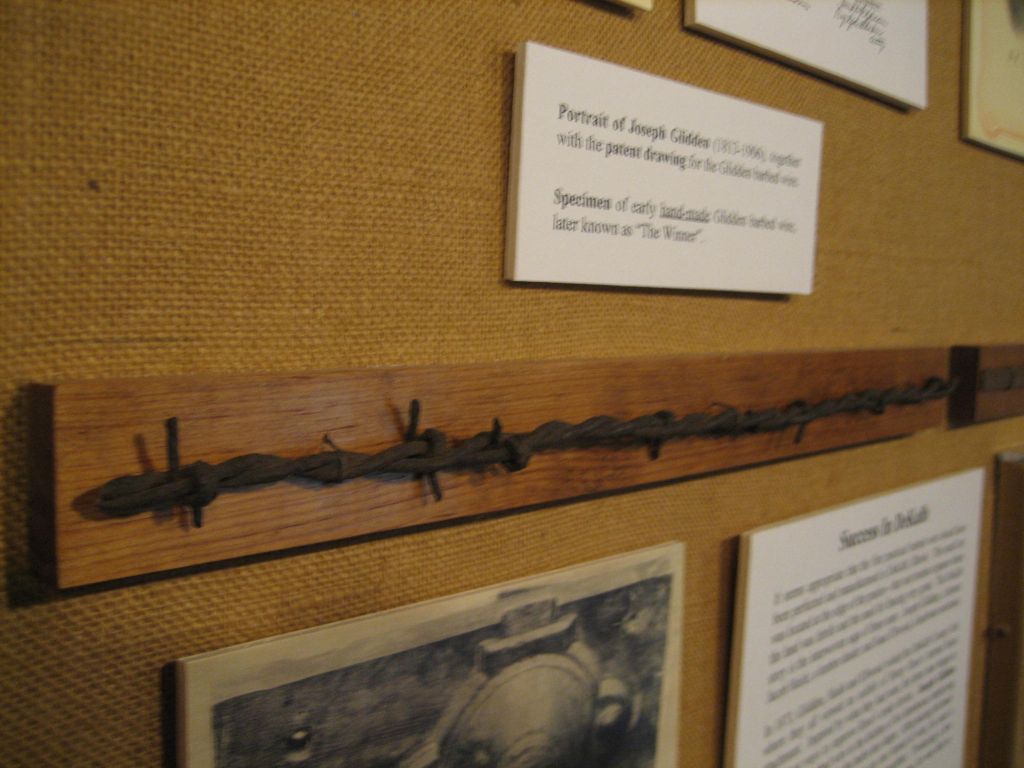
John Gates moved to St. Louis and founded the Southern Wire Company, which became the largest manufacturer of barbed wire. An 1880 US District Court decision upheld the validity of the Glidden patent, effectively establishing a monopoly. In 1898 Gates took control of Washburn and Moen, and created the American Steel and Wire monopoly, which became a part of the United States Steel Corporation. The working level increased due to need...
More North American History
essays:
To what extent was the Civil War an important watershed in US social and economic history?
... on war, Robert E. Lee, son of a Revolutionary War hero, and a 25 year distinguished veteran of the United States Army and former Superintendent of West Point ...
The Contrast of Franklin D. Roosevelt and John F. Kennedy's Inaugural Speeches.
... the United States of America. Former President Franklin D. Roosevelt voiced the first passage on March 4th, 1933 and late President John F. Kennedy voiced the second passage on January 20th, 1961. Both inaugural speeches came at important times during American ...
American Expansionism ----- College Paper
... the United States, during the next fifteen or twenty years, to hasten or retard the coming of Christ's kingdom in the world by hundreds, and perhaps thousands of years." In America today I think the average American would ...
Entrepreneurs in American History
... these entrepreneurs made enormous profits. Two major entrepreneurs of American history are John D. Rockefeller and Andrew Carnegie. The Standard Oil Company founded by John D. Rockefeller and the U.S. Steel Company founded by Andrew Carnegie, both were two corporations ...
Forced to Fight: the United State's Envolvement in Vietnam, and the Anti-war Movement
... the U.S. government sent more military materials including helicopters with American pilots to assist ARVN. By the end of 1963, over 16,000 military advisors were in Vietnam. Lyndon B. Johnson became the President of the United States after John ...
Anti-War Movement In the U.S during Vietnam
... The United States first became directly involved in Vietnam in 1950 when President Harry Truman started to underwrite the costs of France's war against the Viet Minh. Later, the presidencies of Dwight Eisenhower and John F. Kennedy increased the US ...
Sir Wilfrid Laurier - Prime Minister of Canada
... if war came. In 1911, when his opponents denounced his government's decision to implement a limited reciprocity pact with the United States, Laurier ... imperialists among his followers. Great Britain received support in the Boer War of 1899-1902 from the other self-governing colonies, and ...
The Vietnam War & the 1960's Fthe political changes to the Civil Rights Movement.
... the United States; it was not only a setback to the containment of communism in Asia but a shock to American self-confidence. French Indochina, which included Vietnam, Cambodia (Kampuchea), and Laos, was occupied by Japanese forces during World War II ...