Beowulf and the Song of Roland, the theme of Father/Son Relationship
The representation of father-son type relationships in early Medieval literary works
is a key theme early authors used to give their works more depth and meaning. Two works that use the theme of father-son relationships are Beowulf and The Song of Roland. In Beowulf, the relationship between Hrothgar and Beowulf is one in which there is no actual blood father-son tie, but the two characters take on all the characteristics of a real father son relationship. Hrothgar, although Beowulf's senior, has to rely on this new warrior who comes to Heorot to help him rid his kingdom of a great danger which he can not get rid of by himself, and Hrothgar treats him as if he were his own son. In The Song of Roland, Charles' relationship with his nephew Roland also takes on the characteristics of a father-son type relationship. In this work, although Charles is the better warrior than Roland, he relies on Roland to watch the rear guard of his army and Roland loses his life while serving his King. The significance of these inter-generational relationships will be looked at in this paper, as well as what the authors through the guise of these father-son relationships were trying to say about various different aspects of life during their time.
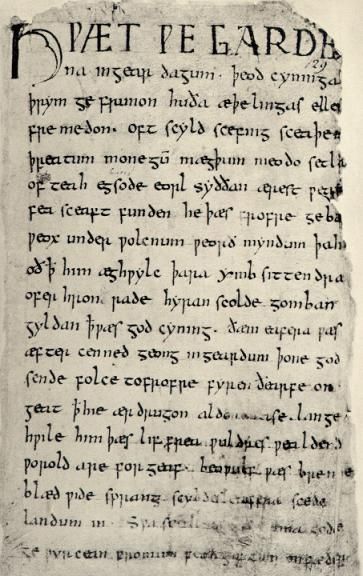
In Beowulf, the function of the relationship between Hrothgar and Beowulf helps to further the plot in several ways. Whenever there is a reliance on family in any literary work, it gives any story more meaning and significance. When Beowulf first arrives in Hrothgars' hall, we get a sense of the old and incapable state Hrothgar is in 'old and gray-haired among the guard of earls' (Beowulf, pg. 62) is how he is first described. When hearing who Beowulf's father is he states in a joyous tone...
More Poetry
essays:
William Blake. Discusses his poems from Songs of Innocence: 'The Little Girl Lost,' 'The Little Girl Found' and 'The Chimney Sweeper.' The other poems, from The Songs of Experience: 'The Chimney Sw
... the Song of Innocence. Its title is 'The Chimney Sweeper.' This poem is about a small child who loses his ... and dangerous animals can have compassion, and care for a young child who is battling for survival without the protection of a mother or a father. The ...
A detailed study of William Blake's 'Songs of Innocence and Experience' in relation to the principles of the pastoral convention.
... Pastoral Convention is particularly referent to Blake's initial anthology--Songs of Innocence. In identifying pastoral characteristics evident in the collection, it ...
Songs of Innocence and Songs of Experience demonstrate both the contrary states of innocence and experience and Blake's social criticism.
... deprived of joy; love has become a type of bondage. Many of the Songs of Innocence have counterparts or 'contraries' in the Songs of Experience, the relationship is ... reality of hypocritical society. "My mother groan' d! my fathers wept."/ "Into the dangerous world ...
T S Elliot's The Love Song of J Alfred Prufrock
... must work hard to survive. If at first he does not succeed, he must try again. His existence is at stake. This representation of mankind ... from a dress/ That makes me so digress?”(The Love Song of J. Alfred Prufrock, T.S Elliot). When Prufrock smells the ...
A comparison of Blake's treatment of his subject in "Songs of Innocence" with that in "Songs of Experience".
... girl is not returned to her family, she loses her innocence and she evolves into a woman. In the Songs of Innocence , there seems to be a force which ... The Little Boy Lost" and "The Little Boy Found", Blake depicts how a young boy is looking for a father figure in his life, in the former poem and how ...
Tiger and Lamb in "Songs of Experience" and "Song of Innocence" by William Blake.
... the "Songs of Innocence" and the tiger from the "Songs of Experience ... the Son, represented all that is good and spiritual, while the Father, God, was a symbol of absolute ... the actual helping of the poor and needy. As a promoter of social ...
BLAKE, Songs of innocence and Experience: From reading of the 'Songs', to what extent do you find Blake a man of his time?
... media, technology and government etc. Blake's poems in the Songs of innocence and Experience can relate to his time but also ... third son of a London tradesman who sold knitwear (hosier). Blake lived in London which dominated much of his work. He ... symbol of peace and freedom, it is a type of harnessed ...
Blake's Songs of Innocence and Experience: "The Lamb"
... also the characteristics from which the child-speaker approaches the ideas of nature and of God. This poem, like many of the Songs of Innocence, accepts ... to the effect of naiveté, since the situation of a child talking to an animal is a believable one, and not simply a literary contrivance. Yet by ...