Biography, Interpretation of poems, and bibliography of Anne Bradstreet.
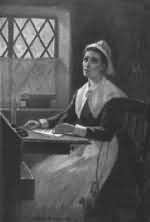
Anne Bradstreet was born in Northampton, England in 1612. She was the daughter of Governor Thomas Dudley and Dorothy Yorke Dudley. At the age of 16, she married Simon Bradstreet, an employee and future governor of the Massachusetts Bay Company. Anne and Simon emigrated to America along with Anne's parents in 1630 aboard the Arabella. They became members of John Winthrop's party, and amongst the first settlers on Massachusetts Bay. The life was there was primitive and rude and she found that it was hard to survive but soon she settled as her husband took over some political duties. He was an assistant in the Massachusetts Company and was twice governor of the colony. Simon and Anne had eight children after moving to Massachusetts Bay. She was a devoted wife and mother as well as a busy one.
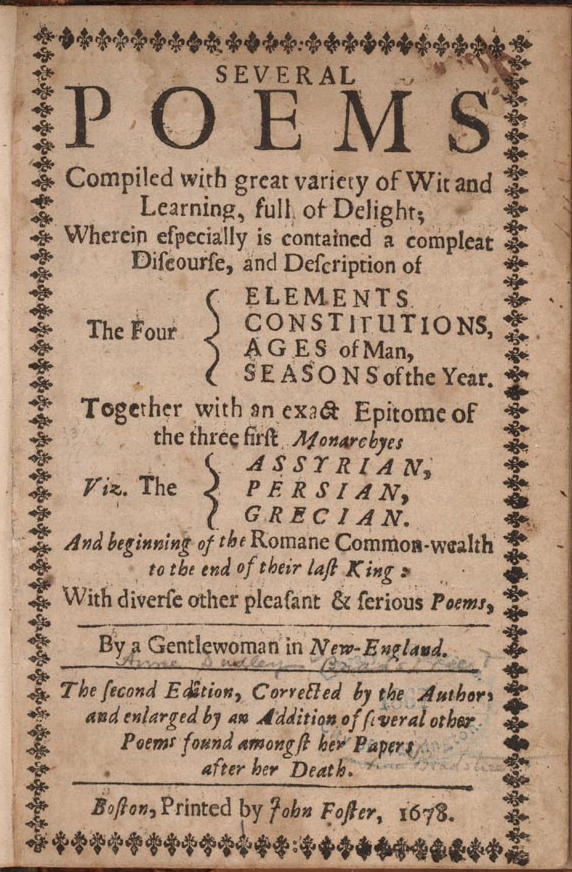
For Anne Bradstreet, the burning of her home and belongings in July, 1866 was a great loss for someone so devoted to her family and domestic pleasures. Anne Bradstreet felt that her love of the pleasant thing of life was unchristian. Anne Bradstreet loved Simon Bradstreet and her children and God with a troubled realization that she fell short of Gods. Anne Bradstreet's poetry shows a merging of the private life with the religious life, but also a rebellious, inquiring spirit. Anne Bradstreet was one of the first poets to write an English verse in the American colonies. Her poems were written for her family and she had no incentive to publish them unlike male poets of the time. She wrote many of the poems that were eventually published after her brother-in-law took her manuscript back with him to England and had it printed without her knowledge. She was in fact the first North American to publish a book of poems. While...
More Poetry
essays:
Songs of Innocence and Songs of Experience demonstrate both the contrary states of innocence and experience and Blake's social criticism.
... of English Literature, (1890), Volume 2, W.W. Norton and Company. Inc. New York. 10. Watson. J.R, (1993), English Poetry of the Romantic ... New York. 2. Ford. B, (1987), From Blake to Byron, The New Pelican Guide to English Literature, Penguin Books Ltd, Middlesex, England. 3 ...
Tiger and Lamb in "Songs of Experience" and "Song of Innocence" by William Blake.
... down the spears at the lower class (Lamb) causing them to have no hope. Blake said, "All men are equal because all possess the Divine imagination, any political or theological system that denies this fact is tyrannous."() This ...
Through close reference to those poems of theirs which you have studied, discuss this assessment of the form and content of Wordsworh or Coleridge's poetry.
... of us feel too strong in need of company and of communication to be more than visitors to that "secluded scene", however, we sometimes intensely long for ... which are the joy of life, the dignity of life, the pleasure principle and the primacy of universal connective love. In his "Essay" of 1815 ...
Definition and Criteria of Poetry.
... poet's duty of producing pleasure with a serious overtone, "The poet writes under one restriction only, that of necessity, of giving immediate pleasure to a ... Romantic Period. Ed. M.H. Abrams, et al. 7th ed. Vol. 2A. New York: Norton and Co., 2000. Gordon, George; Lord Byron. "Don Juan". 1824. The ...
Discuss the significance of sound and silence in TWO poems by Coleridge.
... intense faith in the powers of human reason and a devotion to clarity of thought, to harmony, proportion and balance. The Romantic poets rebelled ... inspiration. In Shelley's Literary and Philosophical Criticism (Oxford, 1909) ed. John Shawcross, Shelley says: Man is an instrument over which a series ...
Poem Analysis of 'Fire and Ice' by Robert Frost and 'The Day They Came For Our House' by Don Mattera
... carefully constructed poem, which carries a straightforward message that emotions become destructive when they are too extreme, destructive enough, even, to end the world. Fire and Ice holds the theme of Mortality and Age, also the destructive power of passion, Robert ...
'A Mother to her Waking Infant' by Joanna Baillie, Analyse the poem and comment on the poetic form and the language used and the way they contribute to the meaning and effects of the poem.
... child over the ordinary and routine aspects of parenthood. Joanna Baillie employs a great variety of techniques throughout this poem to emphasise the subject matter, a mothers unconditional love, and everyday amazement for her newborn child, for even when they ...
A brief analysis and response to William Blake's "To Tirzah" and a short commentary on the "Songs of Innoccence" and the "Songs of Experience"
... fall,' or more, the woman responsible for making him a part of the mortal world, saying, "Then what have I to do with thee?" (5). Because of this woman, the speaker has a body and a defined sex that he also ...