"The Broken Spears" by Miguel Leon-Portilla.
In the book, "The Broken Spears", Miguel Leon-Portilla provides the reader with a chronological account of the events that lead up to the Spanish conquest of the Aztec empire in Mexico. Portilla takes the approach of discussing the entire war, battle by battle. On the contrary, Keen and Haynes, authors of "A History of Latin America", explain the four major aspects of the war that they feel ultimately led to the demise of the great Aztec Empire. They strongly believe that firearms, disease, differing world views, and internal division were the four main reasons that the Aztec empire was not successful in protecting its land and people. Although Keen and Haynes provide a very brief account of the events that took place over 500 years ago in native Mexico, their account is very similar to that of the translation provided by Leon-Portilla. Keen and Haynes draw out very specific and direct causes, while in "The Broken Spears", the entire ordeal is plotted from beginning to end with particular mishaps and miscalculations leading to the eventual downfall. In this paper, I would like to address the factors leading up to the Aztec empire crumbling. It is my objective to compare the similarities, and contrast the differing view points brought about in these two written accounts of the events. My argument is that the account represented and translated by Leon-Portilla, although much more in-depth and complex, is very similar to the description briefly explained by Keen and Haynes.
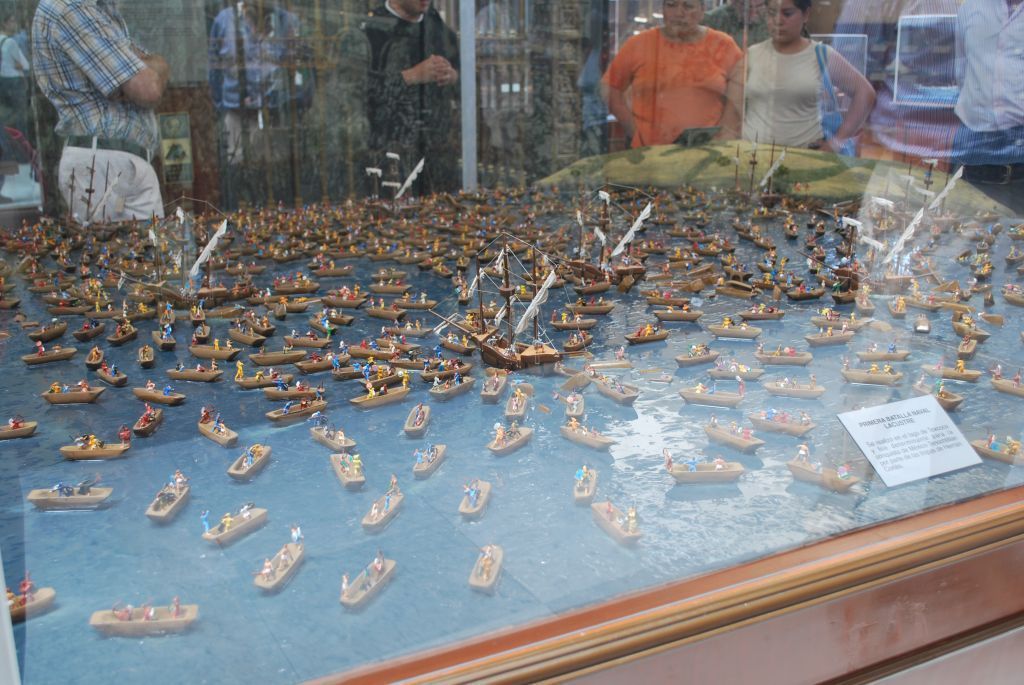
I would first like to address the issue of firearms. In "The History of Latin America", Keen and Haynes speak specifically about the Spaniards use of cannons, swords, and metal armor. According to them this "gave the invaders a decided superiority over Indians armed with bows, arrows, wooden lances, and darts."(Keen/Haynes 69) The Aztecs...
Reviews of: ""The Broken Spears" by Miguel Leon-Portilla."
:
More Central & Southamerican History
essays:
Sandinista Movement
... in the future. Optimism holds a strong influence for progress in later days. Bibliography Chasteen, John Charles. Born In Blood and Fire: A Concise History of Latin America. W ...
Independence Movement of Brazil and Mexico.
... Leslie. The Cambridge History of Latin America. New York: Cambridge University Press, 1985. Meade, Teresa A. Brief History of Brazil. New York: Checkmark Books, 2004. Newhill, Esko E. Exploring World cultures ...
Latin History
... in the more modern historical account rather than jump from region to region. 1. A more detailed record on the history of the native people would have improved interest for many readers. Conclusion The Penguin History of Latin America, This ...
"Che Guevara: Hero or Villain?" Argues that he is different depending on your perspective and context.
... of Latin America where his eyes began to open to the depth of poverty and suffering of his fellows. Whilst in Guatemala, Guevara sees firsthand the government of Jacobo Arbenz overthrown by a CIA coordinated military organization and it appears that ...
A Critical View on Dr. Walter LaFeber's Inevitable Revolutions: The historical objectives of the United States towards the Central American Nations
... made the world aware of the U.S. intention to keep foreign powers out of Latin America, leaving the U.S. as the prime influence in the hemisphere (LaFeber, p. 23). Although the doctrine ...
The Invisible Man
... out of the village. Naked and alone, the fugitive stumbles upon an old student colleague, Dr. Kemp, and tries to draw him into his civil experiment on the world. Griffin ... killed. The story starts in the middle, has a flashback at Dr Kemp's and after that, the plot goes on chronologically. The action ...
Cortez and The Fall Of The Aztec Empire
... Lois World History Series: Aztec Civilization San Diego, California: Lucent Books Inc., 1995 Marrin, Albert Aztecs and Spaniards: Cortes and the Conquest of Mexico Atheneum, New York: Collier Macmillan Canada, Inc., 1986 Leon-Portilla, Miguel The Broken Spears Toronto ...
Latin American History from 1950 Onwards: Focusing on The Motorcycle Diaries by Ernesto Che Guevara, and The Art of Political Murder by Francisco Goldman
... viewpoints viewed Latin America during the tumultuous years of 1930s to 1950s. Both Guevara and Gerardi show the world of how can Capitalism and U.S influence affect certain countries. Both believed that the prosperity of Latin America could ...
Good Essay
This was a good essay. It provided points that were backed up by examples, and kept the reader interested.
2 out of 2 people found this comment useful.