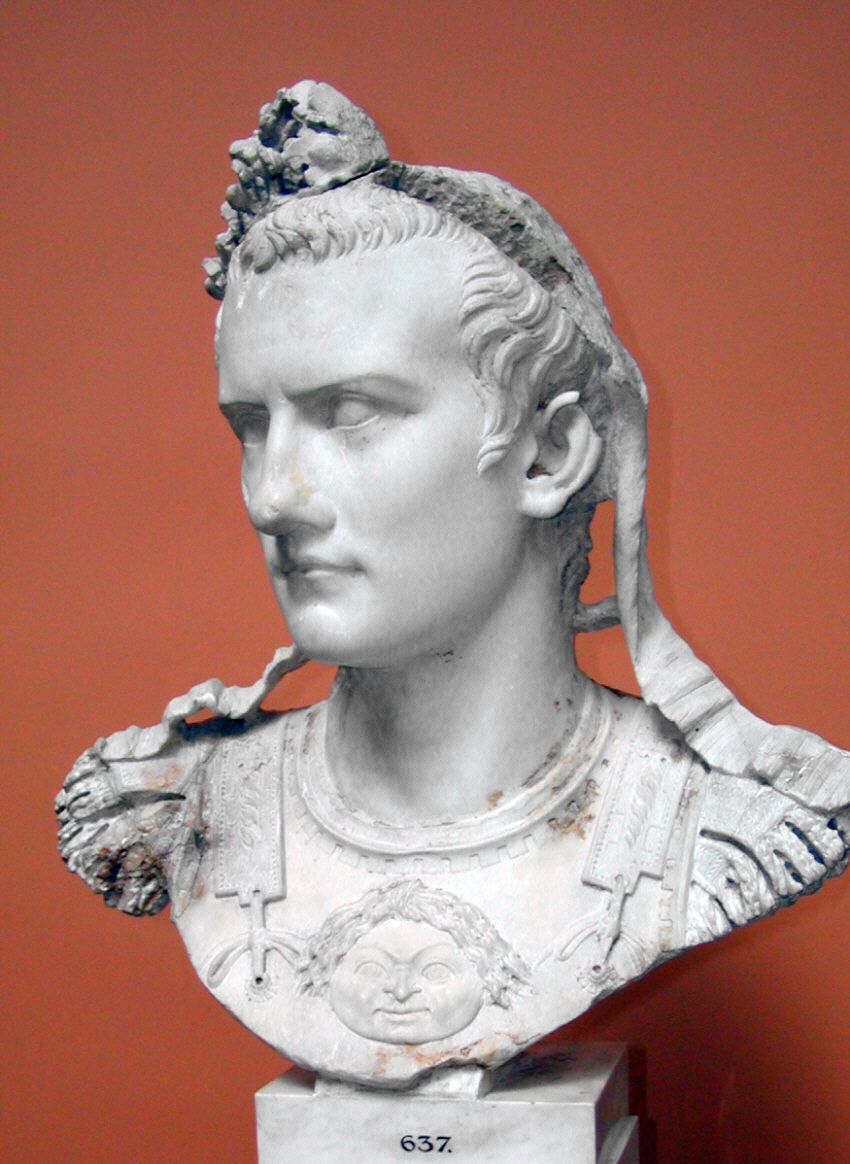
Caligula: In Sickness and in Wealth This is a term paper about the life, reign and downfall of the Roman emperor Caligula
History has shown that power corrupts and absolute power corrupts absolutely. The Roman emperor Gaius "Caligula" represents a perfect example of this truism. Caligula's abuse of power resulted in his own death and the lives of many others.
Gaius Caesar Augustus Germanicus was born August 31st, 12 A.D. at Antium1 as the third of six children of Germanicus and Agrippina. Germanicus was the adopted grandson of Augustus and was adopted by his paternal uncle Tiberius2. He commanded many campaigns for Tiberius and was respected and adored by the people for his lenient and benevolent ways. Caligula had anything but a normal childhood. He lived in an atmosphere of paranoia, suspicion, and murder. As a child, Gaius accompanied his father on military campaigns where he acquired the nickname "Caligula". It began as an army-joke because he grew up with troops of Germanicus and wore a miniature soldier outfit and the "caliga" or little boots3. After the suspicious death of Germanicus on October 10th, 19 A.D., which Tiberius may have arranged by Gnaeus Piso4, Caligula returned with his mother Agrippina to Italy. There he lived with his grandmother Livia Augusta in her house on the Palentine5. A short two years after, Caligula again moved with the death of Livia in 29 A.D. He was sent to live with his grandmother Antonia6 along with his three sisters: Drusilla, Livilla and Agrippina7. Then, The emperor Tiberius called for Caligula, at the age of 19, to live with him at his villa in Capri8. Tiberius had gone into self-exile at the island and ruled Rome through his Prefect Sejanus. Caligula became like a slave to Tiberius, yet he never complained about Tiberius9. A disturbing sign of Caligula's later madness was the fact that he enjoyed and gleefully watched murders and torture sessions10. He also sometimes...
More Roman History
essays:
How Julius Caesar's actions of intelligence and leadership make him one of the greatest historical figures ever
... citizens of the Roman Empire. Caesar knew that corruption and poverty were hurting Roman economy and society, and he fixed those problems as quickly as he could. These reforms are what created one of the most powerful empires ...
Tacitus : The Rise of the Immoral Rome
... With corrupt and insincere rule, the Roman aristocracy had managed to wreck the nation as a whole. His Annals very distinguishably show the rise of immorality, cruelty and oppressing laws as a direct consequence of the emperors in power. Tacitus ...
Emperor Julius Caesar: His Rise to Power
... first Roman Emperor to convert to Christianity. His rise from a humble birth as a peasant boy to Emperor is a tale of bravery, adversity and ultimately ... Using the power of mime learned in Britannia, he made the sign of the ... Latin and raced for the school chariot team. The start of his military career ...
Roman Punic Wars, circumstances and overall effect. Also Gracchan turbulence
... spark of Military power helped create the Empire of Rome. Rome was now an Empire with 5 great powers. The Seleucid monarchy, the Ptolemiac monarchy, the kingdom of Macedonia, Carthage, and the Roman-dominated ...
Political Revolution in Rome 133-78 BC
... downfall of the Roman Republic. His reforms and laws reduced the power the nobles held within the politics of Roman society. His military reforms ... top of reaffirming Tiberius' lex agaria, introduced the lex frumentaria (corn law) which fixed the price of grain and fulfilled ...
Notes on the Roman Empire during Constantine, his successors and The decline of the Roman empire
... successors of Julian were ChristiansTHE 5TH CENTURY INVASIONSWhile roman emperors were worried about their empire and dynastic ...
What does the 'Trial of Verres' reveal about provincial malpractice and corruption in the Roman Courts.
... unique, and states that these acts of corruption and provincial malpractice are rampant throughout the Roman political system. Cicero systematically goes through Verres' misdoings in each of his ...
The Decline and Fall if the Romanov dynasty.
... nothing of the business of ruling". Tsar Nicholas soon decided (or knew no other way) that he would rule the same as his father, and all the Romanov generations before him ruled, with absolute power. He ...