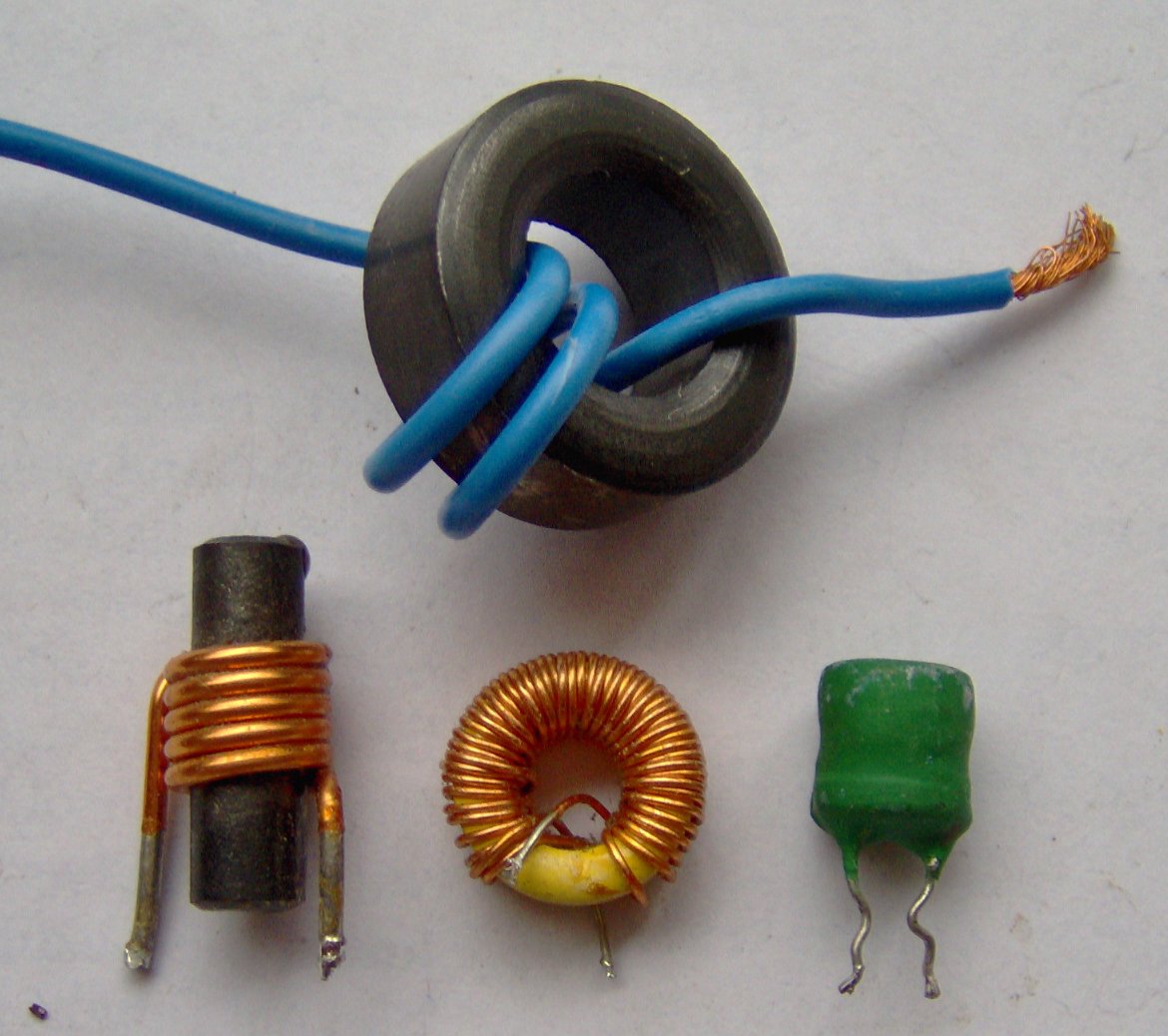
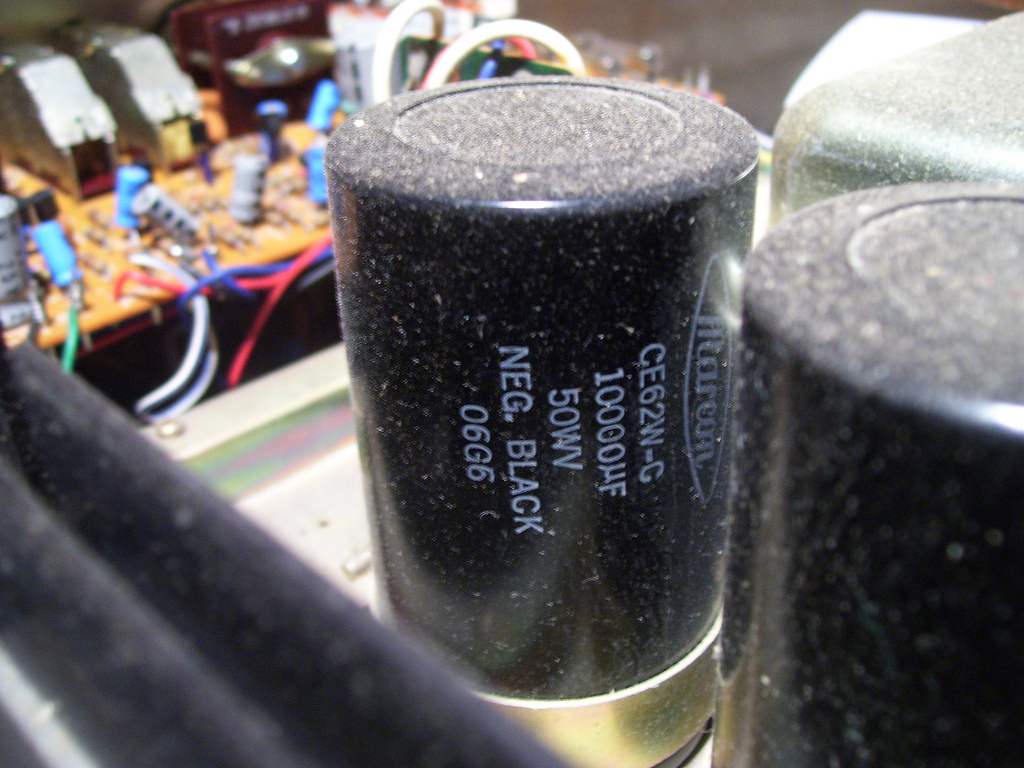
Capacitor vs. Inductor.
Capacitor vs. Inductor
When most people think of an electronic device, they think that all it needs is a cord for it to work, but there is so much more through my eyes. Having over fifteen credits of electronics thus far, I learned to love it. I am currently in Elt 102, which deals with Ac circuits. One of the topics we spend most time with is inductors and capacitors. One may think that a capacitor and inductor are complete opposites, yet they have many strong similarities.
A capacitor is a passive electronic component that stores energy in the form of an electrostatic field. A capacitor opposes a change in voltage, which means that current leads voltage by ninety degrees. The unit of measure for a capacitor is a Farad or its symbol F. The main purpose for a capacitor is to store voltage. Once the circuit is turned, the capacitor will store up voltage to its capacity. The larger the capacitor the more voltage it can store inside it. Usually the average size of a capacitor is not larger than a dime and is valued at a microfarad. The capacitor is a very simple device that has a positive lead and a negative lead coming out it. Inside the capacitor, the terminals connect to two metal plates separated by a dielectric. The dielectric can be made up of any material that does not conduct any voltage such as paper, plastic, and dry air. The capacitor will continue to give out voltage until it runs out or is grounded. While the capacitor deals with voltage, the inductor deals with current
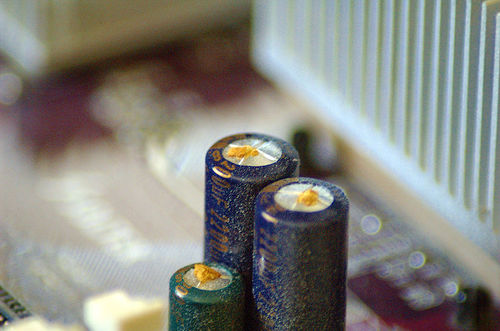
In the other corner, sits the inductor and its simplest body. An inductor is a passive electronic component that stores energy in the form of a magnetic field. An inductor...
More Electrical Engineering
essays:
Robotic Mail Delivery system
... building, circuit testing, programming, designing PCB, designing schematic, developing prototype prepare the project. All of these implementations were done which agreed in the planning stage. Which mean that I ...
MICROWAVE OVEN
... resonant circuit, where flowing currents around the cavity act as inductor and charge at ends of cavity act as capacitor, thus producing a natural resonant frequency. This frequency will keep pumping in the cavity by a process called thermionic emission. Electrons ...
Mobile Phone Firmware Flashing for Nokia.
... interface that acts like operating systems to perform some special function on those particular devices. The firmware upgrade circuit has been designed and implemented for a mobile phone. 1.2 Background Firmware is the heart of many electronic devices. It ...
Integrated cicuit technology - silicon.
... all electronic systems used in computers, communications, control and instrumentation systems, etc. The fabrication of integrated circuits were the individual components such ...
State Machine Design with Programmable Logic
... in today's technology. Nowadays, regardless of how simple an electronic device may seem, be it a washing machine, vending machine or ... receiver circuit Element/Component Function Timing module The output signal bit[2..0] specifies which of ...
ECU / VCS
... of electronics, the ECU monitors many of the engine parameters including RPM, to control the torque output from the engine. This means that the ... debited by those machines, Engine mappings can change completely from circuit to circuit depending upon the nature of the track. At Monaco for ...
Carry Ripple Adder
... through which the circuit was designed. There were several steps taken to reach the final implementation. The design stages are as follows 1. Realization 2. Implementation 4.2 Realization The gate level logic devices that had ...
Automatic Repeat Request (ARQ) Protocols
... If there is a delay in transmitting one frame, this means that all other frames will be delayed also. Analysing the equation ... Electronic EngineeringDigital Communications and NetworkingLaboratory Write-up 1Automatic Repeat Request ...