The Great Depression was a period of lowered economic activity and extensive unemployment. In general, times were hard and most people lived in a state of hopelessness. There was a much-needed entertainment that arose during this time, and that was the work of Frank Capra. His dream of goodwill was expressed through his memorable works and was uplifting to the people of this era. It balanced this time period that was so consumed with despair, with laughter and optimism. Capra once said that the purpose of filmmaking was, "First to exalt the worth of the individual. Second, to champion man. And third to dramatize the viability of the individual." His films displayed patriotism and celebrated all-American values. These standards are completely evident in Capra's film "Mr. Smith Goes to Washington".
Jefferson Smith is just an average guy pulled into something that he is not quite sure that he can do.
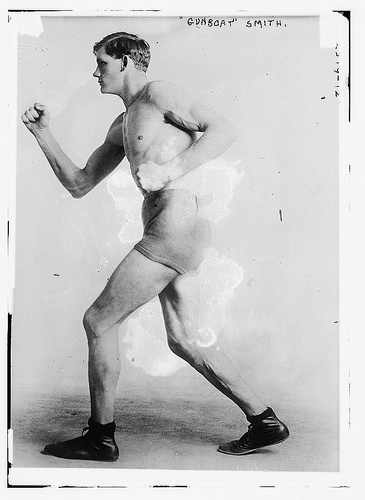 Gunboat Smith (LOC)
 Bailey -- Smith -- Weeks (LOC)
![Gunboat Smith & Pelky [i.e., Pelkey] (LOC)](/uploads/5/58384/gunboat-smith-pelky-e-pelkey-loc.jpg) Gunboat Smith & Pelky [i.e., Pelkey] (LOC)
Gunboat Smith & Pelky [i.e., Pelkey] (LOC)When a former senator dies and he is asked to serve the remaining time in his place, Smith finds out about dirty politics. He gets rather bored of just going along with the everyday schedule of being a senator. He is the kind of politican that the public admires. Since he does not really understand the procesess going on around him, he decides to work on his little project. He has the wonderful idea of forming a boys camp, and he plans on buying a piece of property through the contributions of others. Unbeknowst to him, some crooked senators are already after this property to make money for themselves. Mr. Smith makes his debut of his little project and many of the senators are visably upset. Later he is confronted by them and learns of their wayward plans. When he refuses to back down and go along...