Essay #1Four contributions Charles Darwin contributed to the field of evolutionary biology were: non-constancy of species, branching evolution, occurrence of gradual change in species, and natural selection. Each of his contribution became the foundation of evolutionary biology and can be seen in the wild very commonly. Non-constancy can be observed though variation in the offspring. For example, different sized beaks in finches display variation in the species and therefore, non-constancy. This can cause change in the gene pool of a species over time. Many evidence of branching evolution can be seen in the anatomy of different species like homologies and vestigial structures. In whales, the hip bones are similar to humansÃÂ which indicates the common ancestry between the two species. Gradual change is displayed by the fossil records of many species. Older fossil records have some small differences from the newer fossil records which can be used to prove gradual change in species over time.
 The modern theory of natural selection derives fro...
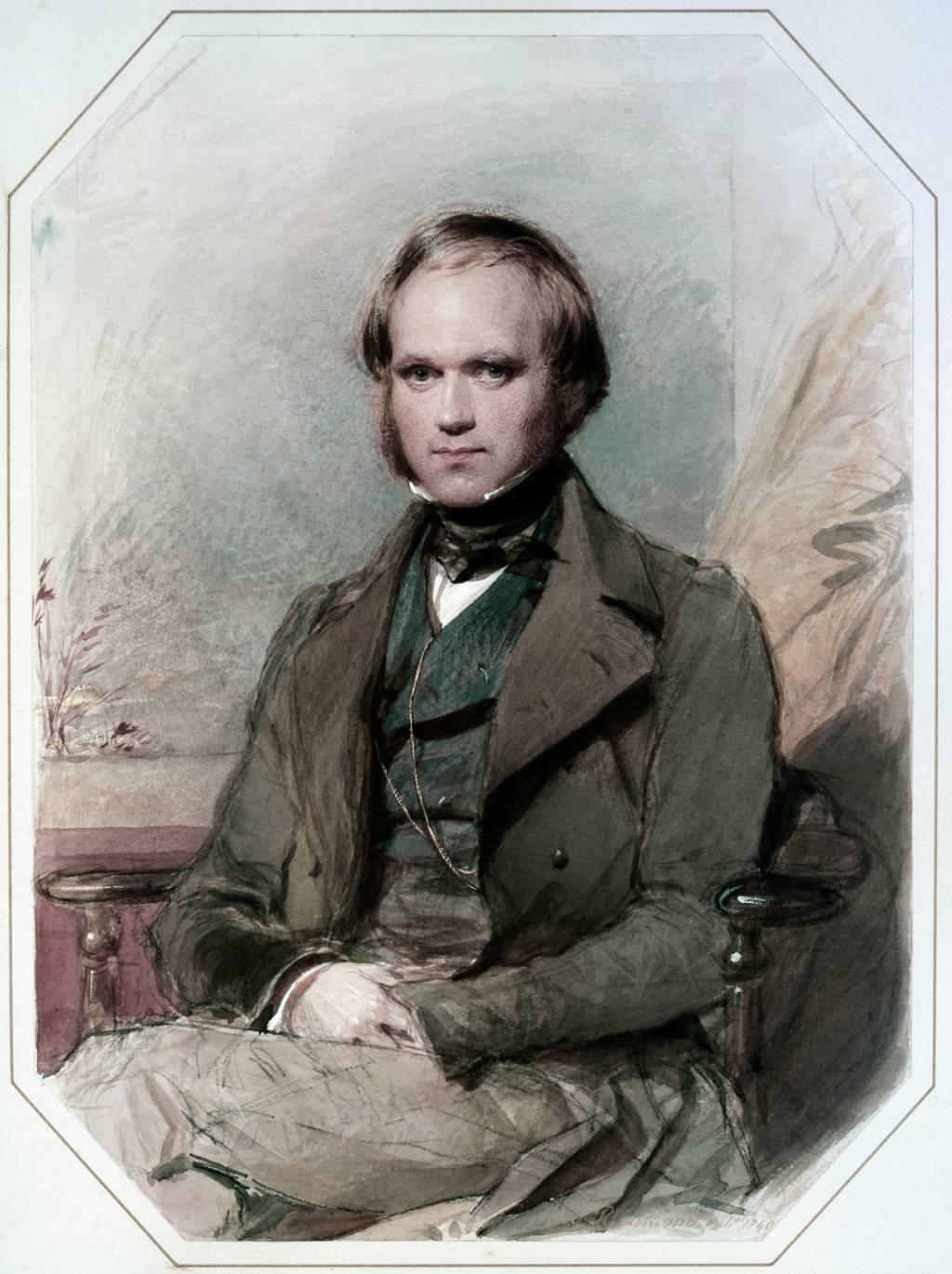 Charles Darwin as a young man, probably subsequent...
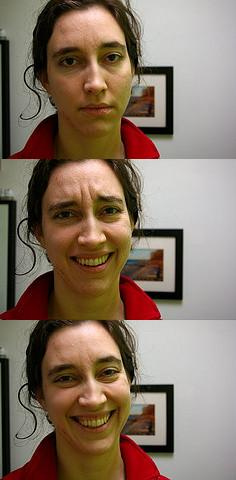 evolution
These changes occur due to mutation and are picked out by the natural selection. These mutations accumulate over time and cause the species to look drastically different after many decades. Natural Selection picks out individuals better suited for the environment and allows them to reproduce and pass on their gene while unsuited individuals die without passing on their gene. Natural selection occurs every time a predator feeds on the weakest, slowest, worst camaflouged, or most un-adapted prey. This allows the gene pool of the species to evolve and shed off undesired genes.
Hardy-Weinberg Equilibrium assumes that the allele frequency stays constant over time. The equation presumes there is no genetic flow, no mutation, no natural selection, random mating, and a large population. Hardy-Weinberg equation is used as a null hypothesis to determine if evolution is occurring in the species. Punctuated Equilibrium shows a sudden change in a species gene pool usually due to an environmental disaster after a long period of no change in the gene pool. This idea is demonstrated by the rise of mammals and the downfall of reptiles and other organisms.
References: Campbell, Neil, and Reece, Jane. AP EDITION BIOLOGY. San Francisco: Pearson, 2005.
 English: Caricature of Charles Darwin from Vanity ...
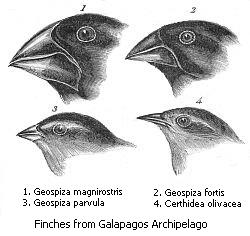 Darwin's finches or Galapagos finches. Darwin, 184...
 Endangered Species Carousel