How Chauser shows dislike for characters in canterbury tales
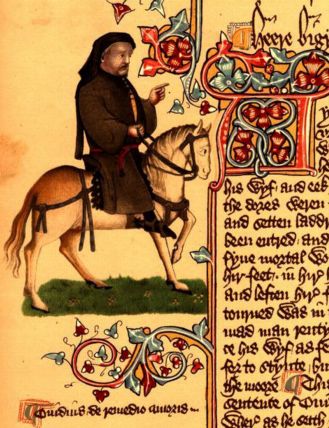
In Chausers "Canterbury Tales" he shows his dislike for certain characters by the way he describes their physical appearance and the way they act towards other people and the way they act in more personal aspects. Chaucer was not reprimanded for talking about people he did because he did it in the "literary state". This essay will focus on three different people he shows dislike for by the way he describes them.
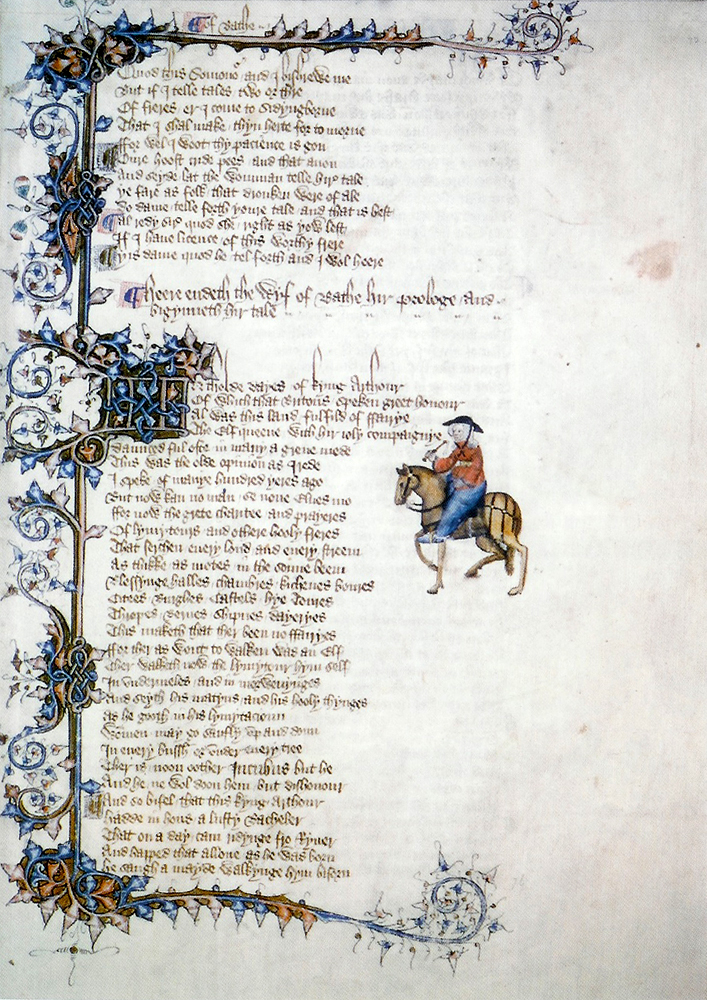
The Wife of Bath does not seem to be a favorite of his, although he seems to like her figure he seems not to like her personality. You would almost think of her as a husband killer as she had five husbands and each of them died, and quickly after she remarried. She seems to be a modern day black widow. Her face was bold and she always wore large hats, perhaps to hides her tentacles. She had large rolling hips and seems to be appealing. Chaucer does not seem to be particularly against her he just seems to be annoyed wit her her all together. His style of writing changes when he speaks of her, as though she is an offensive type of female.
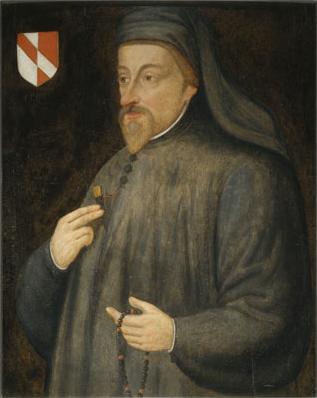
The Friar is a man who does not care about his fellow humans. He is an immoral man and cares only about himself and his fortune. Although he could have a large fortune he squanders his money on things of no importance. He becomes a beggar and does no one any good. He is a sore on the community's heel. Chaucer shows his dislike by the way he describes him as an "immoral man concerned largely with profit rather than turning men away from sin. His tale is an attack on the wickedness of summonses".
The cook is a man who has violent...
More "Canterbury Tales" by Geoffrey Chaucher
essays:
Right Roles? "The Wife of Bath" Speaks Out: Analysis of the prologue of "The Wife of Bath" from "The Canterbury Tales" by Geoffrey Chaucer.
... Geoffrey Chaucer, d.1400: Canterbury Tales: Prologue to Wife of Bath's Tale [Parallel Texts]", , November 14, 2005 "The Geoffrey Chaucer Page ...
This essay is talking about how it is significant that a Miller tells "The Millers Tale" and how it is significant that the wife of bath tells her tale.
... his physical appearance which is a large messy oaf, and his manners or lack there of. The prologue to the Wife of Bath's tale describes her as a person very ...
THE PRETENTIOUS AND THE PRECOCIOUS: The Canterbury Tales, Geoffrey Chaucer; Analysis of Monk and Oxford Cleric
... the physical description and social standing of the characters define their respective personalities. Chaucer makes most of his commentary about society through the personalities of the characters in The Canterbury Tales. The ...
Dance, Puppets, Dance. Character Analysis on the Wife of Bath in Chaucer's "Canterbury Tales "
... carries the story. In Geoffrey Chaucer's Canterbury Tales, he portrays the Wife of Bath, Alison, as a woman who bucks the tradition of her times with her ... he gives her control, "we hadde never debat" (P828). She has won this battle of wits, but it seems as though Jankyn has none. One way or another, ...
The Wife of Bath in The Canterbury Tales
... In Chaucer's work, the Wife of Bath's Prologue and Tale provides the reader with an impressive example of a woman who discovered a method of securing personal rights ...
Canterbury Tales - The Wife of Bath
... Geoffrey Chaucer's "Canterbury Tales," I found that of the Wife of Bath, including her prologue, to be the most thought-provoking. The pilgrim who narrates this tale, Alison, is a gap-toothed, partially deaf seamstress and widow who ...
Consider the Relationship Between Experience and Authority in the Wife of Bath's Prologue (Geoffrey Chaucer: The Canterbury Tales: The Wife of Bath's Prologue)
... the Wife of Bath and All Her Sect (London: Routledge, 1994) Muscantine, Charles, Chaucer and the French Tradition (Berkeley: University of Calafornia Press, 1957) Pearsall, Derek, The Canterbury Tales (London ...
The Canterbury Tales: The Humanity of The Wife of Bath and The Pardoner
... Chaucer's Wife of Bath and his Pardoner are by far the most analysed, critiqued and admired of all his characters. Even for the Miller, for his ridiculous and entertaining tale, is ... best tale, giving a personal lisence to each of his ...