Marie Sklodowska Curie (1867-1934)
(based on "Woman in Chemistry and Physics" by Grinstein, Rose, and Rafailovich)
Maria Sklodowska was born on November 7, 1867, in Warsaw, Poland. Her father was a professor of physics and mathematics, and the mother was a teacher. Religion and academic success were emphasized in their household. Unfortunately, young Sklodowska showed her first signs of atheism and religion rejection around the beginning of her teenage years.
After finishing high school she started her association with young intellectuals who met to discuss the ideas of the positivist philosopher Auguste Comte and other advocates of social reforms. She read everything in the original: Dostoevsky, Marx, as well as the French, German, and Polish poets.
In 1891, at the age of 24, Maria went to Paris and became a student at the Faculty of Science of the Sorbonne. In only three years she obtained Licenciateships in Physics and the Mathematical Sciences.
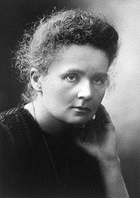 English: Marie Curie (born Maria Salomea Skłodows...
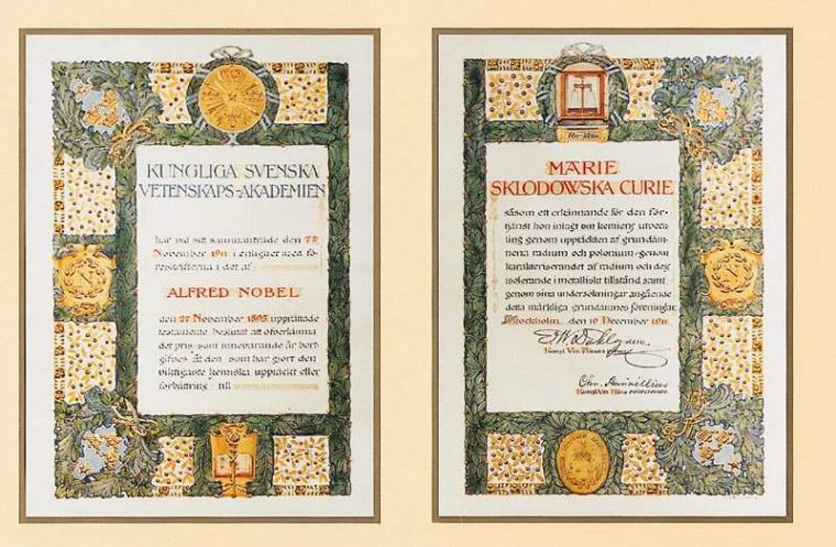 English: Marie Skłodowska-Curie Nobel Prize Diplo...
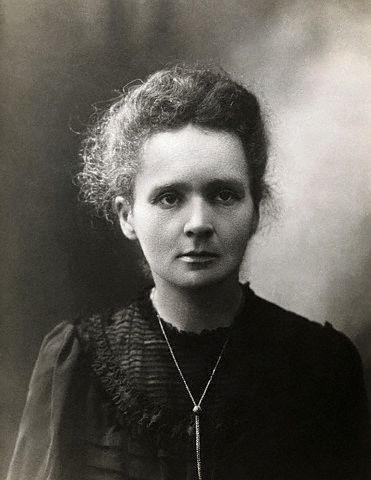 Portrait of Marie Skłodowska-Curie (November 7, 1...
During her stay in Paris, Sklodowska met Pierre Curie, who was then laboratory chief at the School of Industrial Physics and Chemistry. He asked her to work on his laboratory.
In two years, in July 1895 she married him. In September 1897 Curie gave birth to couples first daughter, Irene.
The discovery of radioactivity by Henri Becquerel in 1896 inspired the Curies in their researches and analyses which led to the isolation of polonium in June, 1898, named after her own native country. Four months later the couple was able to confirm the presence of a second element, which tentatively named radium. Four years later, in September 1902, the couple announced the isolation of one-tenth of a gram of radium chloride in its purest form. Awards and recognition followed almost at once. The discovery caught the attention of the scientific world. The experimental results were the major part...