Citizen Kane Analysis
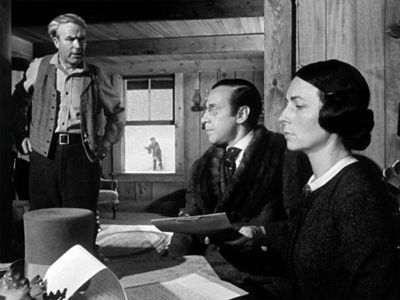
Many critics consider "Citizen Kane" to be the greatest movie of all time, and with all reason to conclude so. After all, it was an artistic masterpiece and a technological wonder. However, the film's greatness does not derive solely from its artistically executed cinematic, dramatic, and literary elements, but also from the details instilled within each and every frame, and the manner in which its every aspect helped develop the theme.
Gregg Toland's cinematography was revolutionary. The combination of montage, black-and white lighting, wide-angled lenses, deep focus photography, long tracking shots and sets with ceilings, redefined American film narrative. Deep focus allowed everything in the frame, foreground and background, to be in focus at the same time. The story was told by means of composition, camera angle, and visual styles, just as much as it was told by plot and dialogue. The entire tale was told in flashback, and used fading transitions to show the passage of time. It had an enormous impact on the movie industry, as the camera took positions that were previously unknown. Before "Citizen Kane," the camera tended to film "context shots." The audience would be exposed to things that a human observer may not have noticed, but seemed natural on screen. "Citizen Kane" introduced a camera view that no human would see otherwise. It would notice two things at once, exemplified in the scene where Mr. Bernstein is discussing the influence of the new employees with Mr. Leland, and Mr. Kane can be seen in the mirror reflection dancing with the showgirls. Not only did this film influence the look of studio pictures of the 40s, but it also set the tone for the future of cinema, proving that the were boundless possibilities and that the camera could record any conceivable image.
As a tribute...
More Film History
essays:
Early Japanese Films.
... As technology continued to advance, more and more production companies came into power. Big directors and actors began to emerge to produce great feature length films. The ...
ENGL 284: Citizen Kane
... Citizen Kane set a high standard for the art of cinematography as it made cinematic advances and technical innovations on many fronts. A new style of film making was created with innovations varying from the use of deep focus technique, camera ...
The changes within the film industry 1990-2004
... a narrative story in his film Cendrillon (1899). The 1930s gave way to the introduction of sound in film. Consequently, movies took on a role as a form of entertainment. Technological Advances ...
The changes within the film industry 1990-2004 (with works cited)
... a narrative story in his film Cendrillon (1899). The 1930s gave way to the introduction of sound in film. Consequently, movies took on a role as a form of entertainment. Technological Advances ...
Were the 1927 and 1938 British Film Acts Successful?
... that American films were more popular because the lower classes could identify better with them and that British films had a failure to respond to popular taste and cites. The films did not accurately show the lives of most British citizens ...
Elizabeth The Golden Years Final Paper
... d.). Cinematography focuses on relations between the individual shots and groups of shots that make up a scene to produce a film's effect. The cinematography and lighting found in Elizabeth the Golden Age were grandly elaborate. Camera angles were ...
In what sense might Fritz Lang's "Metropolis" and Josef von Sternberg's "Der Blaue Engel" be considered 'modernist'.
... and artistic current to offer something for everyone" . It is certainly true to say that Metropolis did not simply rely on modern filmic techniques, it used a rather Romantic story line, was filmed using much expressionist cinematography, incorporated ...
History of chinese cinema.
... popular American films such as Raiders of the Lost Ark and Who Framed Roger Rabbit were outgrossed by other films in Hong Kong. Many people may wonder how ...