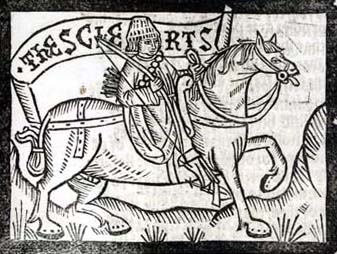
Clerk & Squire Contrast "The Canterbury Tales"
In Chaucer's "The Canterbury Tales," two young men of the Middle Ages, stand in sharp contrast to each other. The clerk and the squire are of similar ages but are very different. The clerk is a member of the middle class, has attended Oxford and studied Aristotle, while the squire, a member of the upper class, has been educated in the arts of chivalry.
In appearance wise the clerk is a "grave" or somber individual. He is thin "hollow-cheeked" and dresses poorly ("outer cloak threadbare"). On the other hand the squire is a bright, cheerful person. He is lusty, strong and nimble and dresses extravagantly "red and white embroidery; short coat with long wide sleeves." His facial appearance is similar to his dress habits, his hair is curled and he is very handsome.
The two differ in personality as well. The clerk is formal and modest when he speaks and he only speaks (gives his input) if it is needed. He is also considerate of others, "pray diligently for the souls of them that gave him wherewith to stay at the schools" and his speech is of moral virtue. The royalty of the squire was apparent in his personality. He is courteous, modest and helpful to others. His royal roots show that he is a respectable man and in his youthful state, he is full of energy.

Finally, we can see that the two have very different interests. The clerk is interested in lectures on logic, reading Aristotle and studying Philosophy. He also loves to learn and teach and convey his knowledge to others. The squire is engulfed with the many campaigns/battles of the country and loves jousting in his spare time. He also enjoys singing, playing the flute, riding horses, making songs, dancing drawing and writing. The squire's royalty...
More "Canterbury Tales" by Geoffrey Chaucher
essays:
Compare and contrast: The Canterbury Tales
... S TALES REVISITED The Canterbury Tales by Geoffrey Chaucer is a classic piece wherein pilgrims tell tales during their journey to a holy shrine in Canterbury. A Knight and Miller are two of the pilgrims. Chaucer gives personality to ...
The Knight and The Squire from "The Canterbury Tales'.
... the middle ages is Geoffrey Chaucer's epic poem The Canterbury Tales. In his classic work, Chaucer creates ...
THE PRETENTIOUS AND THE PRECOCIOUS: The Canterbury Tales, Geoffrey Chaucer; Analysis of Monk and Oxford Cleric
... the Middle Ages. Authored in late fourteenth century England, The Canterbury Tales is a compilation of tales which can be best described as a work of poetry. Chaucer's ...
An Observation of the Nun Prioress
... The Canterbury Tales" by Geoffrey Chaucer, there is a detailed description about the nun Prioress in the "General Prologue". Chaucer uses physical and spiritual relationships to show the characteristics of a person. To ...
The Canterbury Tales - by Geoffrey Chaucer
... a young man who in the Middle Ages devoted his life to become a powerful knight. However, it seems that Chaucer wanted to illustrate the other side of the character's personality. As a candidate to become a Knight, the Squire ...
The Canterbury Tales--Geoffrey Chaucer.....explains how Chaucer says that the Medeival Church is corrupt
... The Canterbury Tales, Chaucer paints an interesting picture of the medieval church. The Christian Church provided leadership for the people of Western Europe. Saint Augustine was not the most diplomatic of men, and ...
Canterbury Tales - The Wife of Bath
... I cheer the rather raunchy weaver, the prevailing standards of idealistic chivalry and religious misogyny of the Middle Ages kept the Wife of Bath from being heralded by most people of that same period -- including her creator. Looking past my personal ...
"The Canterbury tales"
... of tales among pilgrims journeying to the shrine of martyr Thomas Becket at Canterbury. This gave Chaucer the opportunity to show a cross section of medieval society. Feudalism was the social structure of the middle ages. It ...