Comparison of the Met and Guggenheim Museum New York
New York City has been called "the greatest city in the world" numerous times by its own people and visitors to the city. New York is civilization's greatest world within a city. It gives the overpowering impression of being a magnet and mirror for all of humanity and all that humanity does. For a city so young, New York is home to number of architectural classics. Two of these masterpieces of architecture are the Metropolitan Museum of Art and the Guggenheim Museum. Both continue the metaphor of New York being a world within a world and possess the latent fusion of form and function, one dependent on the other. The Metropolitan Museum is the epitome of neo-Classical style while the Guggenheim is a modernist powerhouse. Each museum serves the same purpose: displaying humanity's greatest achievements. By comparing and contrasting their history, location, façade and interior, I will investigate how they arrive at this goal in contrasting styles
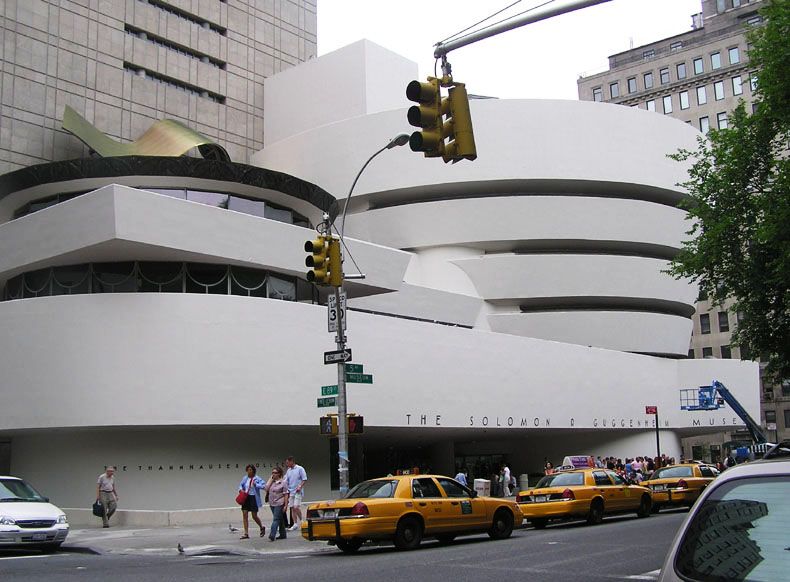
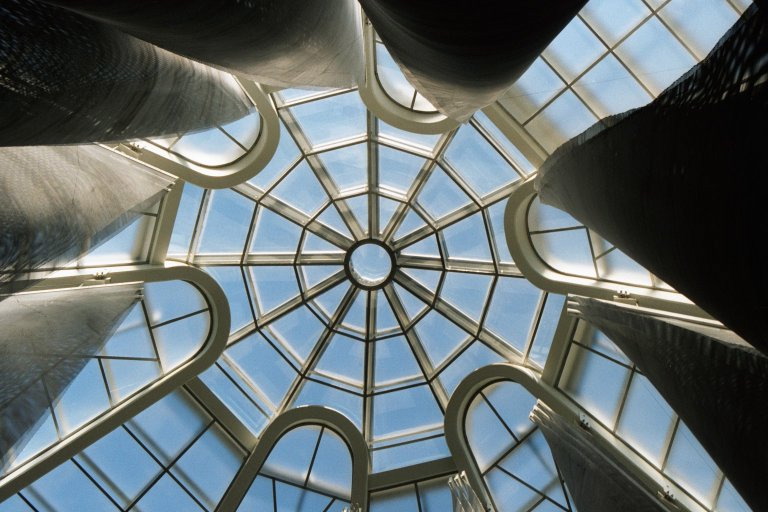
Location of a building is significant, often giving an insight into the edifice's function. The Solomon R. Guggenheim Museum is located on Fifth Avenue between 88th and 89th streets (picture1). It was commissioned by Solomon Guggenheim in 1943. Guggenheim chose Frank Lloyd Wright to design a new building to house Guggenheim's four-year-old Museum of non objective painting. Wright was reluctant on New York being chosen as the city to house the museum but he finally decided on its current location. Its proximity to Central Park was a vital factor in his decision - the park offers a respite to the hustle and bustle of the city and gets as close to nature as possible in the City (picture 2). Like Robie House and Falling Water, the museum is a product of its environment and finds its inspiration from nature. As is stated on...
More Design Arts
essays:
"Symbolic Space: French Enlightenment Architecture and Its Legacy" by Richard A. Etlin.
... glass and steel? Are these able to generate emotion in the same way as their neo-classical ancestors? After reading this book, it will be impossible to judge modern architecture without ...
Analysis of the Loccitane 2005 Catalogue.
... elements of nature and beauty. The Design. Colour and Contrast: The dominant colour is the tanned yellow background which sets the mood of the catalogue. The tanned yellow is a very ...
Aegean, Greek, Etruscan and Roman Art: A selsection of works to highlight on a tour of the ancient world.
... Etruscan form (Museum of Fine Arts, 2006)." This work embodies the warmth and intimacy of the Etruscan period. The group should depart the site with an understanding of the Etruscan style and its ... them a less known piece with characteristics of the Greek Archaic and Classical periods ...
DNT - Rudolph Diesel - Inventor of the diesel engine
... in Paris where he was an excellent student. He enjoyed art and spent a lot of his time in the museum of arts and crafts. The outbreak of the ... in total. Because of economic troubles, Diesel had to settle for a new job in Berlin. So Rudolph and his family moved to Germany in 1890. There he met ...
TITLE: Interpretation of an Architect: Frank Gehry
... triumphs and contributions to the Architecture world, not so much criticisms. 4. Jodidio, Philip, Contemporary American Architects, Volume III, Taschen, New York, 1997 This book was a general overview of some of the ...
Cubism was one of the strongest art movements in the 20th century that gave birth to many other movements such as futurism and suprematism.
... This new style gave a 3 dimensional look on the canvas. The cubist movement gave rise to an extraordinary reassessment of the interaction between form and space changing the course of western art forever ...
Essay on modernism including cubism and expressionism
... Philadelphia and the Museum of Modern Art, New York). He produced fascinating theatrical sets and costumes for the Ballet Russe from 1914 on, turned, in the 1920s, to a rich classical style, creating ...
What impact has technology had on architecture of the 20th century? - mainly notes
... Towards a New Architecture) Link the whole shift to modernism in art with its eradication of representation beyond the essentils (when painting became only about paint and surface, scuplture only about form and material ...