The start of the modern science that we call "Computer Science" can be traced back to a long ago age where man still dwelled in caves or in the forest, and lived in groups for protection and survival from the harsher elements on the Earth. Many of these groups possessed some primitive form of animistic religion; they worshipped the sun, the moon, the trees, or sacred animals. Within the tribal group was one individual to whom fell the responsibility for the tribe's spiritual welfare. It was he or she who decided when to hold both the secret and public religious ceremonies, and interceded with the spirits on behalf of the tribe. In order to correctly hold the ceremonies to ensure good harvest in the fall and fertility in the spring, the shamans needed to be able to count the days or to track the seasons. From the shamanistic tradition, man developed the first primitive counting mechanisms -- counting notches on sticks or marks on walls.
 English: Image of punched card of Herman Hollerith
 The grave of Herman Hollerith, the punched-card pi...
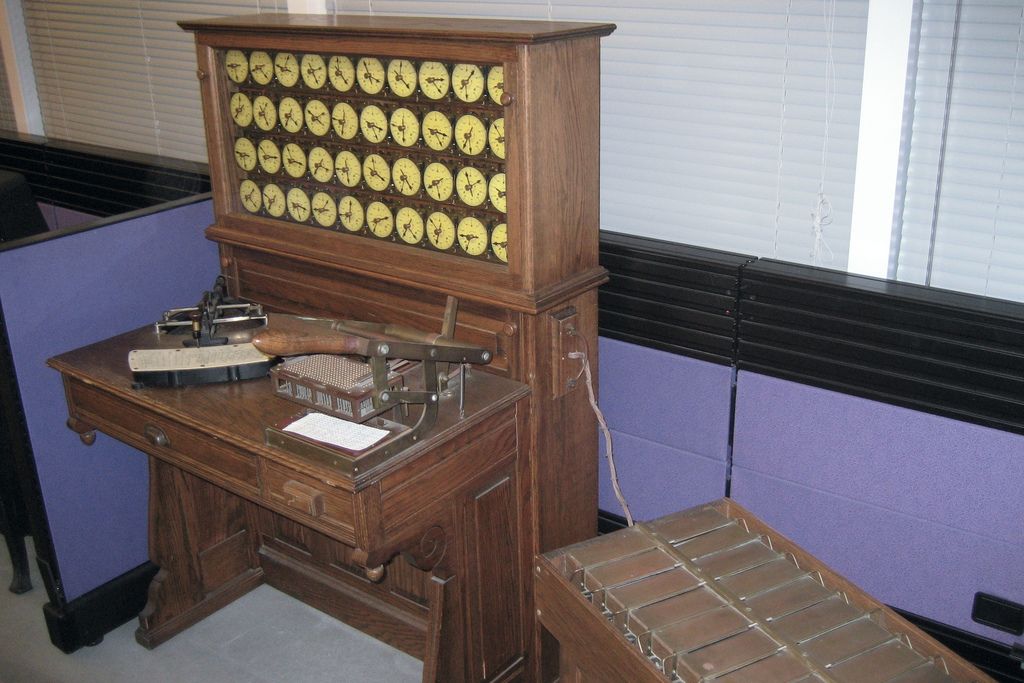 Replica of early Hollerith punched card tabulator ...
erected by the Druids. Regardless of the identity of the builders, it remains today a monument to man's intense desire to count and to track the occurrences of the physical world around him.
Meanwhile in Asia, the Chinese were becoming very involved in commerce with the Japanese, Indians, and Koreans. Businessmen needed a way to tally accounts and bills. Somehow, out of this need, the abacus was born. The abacus is the first true precursor to the adding machines and computers which would follow. It worked somewhat like this:
The value assigned to each pebble (or bead, shell, or stick) is determined not by its shape but by its position: one pebble on a particular line or one bead on a particular wire has the value of 1; two together have the value of 2.