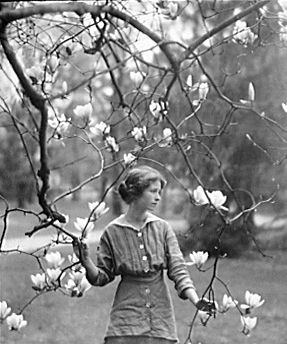
The connection between Edna St. Vincent Millay's poem 'First Fig' and (teenage) life in the twenties. I wrote this in the 9th grade, so it's not my best work.
Edna St. Vincent Millay was a poet in the 1920s. She wrote mainly about celebrating youth, the freedom, and independence the youths had during these "Roaring Twenties." This essay will tell what her poem 'First Fig' reveals about a teenages life in 1920's America.
The Poem: My candle burns at both ends;
It will not last all night;
But ah, my foes, and my friends---
It gives a lovely light!
The poem 'First Fig,' written by Edna St. Vincent Millay, symbolizes the 'live for the present' attitude that was prevalent in the 1920s. At this time, society was changing a great deal. These changes were especially visible in the lives of teenages.
The first line: "My candle burns at both ends;" tells about how the life of a teen was much different than what it used to be. By reading this first line, one would get the idea that life was better and 'brighter' than ever before. It was more fun and exciting, and people are having a good time. The candle probably represents the good years of their lives; and it's as good as it gets.

The second line: "It will not last the night;" tells of how these good times aren't going to last forever. a burning candle has to go out eventually; one that burns at both ends will go out even sooner. The brighter it burns, the shorter it lasts. The better life is, the less time it is going to stay that way (a classic example of "What goes up, must come down").
The third line: "But ah, my foes, and my friends;" states that it doesn't matter if someone is your best friend or your worst enemy, they can't change the inevitable, nor can they take away what you or anyone else will get...
More Poetry
essays:
"love through the ages" discusses the differences and similarities between the 2 poems "Love is not all" (by Edna St. Vincent Millay) & "To my dear and loving husband" (by Amm Bradstreet).
... the poem. Although these poems are written in different time periods, they have many similarities considering their content and meaning. Ann Bradstreet and Edna St. Vincent Millay have different ...
"I had been hungry" by Emily Dickinson.
... words and imagination to describe natural facts that are intended to reveal spiritual truth. This becomes also obvious in the poem I will interprete later. From the about 2.000 poems she wrote during her lifetime, only twenty or ...
The Dark Side Of Robert Frost
... This poem seemed really gloomy and sad. Lesley Francis stated in her journal, “War is a good thing if you have a good reason for it…”. That really showes the differences in their personalities (164). Robert wrote a series ...
The life of Anne Sexton
... father. She clearly did not have a good relationship with her father and his death left many questions unanswered. This is made evident in the following " My father time meanwhile ...
Anne Sexton and Sylvia Plath: Minds of Distortion and Darkness
... this and wanted to make her father into a person that she would have a reason to resent and dislike. For Plath this was a Nazi ... why she used them in so much of her poetry. Anne Sexton wrote a poem entirely about Nazi's and the ...
An Explication Of Langston Hughes' "Mother To Son"
... believes and to have a more prosperous life than what she had. Langston Hughes was born in ... I'll tell you:" gives the reader a good idea in which direction the poem is taking. At ... racism and prejudges from the white culture. The 1920's were a time of struggle for many blacks and Negro ...
A Grandfathers Love
... he loved her and that should he die before they share some life together they have this poem to tell them about his love. This poem will ... first time I read Miller Williams poem "A Poem for Emily" I did not see any major theme standing out. It is a simple poem written ...
Robert Frost "home burial" a poem that shows how a death of a child splits two lovers
... Despite having a good side, the husband is still seen as domineering and controlling. Towards the end of the poem, we ... he pleads "Amy! Don't go to someone else this time". (Line 41) This shows that not only has she not trusted him with her emotions in the past, but ...