A boy graduates from high school at age 18. He goes to a pool party to celebrate. He confuses the deep end and shallow end and dives head first into the pool, breaking his neck and becoming a quadriplegic. At age 19 he has his first urinary tract infection because of an indwelling urinary catheter and continues to suffer from them the rest of his life. At age 20 he comes down with herpes zoster of the trigeminal nerve. He suffers chronic unbearable pain. At age 21 he inherits a 10 million dollar trust fund. He never marries or has children. At age 40 after hearing about Dolly being a clone, he changes his will and has his DNA stored for future human cloning. His future mother will be awarded one million dollars to have him and raise him. His DNA clone will inherit a trust fund. He leaves five million to spinal cord research.
 Clone Trooper vs. Spider-Man Clone (93/365)
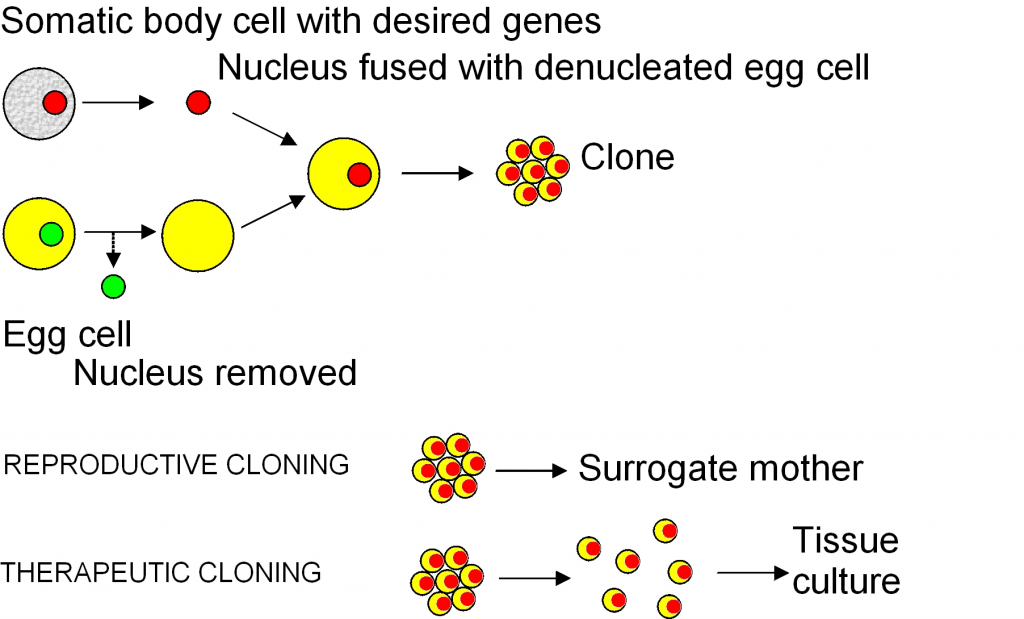 en: Reproductive and therapeutic cloning english d...
 English: small decription of the diagram
He dies feeling that although he was robbed of normal life, his twin/clone will lead a better life (Smith, "Benefits").
Depending on your outlook, you may feel sympathetic to this man's wishes or you may feel indignation. The days of horror, science-fiction stories are falling behind us and the idea of cloning yourself, or anyone else for that matter, may seem more acceptable and plausible when considering situations like these. Still, cloning is very controversial; there are many social and biological implications to carefully mull over before something like this becomes an accepted practice. Cloning is morally irresponsible when used as a means of asexual human reproduction; while the principles behind therapeutic cloning may be considered practical, the current technology is superfluous for use in the treatment of human disease. To make an educated opinion on this topic, one must understand the different types of...