Courage in "To Kill a Mockingbird" by Harper Lee; this focuses on true and false courage and the natural characteristics of courageous people.
To Kill a Mockingbird demonstrates courage by certain characters' willingness to defend and sustain their own perspective. Also, true courage involves boldness and strength to resist other opinions, disregarding the pressure of others and their morals. False courage would include hypocrisy. Throughout the novel, Atticus and Mrs. Dubose are courageous in their acts, while Aunt Alexandra and the other hypocrites like Miss Gates, possess false courage.
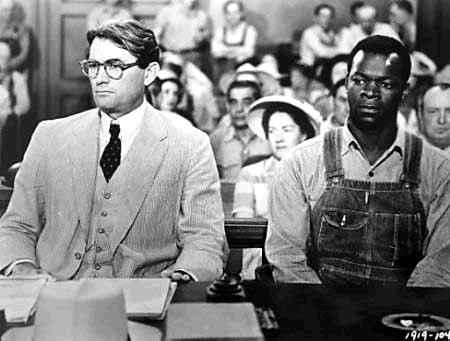
Atticus has his own philosophies that often contradict the tacit philosophy of his society. He believes that African-Americans are no different from other intelligent human beings. He believed that in Maycomb, whites are excessively brutal to blacks, and this should stop. He defended his beliefs and strengthened them day after day. With the courage possessed, Atticus did not take the description "nigger-lover" as a discouragement, but as a support to his value system. He fought for his beliefs, not physically, but morally. Even when the actions were not beneficial, he would act courageously. He sat in front of the jailhouse facing a mob, only to protect the rights of a Negro, Tom Robinson. This event clearly illustrates the courageous deeds of Atticus, as he acted toward his moral stability. Another character that demonstrated courage was Mrs. Dubose. "She said she was going to leave this world beholden to nothing and nobody. (p.111)" She expressed her opinion repetitively, ignoring the opposing force. Unlike the society, she claimed that Atticus was trash, "lawing for niggers." Only a man with courage could stay calm and sturdy with the public atmosphere against him. Atticus did not take the insults as denouncing him; instead, he though them to be encouragement to his courageous demonstrations. Mrs. Dubose also fought morally for her value systems, supporting the segregation of blacks and whites. She did not have a "cowardice" attitude towards the...
More "To Kill a Mockingbird" by Harper Lee
essays:
The Themes in "To Kill a Mockingbird" by Harper Lee
... proved to be good. The timing for the release of To Kill a Mockingbird could not have been more perfect. 'In a time ... Only a few courageous people, such as Atticus, are willing to do ... novel, Atticus is sitting at home one night when a mob comes along, 'In Maycomb, grown ...
Harper Lee's "To Kill a Mocking Bird".
... in "To Kill a Mockingbird" like the way things are. And people will do anything to keep ... of "To Kill a Mocking Bird" which is what Atticus was trying to do in Tom Robisons case. But as Atticus knew one case wasn't going to change the people of Maycomb and ...
To Kill a Mockingbird: Irony and Sarcasm
... and hypocrisy inhibit upon the readers' mind is presumably the reason that Harper Lee employed them to criticize the various elements of life in Maycomb. It is one of the reasons that make To Kill a Mockingbird such ...
A book report on Harper Lee`s "To kill a mockingbird"
... s a sin to kill a mockingbird.' That was the only time I ever heard Atticus say it was a sin to do ... and a counterpoint to Aunt Alexandra is a sharp-tongued widow, and an old friend of the family. She shares Atticus's passion for justice and is the children's best friend among Maycomb's ...
"To Kill a Mockingbird" Character Review: "Both as a father and as a lawyer, Atticus is a failure."
... spotlight. Atticus tells both the court and the children that, quite simply, racism is bad and that to kill a mockingbird is a sin. The mockingbirds of ...
Justice in David Williamson's "The Removalist" and Harper Lee's "To Kill A Mockingbird"
... community. "To Kill A Mockingbird" is a story of prejudice and corruption of the legal system. Tom Robinson, an African American, lives in a racist white society and is consequently being wrongfully ...
Relationship between "How to Kill a Mockingbird" and "Mississipi Burning"
... mediums. "To Kill a Mockingbird" is a great example of showing how racism was portrayed during the 20's and 30s. Life was very different from then, where previously there were still African American slaves that were not being recognised ...
"To Kill A Mockingbird" by Harper Lee: Discourse of Racism and the Influence of Atticus and Aunt Alexandra on Scout
... To Kill A Mockingbird', Maycomb is a town of prejudice, racial intolerance and conservative views. Despite this, there are still a few members of the community who believe in racial tolerance. The racial opinions of the town, as seen in Aunt ...