The Renaissance period brought a revival to all forms of the arts, including that of literature. Poetry became a way for writers to display their skill with language as they artistically sculpted the words and lines of their poems. Poetry at this time followed strict forms that gave the structure within which the poet can operate. One such form that became very popular throughout the Renaissance period was the sonnet. This form was very widely used, and two poets who became popular partially for their sonnets are Sir Thomas Wyatt, and Samuel Daniel.
Thomas Wyatt was one of the first from England to use the sonnet form. Because of this his sonnets follow the form that was first developed in Italy by the poet Petrarch. Wyatt's fourteenth sonnet, "My galley charged with Forgetfulness" likewise follows this petrarchan sonnet form. One of the principle practices of this period was that of imitation, where one poet would imitate the form or themes of other poets.
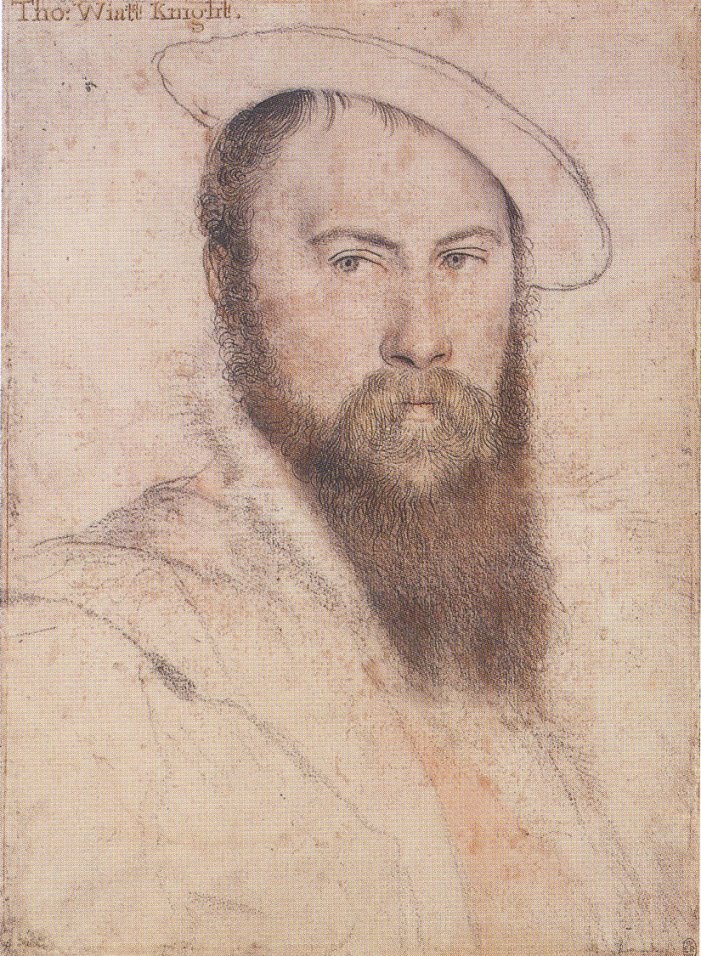 Thomas Wyatt the Elder died this year (Portrait of...
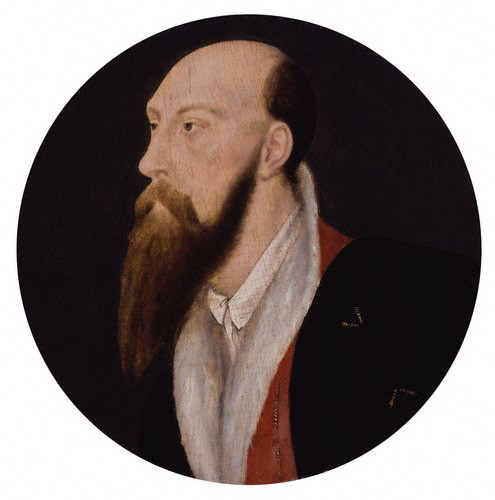 Sir Thomas Wyatt
 Sir Thomas Wyatt, poet, suitor of Anne Boleyn
This is what Wyatt did in borrowing this petrarchan form. Like most petrarchan sonnets, this one is composed of an octet followed by a sestet. The rhyme scheme of the octet is the conventional, ABBA ABBA rhyme scheme, while Wyatt alters the form of the sestet from the early petrarchan sonnets as it follows a CDDC EE rhyme scheme. Also, as in nearly all poems, he uses iambic pentameter. This pattern of alternating weak and strong syllables is particularly useful in this poem as it resembles the rise and fall of a ship, which is the main image in the sonnet.
Wyatt further imitates Petrarch by using the petrarchan idea of women and love. The petrarchan love convention is one in which the writer (a man, as basically all writers were during the Renaissance period) expresses his misery over the unrequited love of a woman. Many of the poems using the petrarchan love convention describe the woman and the negative way in which she turns down the advances of the man. In this particular sonnet, however, Wyatt is focusing not so much on the woman as he is on his own personal drama that the emotions caused by his unfulfilled desires are causing him. This focus on the writers own misery was also widely found in renaissance poetry.
Another way in which Wyatt imitates the popular poetry processes of the days was by utilizing a conceit, or an extended metaphor, to explain his point in this sonnet. He uses the metaphor of a ship being battered on the violent stormy sea to express the turmoil his emotions are in, and how they're torturing his mind. Also, in using a ship, Wyatt is displaying the intense interest in ships and sea travel that arose during the Renaissance period as much exploration was going on as well as an emphasis on navel fleets, that was particularly brought out around the time of the Spanish Armada.
Wyatt's sonnet begins with the line "My galley charged with Forgetfulness". In this line Wyatt is setting up both the image of a ship in distress but is also linking it to himself as he claims "My galley" as in something belonging to him, either his life, or more specifically his mind, is so "charged" or laden with burdens that he is forgetting all else besides his central problem. He goes on to further emphasize the disturbed and tortured state that his mind is in as he is passing through "sharp", dangerous seas during "winter nights" which are the coldest as well as the longest nights a man can go through. The danger rises in the third line as he states the obstacles that has entrapped him, as he states "tween rock and rock, and eke [also] my foe", followed by a despairing "alas". This foe that he mentions is then identified in the following line as "my lord". As this sonnet is showing the distress that can be produced by love, "my lord" can be seen as the god who causes love, Cupid. There was a great interest in the Renaissance period of all that involved classical Greek and Roman practices, including their mythology. Cupid, Wyatt states, steers his ship "with cruelness", so he is placing the blame on Cupid for cruelly putting him in such a miserable and disturbed state.
In the second half of the octet Wyatt furthers the metaphor of the ship, as well as builds up the danger and torture of his position. He states that "every oar, a thought in readiness". This image produces the idea that his thoughts are coming steadily and readily with the repetitive, constant motion of the oars. Also, as the tone built up to this point is one of agitation and affliction, it can be seen that the oars or the thoughts controlling the direction of the ship (mind) are taking him deeper into these emotions.
The next line first brings in the idea of death which helps to add tension to the poem, especially as death is emphasized through the alliteration of the /th/ sound in the phrase "As though that death". In this line death is described as being "light" in this case. This could either connote that death were light as in it is a light matter, not something of big importance, or it could imply the meaning of light as it is used as the opposite of darkness where darkness is used as something bad, and light as something good. The idea of light verses darkness was very popular during this period, and was utilized in all manners of artistic endeavors. In this section of the poem, it is the "endless wind" found in the ensuing line that is treating death as light in this case as it tears his sail apart. The reference to endless shows just how there is no reprieve from his situation, and by the sail being torn it makes it almost impossible for him to make any progress what so ever. The next line shows this wind to be created from "forced sighs" which are forced as he does not wish to be in the situation as he is but was forced into it, and by the "trusty fearfulness" that is reliable as in it is always there.
At the beginning of the sestet Wyatt, the metaphor becomes more personal as he draws closer connections between the idea of a ship caught in a storm, to his own mind and emotions. He shows how the rain is constructed of tears which are evidently flowing heavily and ceaselessly, and the constant presence of a cloud of "dark disdain". The alliteration here of the hard /d/ sound displays the emotion with which it is spoken as well as adds to the tension of the poem. What this rain and cloud have done the "wearied cords great hindrance". In the cords being wearied or worn it can be seen that it is becoming harder for the narrator to hold on and that it is only a matter of time before the cords break, sending him plummeting further into the pit of despair. The next two lines mention for the first time the mistress who sent him into this despair by claiming that his pain was caused by the "stars that hid". It was a popular convention for poets at the time to describe their mistress' eyes as stars, and as these eyes are hidden from him it is likely that she will not even look at him, and because of this she is the one is "wreathed, surrounded and ornamented with "error" or fault, but is ignorant of this, making it all the more painful.
Lastly, this sonnet ends with the final anguished proclamation that "Drowned is reason that should consort/ And I remain, despairing of the port." By drowned he's raising again the image of death, and showing how permanency. As it is reason that is drowned it is seen that he can no longer think logically to bring himself any comfort, and that his emotions are ruling over him. It was believed during this period, as it was in classical times that it is ideal to use reason, and so gain mastery of one's emotions. As the narrator cannot do this, he cannot find comfort, nor find a safe calm place to rest, but is condemned to be endlessly beaten and battered by his emotions, and so be slowly destroyed.
Wyatt adds to the tension and emotion produced by this poem by first adhering strictly to using exact rhymes that rigidly hold the poem together, and by his lack of punctuation. The is very little comma use particularly within the lines so that it speeds up the poem, so that the reader is hurried along, pushed through the poem, similar to the manner in which the narrator is pushed along by his emotions.
Samuel Daniel is another writer who produced a number of sonnets during the Renaissance period. Like Wyatt, Daniel imitated the themes and forms used in sonnets by other writers. However, unlike Wyatt, he utilized a different sonnet form known as the Shakespearean or Elizabethan sonnet form. This form breaks the fourteen lines of the sonnet down into three quartets and one rhyming couplet at the end. Daniel does a particularly good job in his sonnet "Care-charmer Sleep" with gradually building the sense of agitation and distress through the three quatrains, so that it culminates into a final passionate proclamation in the last couplet. The rhyme scheme of the quartets is somewhat intertwined as it goes ABAB BCBC DEDE and then ending with the FF rhyme in the couplet. This is fairly typical of sonnets produced at that time, as is the iambic pentameter he used.
This sonnet by Daniel is number forty-five out of a sequence or collection of sonnets that he wrote to "Delia". Delia is a classical name, so it again follows the interest during the Renaissance in the classical period of the Greeks and Romans. It also follows the petrarchan love convention as it is once again about the misery caused by love. Similar to Wyatt, this particular sonnet does not focus on the woman, but rather the emotions and inner turmoil of the one wronged by love.
The first quatrain begins with an appeal to sleep. Sleep is called a "Care-charmer". This implies that sleep charms the cares, making them dormant and unable to hurt anyone, much in the way a snake charmer charms a snake. He goes on to refer to sleep as the "son of the sable night" in which sable is the darkest color one can obtain. He also refers to sleep in this appeal as the "Brother to Death", creating an uneasiness and tension as death is brought up, but also showing how death is not necessarily a negative thing as it is seen in relation with the thing being begged for, sleep. Sleep is then said to be born in the "silent darkness", in other words out of a state where there is nothing, no noise and no light, the state he is apparently asking for as it would be void of all his cares. The narrator then goes on to as sleep to "Relieve my languish and restore light". In this Daniel creates a paradoxical situation as he is asking darkness to produce light. Light could be considered as that which is good, so the darkness is giving him what is good, or light can be interpreted in means of weight as a light burden; that the darkness lightens the load the narrator is bearing. The last line of this quatrain offers an odd syntax as it states "With dark, forgetting of my cares, return". Stating it in this way emphasizes the fact that it is the dark that produces the forgetting of the cares. This quatrain uses quite a bit of alliteration, particularly in the beginning with the soft, soothing sounds of /s/ and /th/. Also it has a lot of punctuation throughout the lines, keeping the pace slow, as well as uses slant rhyme instead of exact rhyme between the words "born" and "return" so that there seems to be a lack of passion propelling these lines, giving it the tone of a melancholy lament.
The second quatrain turns from discussing what is good about the dark and sleep, to what is bad about the day and waking. In the first line he once again makes an appeal to "let the day be time enough to mourn", that during the day he suffers, so don't let the suffering continue on into the night. What causes him to suffer is the "shipwreck of my ill-adventur'd youth". By using the word "shipwreck" he produces a strong image of destruction and suffering, so it shows vividly to the degree that his youth was "ill-adventur'd". Also, Daniel is displaying once again the preoccupation that people in the Renaissance had with ships. The third line of the quatrain very much echoes the first line of it when he states, "Let my waking eyes suffice to wail their scorn". However, in using the words "wail" and "scorn", he is producting a stronger and more desperate image that the one that had been present in the first line. The last line ends with a return to the idea of nighttime, but in a different manner than the first quatrain as he states, "Without the torment of the night's untruth". "Torment" here offers yet again a stronger and more passionate image. Along with the use of stronger language, this quatrain has little punctuation, and exact rhyme, all of which serves to speed the poem up, and create a more emotional and urgent tone, and is much less melancholy than the first quatrain had been.
The third quatrain explains how it is that the "night's untruth" torments the narrator. It is by the night's dreams that bring up the "day-desires" that he is tormented. He is not just appealing, but commanding the dreams to not give him this imagery, or to "model forth the passions of the morrow". He tells the dreams to not allow day to "approve you liars" as it just adds "more grief to aggravate my sorrow". In showing him his desires and passions, the dreams demonstrate all the more vividly what he is missing, and cannot have, making his sorrow all the more painful to bear. This quatrain not only lacks punctuation, but some of the words are cut short or hyphenated, speeding up the tempo all the more, showing the narrator becoming more angry and impassioned. This tone is very much contrasted to the sorrowful melancholy of the first quatrain.
Finally the last couplet announces the arrival of a turn in the sonnet by beginning with the conclusive word "Still". He once again appeals for sleep, tying back in with the first line, but he also asks to embrace the clouds even though it is in vain. This is because as he states in the next line, he never wants to again wake to "feel the day's disdain". He can embrace dreams if he is never going to wake again, because it is in the day that the disappointed and sorrow is felt. Also, in the alliteration of the hard /d/ sound in "day's disdain" he's showing how these words are said with bitterness and anger. Lastly, it can be seen that this narrator is so tortured and in turmoil that subconsciously he is appealing for death as to "never wake" would essentially be to die.