Guthrie P. Ramsey, Jr.'s book Race Music is an intensive study of African American music post World War II. The entire book is profoundly informed by the author's experience as an accomplished musician, a cultural theorist and musical enthusiast. I have found very little to negatively critique about this book, being that it is so well researched and well-organized. The author steers clear of any cryptic language, despite the fact that the book is probably read mostly by scholars of music theory and African American studies (a point he later brings up).
Race Music explores the global influence and popularity of African American music, its social relevance, and the various interpretations of former and present scholars. Ramsey explains that his book is not a sequential and historical study of African American music. "This is not a comprehensive, strictly chronological study of African American popular music. Rather, it is a meditation on the interpretation and criticism of various aspects of history" (Ramsey xi).
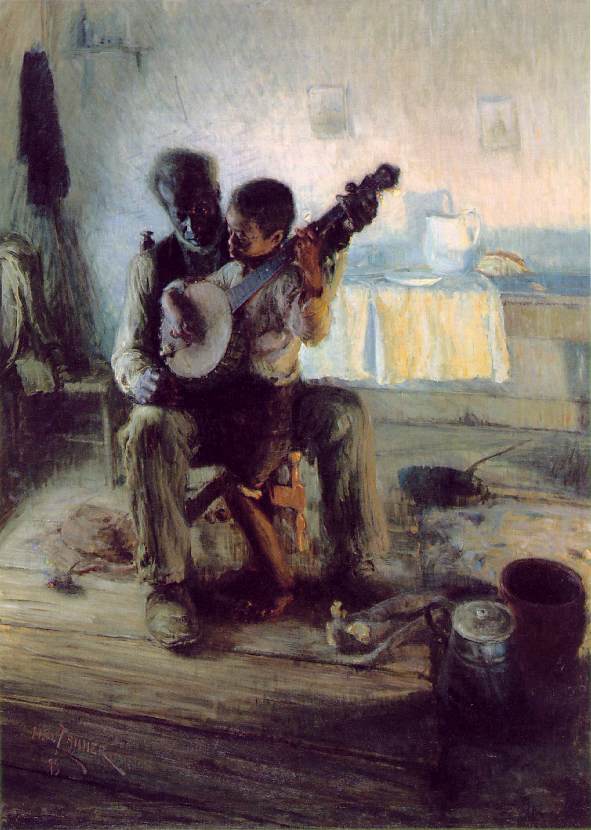 English: Henry Ossawa Tanner - "The Banjo Lesson"
 Ramsey FD
 ramsey_high2
Ramsey provides a thorough analysis of several genres of African American music. He explains how jazz, rhythm and blues and gospel are unique and grounded in their own conventions and performance practices, but how they are all also connected by similar techniques and conceptual structure recognized within traditional African American music. Ramsey also profiles three musicians essential to the development and popularity of African American music: Dinah Washington, Louis Jordan, and Cootie Williams.
Race Music is a well documented, powerful, and multi-faceted book. Ramsey provides a dynamic framework for rethinking African American music and the history and culture that infused its formation.
Toward a Cultural Poetics of Race Music.
Ramsey, with the opening of his book, brings into thought the idea of cultural memory by using a quote by Samuel A Floyd, Jr., author of The Power of Black Music (a book he later explains in greater detail). "Cultural memory, obviously a subjective concept, seems to be connected with cultural forms - in the present case, music, where the "memory" drives the music and the music drives memory" (Ramsey 1). The quote opens Ramsey's chapter by addressing his attempt to identify and explore some of the ways in which meaning is achieved through various styles of African American music. Ramsey boils his book down to his address of one central question: "How does the music under consideration work as discourses and signifying practices at specific historical moments" (Ramsey 3)? With the address of this question, Samuel A. Floyd Jr.'s quote from the first page of Ramsey's book takes on stronger meaning. In order to gain a true understanding of race music as well as the memory and history surrounding it, we must consider each as both a drive and a product of the other. Race music itself, however, is specific to history in that Ramsey's defines it as music post-World War II: jazz, gospel, and rhythm and blues.
Ramsey expresses his want to recapture and possible reinvent the term "race music" due to the scholarly controversy around the word "race". "The concept "race" is recognized in most academic circles as a "fiction" and social construction and has become almost reviled in today's cultural criticism" (Ramsey 3). Ramsey hopes to bring the term "race" back to a time when the word was once a positive self-identification. Ramsey explains he uses the word as an attempt to convey the worldviews of cultural identities from a specific historical moment, bringing up again his interest in the idea of cultural memory.
Disciplining Black Music: On History, Memory and Contemporary Theories
Black Music and the "Musicologies"
Beyond the fact that music can be personally meaningful, music can also be a dynamic social text. Ramsey states that music scholars argue that music is "a meaningful cultural practice, a cultural transaction, and a politically charged, gendered, signifying discourse" (Ramsey 18). However "music" within traditional musicology has mostly meant European art music and its derivatives. Only recently has African American music been interpreted as meaningful, valid, and worth considering seriously. Two fields of study are responsible for this - ethnomusicology and African American study. Both fields have worked to seek the association between the musicological and the ethnological, within not only African American music, but music in general. Furthermore, ethnomusicologists themselves have a greater sociopolitical agenda.
"Generally speaking, ethnomusicologists themselves have maintained that their focus on "nonelite" music making, their interests in preserving traditional folk music and their desire for cross-cultural understanding have put them on the right side (read "left") on the global struggle against colonialism, ethnocentrism, and imperialism" (Ramsey 19).
Ethnomusicology was finally taken seriously following the Black Power movement of the 1960's. This era saw the birth of the Afro-Americanist in the scholarly realm.
History, Memory, and African American Music.
Ramsey struggles continuously throughout his research on what many perceive as the "great divide". He explains this as the space between the area of "cultural memory" and the "truth claim" of scholarship. He explains that cultural memory is subjective, and that the truth claim (history) is objective. While both history and memory involve the recovery of felt experience from the jumble of the past, they nonetheless are considered to be quite different activities. History is science, and is objective and based on evidence and analysis. Memory, however, is personal and subject to biases and personal quirks. Yet, it is apparent that there is a tie between history and memory... but when is memory a part of history? Ramsey explains that the meaning of music must lie somewhere within the mix of the past: in both the biased and individual rhythms of personal memory as well as the evidence of history. I find this concept to be personally meaningful and very true. Musical meaning, on both a personal and general level, seems to be the bridge between the historical context of certain situations and the personal memory of the circumstances themselves.
Afro-Modernism, Black Consciousness, and Postindustrialism.
The historical arc of Ramsey's study is based on a period of roughly fifty years, from the 1940's to the 1990's. He identifies three important points within this arc, the 1940's, the 1960's to the early 1970's, and the 1990's. The three eras represent vital moments in the cultural, social and political realms of the twentieth-century African American history.
Ramsey begins his historical arc at the 1940's, a time where he believes a certain "progress" began, which he refers to as Afro-modernism. "What exactly is Afro-modernism? In this study it is connected to the new urbanity or African American communities, the heady momentum of sociopolitical progress during the first half of the twentieth century, and the changing sense of what constituted African American culture (and even American culture generally speaking) at the postwar moment" (Ramsey 28). The use of the term "Afro-modernism" assists in the understanding of race music appearing at this time as historically specific social discourses. Therefore, the music itself of the time influenced the social setting of the Afro-modernist movement.
The next era Ramsey delves into is that of the 1960's. The Black Power movement of the time popularized a specific brand of black cultural nationalism within our country. This brand, "Black Consciousness", found expression through many areas, among them religious, social, and cultural. The movement developed partly in reaction to the deteriorating urban spaces that once were thought to hold promise during the Afro-modernist movement. Due to the white flight to the suburbs and the heavy population of African Americans within urban areas, a "nation within a nation" sensibility began to develop.
Ramsey's third "point of arrival" is the postindustrial movement, which took place during the late-twentieth century. At this time, the living conditions in many of America's large cities had left few chances to individuals, especially the young and black. However, despite this fact, this period saw artistic expression from within the core of these urban spaces. Musicians, filmmakers, and writers began to either depict the horrible conditions of the inner city or attempt to modify the image of such cities in more complimentary terms.
"It's Just the Blues": Race, Entertainment, and the Blues Muse
The Migrating Blues Muse.
Ramsey, with the start of this chapter, begins to introduce the ways in which the Urban North and the Agrarian South became both an important site of cultural memory and of cultural production.
"The North is signified by practices associated in the popular imagination with the urbane, sophisticated and cosmopolitan. The South is referenced by musical gestures that evoke the southern, agrarian past of African Americans" (Ramsey 47).
The two sides to not necessarily stand in opposition to each other, but rather form as a rich and complicated relationship. For example, many blues songs show the fusion of certain southern "codes" as well as the more sophisticated gestures of the North.
Ramsey does not delve much further into this concept at this point in the book, and actually provides a somewhat awkward transition into profiling the three musicians he feels were vital to race music. Although there is a connection between the two pieces, Ramsey does little to explain it. This, however, is the first time within the book I have found a confusing or hard to follow transition.
The Living Jukebox: Dinah Makes Herself Heard.
Dinah Washington was already introduced in the beginning of Ramsey's book as one of the three key figures in African American music, post World War II. Ramsey's basis for such a thought lies in the fact that the life and career of Dinah Washington began to raise key issues with regard to female subjectivity in the blues at mid-century.
Born as Ruth Jones in 1924, Washington grew up in a poor family in Tuscaloosa, Alabama. She later moved to Chicago with her family where she was nurtured musically in the Baptist churches of the city's South Side. In 1939, Washington won an amateur contest at the Regal Theater, and had a brief career as a nightclub singer. During this time, Washington had seen Billie Holiday and adopted her as her musical icon.
Washington's "big break" occurred in 1943, when she was belting out lyrics while working as a ladies' restroom attendant. Lionel Hampton discovered her, and the next day introduced her as "the girl singer" in his big band. She was not well received by her fellow male band members, who viewed her as tousled and homely. Her vocal talents were later recognized by Leonard Feather, who produced her first recordings on Keynote, a small jazz label. After gaining popularity, Washington was quickly given the name "Queen of the Blues". She no longer was viewed as tousled and homely, spending a large portion of her money on clothing, and became well known for her keen fashion sense. Dinah Washington had an extensive recording and performing career, as soon became one of the first women in Blues to be taken seriously as a vocalist.
Despite her growing popularity within the Blues scene, Washington struggled within her personal life. Washington obsessed with her appearance, and had constant weight issues, which she attempted to fix with diet pills, which later she overdosed on and passed away from. Washington was married seven times during her short life, and had gained a reputation as a "bitchy fashionista" (Ramsey 61). Despite her tumultuous personal life, Washington had established a reputation as a staunch professional, and a pioneer for women in Blues.
"Keep it Simple": Louis Jordan, King of the Jukebox.
Louis Jordan, like Washington, was born in the South, in Brinkley, Arkansas. He grew up into a musical family, and received musical theory lessons at a young age. Jordan's influences were more performers then musicians. He credited actor Bert Williams as his primary influence, although theatrical jazz stars such as Cab Calloway and Fats Waller were also very important to Louis Jordan's musical approach.
Jordan formed his own band, called the Tympany Five in 1938. He made a big band sound with a small band, and was quoted as stating "I made the blues jump" (Ramsey 62). Jordan, in a sense, had created his own genre, which was the foundation for most of his success.
"It is important that Jordan's outline for success was expressed in terms of the musical genre, the economics and politics of leading a big band (which was, of course, the industry's standard at that time), the blues modality, race, and a specific attitude toward entertainment" (Ramsey 62).
Louis Jordan had enjoyed huge commercial success among both blacks and whites. He had begun selling video recordings of his performances, being one of the first performers to capture and sell music videos. Jordan's shows were polished and rehearsed, and became known as an entertainer as much as he was considered a musician.
Jordan's popularity had caused great tension in the African American community as well as the white community, however. Jordan's popularity may be viewed as both a source of black pride as well as a point of tension between what the black masses enjoyed as entertainment and what representation they could risk presenting to white America. Nonetheless, Louis Jordan contributed greatly to the growing presence of African Americans in the mass media, and also assisted in making black "representation" a central issue in black cultural politics.
Happy Feet or Futuristic?: Cootie Williams - Caught Between Styles
Charles Melvin "Cootie" Williams had also paid his dues within big bands, including those of Chick Webb, Fletcher Henderson, and most importantly, Duke Ellington. Williams had joined Ellington as a replacement for a trumpeter, and later gained enough notice to successfully start his own band. However, instead of putting himself within the typical categories of jazz of rhythm and blues, he had instead combined several types of music, creating an eclectic repertory. Williams's band is described by Ramsey as "a transitional ensemble halfway between swing and bop, and a haven for many of the younger up-and-coming black players who were unable to find a place in older well-established orchestras" (Ramsey 67).
However, Williams's straddling between several styles seemed to greatly limit his popularity. Many viewed the band to have a lack of direction due to the new sound, but in retrospect, Williams's band has been considered as an embrace of several types of music, as an eclectic and important ensemble.
"We Called Ourselves Modern": Race Music and the Politics of Afro-Modernism at Mid-century
At the start of this chapter, Ramsey begins to discuss the establishment of "modern" cultural forms within race music. The use of the term "modern" within race music was used as a rejection of the market-ready label "bebop". Drummer Kenny Clarke, who worked with Dizzy Gillespie, felt that the label of bebop "tainted his music with a commercial veneer unworthy of its artistic contribution" (Ramsey 97). However, Ramsey believes that the perception between modernistic artistic expressions, commercial expressions and those of "the people" are unclear in the context of African American culture within the timeframe of Clarke and Gillespie's popularity, within the 1940's.
Ramsey again brings up the use of the term "Afro-modernism" which he introduced earlier in the book. Ramsey reiterates that he uses the concept of Afro-modernism to identify African American responses to the experience of modernity. There were several Afro-modernist moves in the 1940's, and they were created with specific socioeconomic and historical developments. Ramsey considers this fact as part of the modernization of African American culture.
"Things Ain't What they Used to be": Migration, Modernization, and Society
In the 1940's American intellectuals began to rethink American culture and heritage. This new sense of nationalism led to a new perception of American family life. This modernist outlook swept through the arts and changed popular culture.
For African Americans, though, there were many consequences, especially within cultural practices. African Americans began to migrate from Southern states into Northern, urban communities. This fact, along with a booming wartime economy and technological advances in recording, had a huge effect on the development of music and entertainment in general. "The postwar period's strong economy had a profound impact on the American entertainment industry, most notably in the area of record sales" (Ramsey 100). Musicians seized the opportunity to establish themselves. As a result, new and inventive styles appeared, as well as an array of new and innovative artists.
Afro-modernism, Jazz, and the Politics of Integration.
As stated above, Jazz was able to flourish in a wartime economy, and it was able to gain popularity quickly with advances in recording technology. This was important at a time when African Americans stressed the political potential of their art in the struggle for racial equity. The most noticeable of these advances were in popular music and jazz.
Jazz's primary method of distribution had been through recordings and not written stores, due to the recording industry boom as well as the improvisational nature of jazz music itself. African American music has been grounded in a sense of "orality". This has been traced back to the time when African Americans, as slaves, had used their voices and music as a way to express their literacy. Due to importance of writing in Western culture, jazz criticism has greatly contributed to jazz's increasing cultural relevance. "Through criticism jazz became somewhat 'legitimate'" (Ramsey 121).
Ramsey states that one of the most important contributions to jazz literature came from Esquire's 1944 Jazz Year Book. Writer Robert Goffin and Esquire's editor Arnold Gingrich sought to direct and elevate the tastes of listeners for the sake of edification. Instead of dissecting the music Goffin and Gingrich wanted to teach listeners to do just that - listen. As Gingrich writes, "The most important thing to do about hot jazz is - not to write about it, not to argue about it, not even to dance to it - but, of all things, to listen to it" (Ramsey 123). I think that such a statement was very important in the realm of jazz criticism. Due to the nature of jazz music, specifically the improvisational aspect, it is more important to teach informed listening rather then dissecting structure.
"Goin' to Chicago": Memories, Histories, and a Little Bit of Soul.
"Goin' to Chicago Blues", recorded in 1939, is the quintessential blues song of the era. Sung by vocalist Jimmy Rushing, the lyrics express a sentiment found in many blues songs: "a male fleeing an unfulfilling heterosexual relationship, escaping to another location, presumably to reestablish himself in a new environment and, perhaps love interest" (Ramsey 131).
Beyond this basic blues sentiment, the song had a greater relevance due to the economic state of our country and the migration of black Southerners. Northern urban regions, such as Chicago, were declining economically due to the Depression. However, black Southerners still flocked to the cities in hopes of job opportunities and economic security.
Despite the varied motivations that caused many to swarm to these cities, new cultural and social formations blossomed as a result. An example of this is the idea of a politically charged blackness in contemporary America. According to Ramsey, this notion was grounded in the migration and related to developments post-1950's. Soon, a radicalized black identity had formed. "Against the general tone of radicalism sweeping the country and shifts in government policies against poverty-stricken African Americans, a growing black militancy and cultural nationalism dominated the cultural landscape" (Ramsey 132). With a sense of urgency, the government, scholars, artists and the public in general began to consider the question of blackness in American culture.
Saying it Loud: The New Politics of Blackness.
When James Brown declared "Say it loud, I'm black and I'm proud", he seemed to be telling African Americans that "a new day had dawned in the world of African American cultural politics" (Ramsey 149). Release in 1968, the song became emblematic of the post-depression and post-war era's new expression of black pride. Brown's presence became so ever-present that he was soon christened the "Godfather of Soul".
Brown's popularity rose during chaotic times, and his musical language, lyrics, and public presentation were saturated with the new consciousness of the late 1960's.
"Brown stood at the crossroads between the Civil Rights and Black Power movements; between the celebration of black sensuality and wholesome, Afro-styled family values; he stood between an urbanized Afro-modernism, which took definitive shape around World War II, and the blight associated with the post-industrial inner city of the 1970's" (Ramsey 151).
Beyond the political importance of "Say it Loud", the song was also key in Brown's evolution and influence as an artist. The song's popularity granted him a large band and a recording contract that gave him a great deal of control over his music. Having such a massive control, his bands forged innovative approaches in complementing the singer's intense improvisations. In this process, Brown and his band helped to lay a musical groundwork for funk, jazz fusion, hip hop and other various styles of popular music.
Scoring a Black Nation: Music and Identity in the Age of Hip Hop.
What is Hip Hop Culture and Practice?
Ramsey raises the above question at the start of his shortest and final chapter. He seeks his answer from Tricia Rose, an author and scholar on the topic, who states that hip hop culture and practice consists of three modes of expression: rap music, graffiti writing, and break dancing. Ramsey uses Rose's expertise only for this piece of information, which I was disappointed with. I searched for her studies, and found her book Black Noise: Rap Music and Black Culture in Contemporary America. According to Rose, it emerged "as a source for youth of alternative identity formation and social status" (Rose 189). Rose argues that typically youth, specifically disenfranchised youth, create fashions, language and music that express their identities and affiliations. While one can find the origins of hip hop in specific locations, the media coverage is what has made it one of the most popular types of music in the twentieth century.
Ramsey reiterates most of what I have summarized of this chapter, and actually says things similar to what I have read in Tricia Rose's book without further giving her credit. However, I have no proof of who came up with any of the ideas. Ramsey's final chapter seems lacking, which is upsetting because of how interesting the subject is to me.