Criticism on Huckleberry Finn
There are many controversies over the ending of Huckleberry Finn. For instance, many critics feel that the ending is too tedious and doesn't tie into the beginning of the book. However, the ending does seem to relate back to the beginning. At the end, Huck is found by Aunt Sally, who wishes to adopt him and make him civilized. She tries to do this because she is thinking of what would be best for Huck. This is the point where Huck goes out west to escape his life and where he will be free. This ties back to the beginning where you last left off when Widow Douglas was trying to civilize Huck. Conversely, many people still feel that Twain's ending contradicted everything Huck had gone through up to that point. The ending of Huckleberry Finn is able to arrest Huck's character development because it shows how Huck has matured throughout the novel.
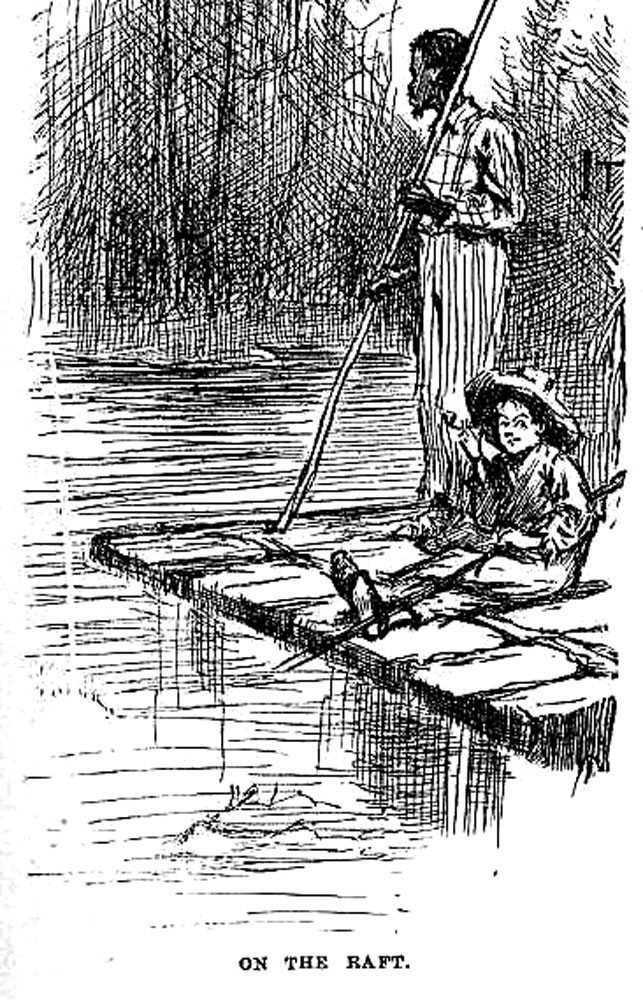
From the beginning of the novel, Huck is a childish boy. He goes on adventures with his friends and doesn't care about more important things in life. Towards the end of the book, Huck has matured into a young adult. However, some people feel otherwise. They think that Huck has really only been "temporarily" matured because as soon as Tom asks him to do something, Huck goes along. It shows you that Huck's time on the raft has only temporarily made him think differently, but has not really changed his old ways.
Huck has matured throughout the novel in the way he thinks about things. For instance when he says, "I knowed he was white inside" (p.94), says that Huck is appreciating Jim and doesn't see how a person like him could be black. Since Huck grew up surrounded by predominantly white people, he doesn't realize that...
More Mark Twain
essays:
Main Character Descriptions of Huckleberry Finn
... him back as his friend and only friend. Jim never in the story is shown as a bad character and he always shows and teaches friendship, and love. There are three characters in the book The Adventures of Huckleberry Finn that ... Huck takes the money from the King and Dike to give back to the Wilks girls ...
"The Critic" Twain, a severe critic of the general public and its cruel, inane conventions, ridicules religion, lower class, and upper class, in "The Adventures of Huckleberry Finn."
... upon to be "civilized" and "Christianized," but the dispute among them is, in reality, very uncivil and unchristian. (Twain, p.106) In conclusion, throughout "The Adventures of Huckleberry Finn," Twain's criticism reaches ...
Research Essay on The Adventures of Huckleberry Finn
... is Huckleberry Finn, and not Jim. Logically, to leave Jim on the raft, which represents freedom, would be safest. One cannot expect Mark Twain to leave his characters on the raft for the duration of the novel, and ...
Analyze the Author-Narrator relationship in Huckleberry Finn by Mark Twain and discuss how this affects the subsequent perception of the work by the reader
... of Huckleberry Finn, A case study in Critical Controversy (Pg ... As the Zurich scholar Bodmer puts it, "Something can appear untrue to reason which appears true to the imagination. Conversely, reason can accept something as true which appears unbelievable to ones ...
Theme of Freedom in Mark Twain's "Huckleberry Finn".
... by the society, while Tom is forced to live with Aunt Polly and face severe reformation. Many critics agree that The Adventures of Huckleberry Finn is a very controversial novel, and ...
A discussion of Mark Twain's anti-racist stance in Huck Finn and the novel's theme of freedom for all.
... Huckleberry Finn on the deeper level it is meant to be read on, more people would realize the true feelings Twain strives to reveal despite the seemingly racist dialog used throughout the novel. If all people could look past these controversial ...
Critical Book Review of The Adventures of Huckleberry Finn
... decides to let Jim go and Aunt Sally offers to adopt Huck, but he refuses. There are many issues in The Adventure of Huckleberry Finn. One is the issue ...
The Controls of Literacy/A look through Mark Twain's eyes on identity.
... traced back to the boyhood experiences of The Adventures of Huckleberry Finn. It could also be a metaphor detailing the experience of growing up and the many ...