Sonno joi, 'Restore the Emperor and expel the Barbarians,' was the battle cry that ushered in the
Showa Restoration in Japan during the 1930's.Footnote1 The Showa Restoration was a combination of
Japanese nationalism, Japanese expansionism, and Japanese militarism all carried out in the name of the
Showa Emperor, Hirohito. Unlike the Meiji Restoration, the Showa Restoration was not a resurrection of
the Emperor's powerFootnote2, instead it was aimed at restoring Japan's prestige. During the 1920's,
Japan appeared to be developing a democratic and peaceful government. It had a quasi-democratic
governmental body, the Diet,Footnote3 and voting rights were extended to all male citizens.Footnote4 Yet,
underneath this seemingly placid surface, lurked momentous problems that lead to the Showa Restoration.
The transition that Japan made from its parliamentary government of the 1920's to the Showa Restoration
and military dictatorship of the late 1930s was not a sudden transformation. Liberal forces were not
toppled by a coup overnight.
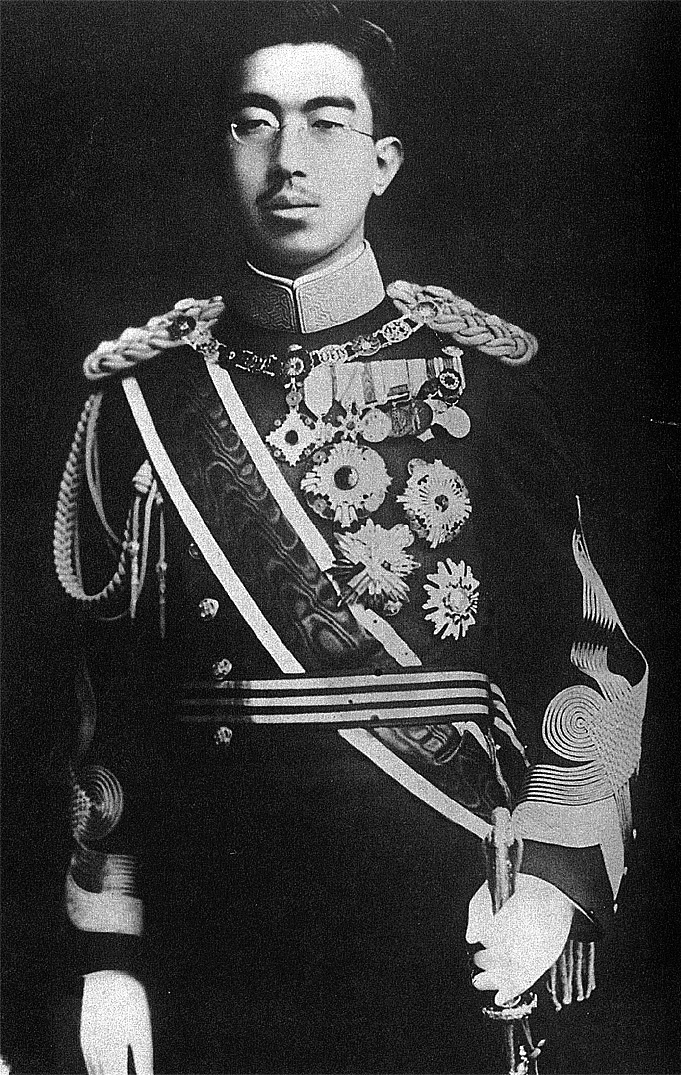 The Emperor Showa (a wartime photograph).
 English: The_New_fighting_the_Old_in_early_Meiji_J...
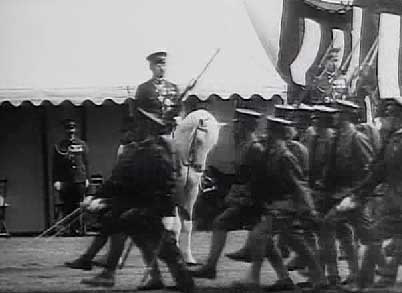 Soldiers parading before emperor Shōwa on imperia...
Instead, it was gradual, feed by a complex combination of internal and
external factors.
The history that links the constitutional settlement of 1889 to the Showa Restoration in the 1930s is
not an easy story to relate. The transformation in Japan's governmental structure involved; the historical
period between 1868 and 1912 that preceded the Showa Restoration. This period of democratic reforms
was an underlying cause of the militarist reaction that lead to the Showa Restoration. The transformation
was also feed by several immediate causes; such as, the downturn in the global economy in
1929Footnote5 and the invasion of Manchuria in 1931.Footnote6 It was the convergence of these
external, internal, underlying and immediate causes that lead to the military dictatorship in the 1930's.
The historical period before the Showa Restoration, 1868-1912, shaped the political climate in
which Japan could...