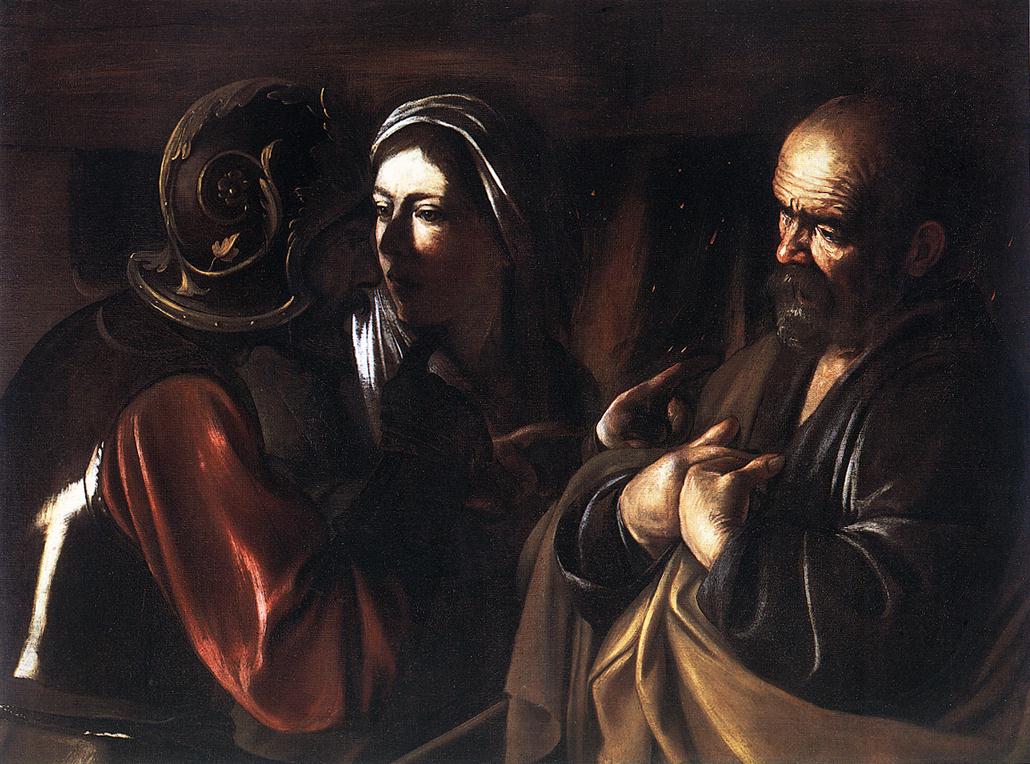
"The Denial of St. Peter" by Caravaggio
The elements most abundant in this piece are that of color, light and shadow, and space. These are the primary elements most apparent, though other elements are present in the painting as well. This particular piece is not so concerned with incorporating background into telling the story, as it is blurred and somewhat distorted. The concentration of the piece is directed to the figures presented in the painting and the story being depicted.
The use of light and shadow are what catches the viewer's eye first as the face of St. Peter and the woman are illuminated by what is said to be a fireplace in the background, though not in view. This effect gives the idea that these are the two most important figures in the painting and the story revolves around these two figures. The figure of the soldier seems to be relatively less important due to the fact that the apparent fireplace only illuminates the back of the armor of which he is wearing. The detail of the soldier's face is hidden in his own shadow and is only outlined by the reflective light from the face of the woman, further demonstrating his importance. The light aids in the telling of the story as one can see that the woman's eyes are facing the soldier while she points at St. Peter indicating that she is telling the soldier of St. Peter's misdoings. The light works to show the expression on St. Peter's face, as he appears to be defending himself against the accusation being made.
The use of color establishes the mood and represents the figures character. Collectively, the colors used are dark, seemingly representing mild silence or discreteness, or melancholy. This use of dark colors surrounds the three characters and incorporates the aforementioned emotions into the...
More Works of Art
essays:
Ancient Greek Paintings
... of light and shadow, and Parrhasios, noted for his skill at line and contours ... which concentrated on its novel subject matter rather than the artistry of its handling of light, that he removed the painting from ...
"Apollo and Daphne" painting
... into the painting. In "Apollo and Daphne" the proportions seem to be correct and there is realistic texture in the clothing and hair. The lights and shadows are also ... that he would catch her. Eventually he caught up to her and as we can see in the painting he held on to her waist. At this point she ...
Gothic Architecture and sculpture: An in depth analysis of the gothic style from the early archaeic period up to the flamboyant
... sculpture also developed an increasing awareness of the contrast between light and shadow, utilizing deep recesses and high ridges for emphasis. Strong S-curves, richly flowing draperies ...
Analysis of painting "Guernica" by Picasso and The "Third of May" by Goya
... sad and gloomy, and a palace looks lifeless and has lost all its grandeur. The only illumination in the painting comes from a lantern at the feet of the soldiers. Initial ... is representational and has asymmetrical balance. The visual elements are used very efficiently in respect to lines and colour. ...
This essay compares two works of art by the artist Louise Nevelson.
... surface and uniform coloration focus the viewer on the play of light and shadow, also suggest the solemnity and grandeur of altar paintings. In ...
Peter Paul Rubens
... contrasts, and vivid clashes of light and shadow. Baroque art often appeals directly to the emotions, exemplified by Peter Paul Rubens masterful painting The ...
Anthony van Dyck: Mother of Sorrows
... style with the use of strong emotional expression, lush colors, and great contrast of light and shadow in this piece. This tranquil, yet emotionally evoking, piece reveals ...
The art of Italy and Northern Europe from 1300 to
... frescoes were done in the Brancacci Chapel of the Church of Santa Maria del Carmine. Massicio mastered many techniques, like use of light and shadows. In Expulsion from the Garden, light crosses the painting diagonally from the right. By having Adam ...