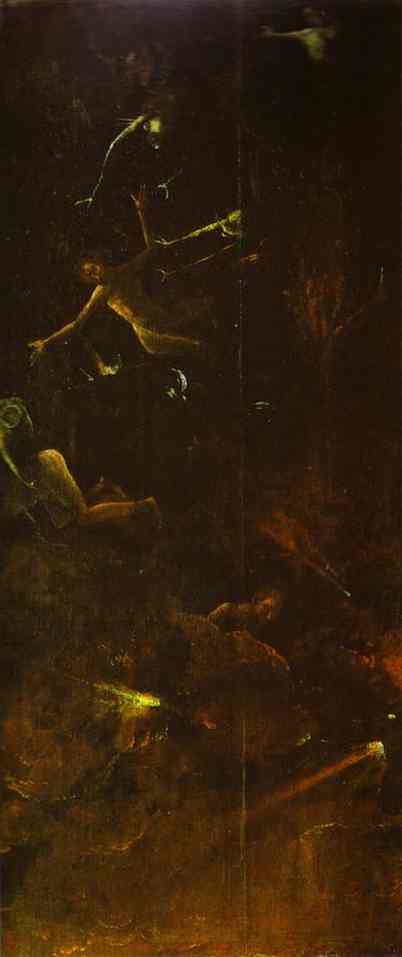
Depictions of death: Beautiful and Heroic. "Laocoon and His Two Sons" by Hagesandros vs. "Fall of the Damned" by Peter Paul Rubens
In this paper I will compare and contrast two pieces of art work that are religious in nature. Through these pieces, I will show a theme of depicting death as heroic and beautiful, though painful and horrific.
The first piece that I selected is a marble statue made in Hellenistic Greece (323-31 BCE.). It was sculpted by Hagesandros, Polydoros, and Athenodoros and is titled "Laocoon and His Two Sons." The second piece is an oil painting on wood panel made during the Baroque time era (1590-1750 CE.). It was painted by Peter Paul Rubens and is titled "Fall of the Damned."
The sculpture of Laocoon is from the tales of Homer. It deals with the Trojan War and, in particular, the fabled Trojan Horse. Laocoon was a Trojan hero and a priest. Upon seeing the Trojan Horse, he told the Trojans not to accept "the gift" from their enemies, the Greeks. The Trojans did not heed his warning and accepted the Horse. That evening, the Greeks came out of a secret door and slew the Trojans. Laocoon attempted to flee Troy with his sons. He was attacked and killed by sea serpents, sent by Poseidon, before the walls of Troy. This sculpture is a depiction of that moment.
Though this piece is mythological in nature, it does not serve a religious purpose. It was probably created for the rich to own and enjoy for their own pleasures. Many pieces similar to this (late Hellenistic style) were placed in gardens or transported to Rome. It has also been said that this piece was possibly created for the Roman Emperor Tiberious.
I feel that this piece is a fantastic image from the Hellenistic era. It contains many Hellenistic traits: detailed hair, deep set eyes, not in religious context, and does not represent...
More Art Essays
essays:
A Battle of Mythical Proportion Paiting: The Horrors of War By: Peter Paul Ruben
... conflict. Peter Paul Rubens' oil on canvas piece "The Horrors of War" was completed in 1638 in Florence, Italy. Rubens uses allegory to convey to his audience the effects of war. Greek mythological figures struggle, grasp, and fall ...
Sight by Jan Brueghel and Peter Paul Rubens
... famous work, Sight, an extraordinary oil painting created by Jan Brueghel and Peter Paul Rubens in 1618. Considered among the most complex, compromising allegorical pieces, Sight is painted with great accuracy and detail ...
Peter Paul Rubens
... color contrasts, and vivid clashes of light and shadow. Baroque art often appeals directly to the emotions, exemplified by Peter Paul Rubens masterful ... by Peter Paul Rubens. The work is oil on panel and measures 45 x 40 and 3/8 in. The work is ...
Peter Paul Rubens: Analysis of Venus & Adonis
... Venus and Adonis further suggests Adonis' struggle. This strong contrast between light and dark values is also a distinguishable trait of Baroque art. Peter Paul Rubens was ...
How a work of art appears in person rather then as a computer reproduction.
... the Greek and Roman Art corridor of the museum, I saw a life size marble statue of a boy with his hands tying something around his head. I approached the work of art, which ...
Laocoon and His Sons. This is an informational report on the art piece that gives basic facts and details about the piece.
... the Trojan horse (Lahanas). This enraged the goddess Athena, who sided with the Greeks for this particular war. She and Poseidon therefore sent serpents to strangle and kill Laocoon and his sons while ...
The Dynamic from Conceptions to Experiences in Early Art and the Characterization of Greek Art in the Classical Era.
... stark contrast to the emotionalism of their enemies. This attitude of intellectual and emotional superiority is especially evident in the metopes of the Parthenon. Each side shows the Greeks battling a different group of barbarians- amazons, giants, centaurs, and Trojans; all ...
Compare and contrast two works of Art
... media and size, location and literal qualities, social, cultural and political issues surrounding the creation of the Artworks but in the form of compare and contrast. I ...