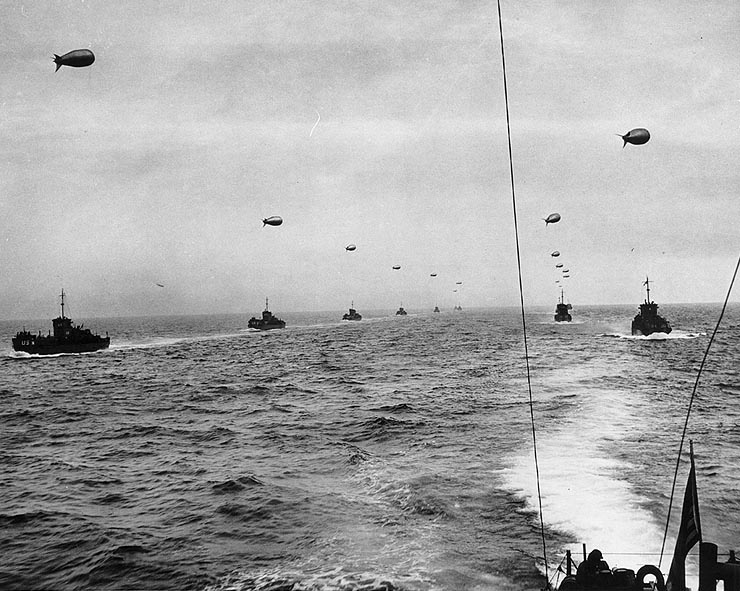
An in depth study of the Normandy Invasion.
The Normandy Invasion
World War II was in full swing, but the end was drawing near. On the sixth day of June 1944, the American forces stormed the coast of Normandy in northern France. To fully understand the Normandy invasion one must know about the buildup, the invasion, and the effects.
Hitler's Third Reich had reached its greatest extent. The allies pondered ways of turning the tide. It was midsummer of 1943, one year before the Normandy invasion and the liberation of Western Europe, which Hitler's forces still occupied (Normandy 1944). Russian counteroffensives at Stalingrad and Kursk held back Hitler's perimeter. Although the American war economy had begun to overshadow Germany's, the Nazi war economy outmatched both that of Great Britain's and the Soviet Union (Normandy 1944). Joseph Stalin, the Soviet leader, pressed his allies, U.S. president Franklin D. Roosevelt and British Prime Minister Winston Churchill to mount a "second front". The American army was still forming and the landing craft necessary to take an army across the English Channel had not yet been built. On December 11, 1941, Hitler declared war on the United States. George C. Marshall, Roosevelt's chief of staff, appointed Dwight D. Eisenhower to the U.S. war plans division and commissioned him to design an operational scheme for an allied victory (Normandy Invasion 456). Two proposals Eisenhower formed were Operations Roundup and Sledgehammer (Normandy 1944). Although both plans were presented to the British, Operation Roundup was adopted. A series of conferences were held in Washington and London in June and July. The allies threw out Operation Sledgehammer and persuaded the Americans to agree to a North American landing codenamed Operation Torch. Operations in Sicily and on the Italian mainland delayed allied preparations through 1943 (Normandy 1944). At the last conference, Roosevelt and Stalin combined against Churchill...
More World War II
essays:
Differences Betwen Franklin D Roosevelt And Hitle
... 1 Franklin D. Roosevelt and Hitler were different in many ways. They were both leaders in WWII, Hitler of Germany, and FDR the U.S. Hitler’s fight for communism and Roosevelt’s for democracy led the countries ...
Assess the significance of the Battle of Britain in turning the tide of war against Germany in the period to the end of 1942
... a British success - a Western defeat of the Germans, which would become what Churchill, saw as 'turning the tide in the war against Germany'. In 1942 the Allies were predominant in the Mediterranean ... to Nazi-Soviet pact). In a series of fast moving offensives the German forces broke ...
Winston Churchill
... Soviet Union). Churchill made sure to have great relations with the United States during this time, for he was sure that eventually the U.S. would enter World War II on their side. His close ties with President Franklin Delano Roosevelt ...
Marketplace at Yalta
... armed forces for the purpose of liberating China from the Japanese yoke. Signed: Joseph Stalin Franklin d. Roosevelt Winston S. Churchill February ...
What if? Counter-factual history is very crucial to our understanding of the nature of history. What if Henry Agard Wallace was not dropped from the ticket in 1944? What would have happened?
... 1933, Franklin D. Roosevelt appointed Wallace to secretary of agriculture. Wallace carried out the "New Deal" policy by providing assistance to farmers. In 1940, despite Wallace's unpopularity among the Democratic House, Roosevelt choose Wallace for his vice-president running ...
This essay is about hitlers rise to power in 1933 and why he was able to become as powerfull as he did.
... Versailles was made up of three Politicians: - 1. Woodrow Wilson - the American President - 2. David Lloyd George - the British Prime Minister - 3. Georges Clemenceau - the French Prime Minister - These three Politicians had there own separate ideas about what ...
What is appeasement policy? Give an example to illustrate the appeasement policy between Britain and France.
... of Nazi Germany demanded for Sudetenland. After knowing the German's demand for Sudetenland, the British Prime Minister Neville Chamberlain arranged the Munich Conference in order to avoid a general war. The Munich ...
Nazi Influence in World War II
... neutralizing the Soviet Union with the promise of dividing Poland, Germany attacked Poland in September 1939. Poland was quickly overpowered, and their allies, the British and French, who had declared war on Germany, did nothing to help. Hitler's forces moved ...