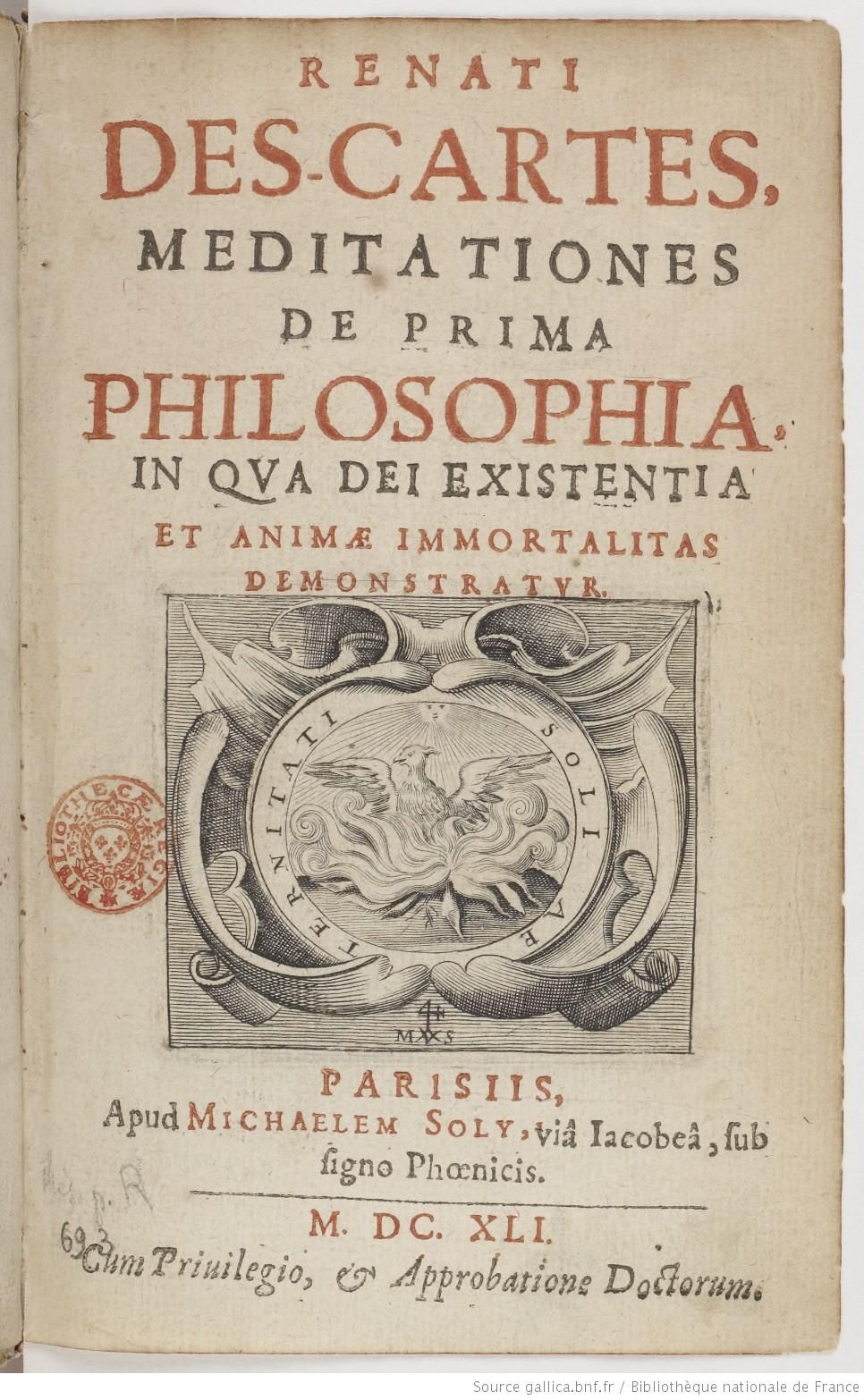
Descartes - Mind and Body.
Descartes overall objective in the Meditations is to question knowledge. To explore such issues as the existence of God and the separation of mind and body, it was important for him to distinguish what we can know as truth. He believed that reason as opposed to experience was the source for discovering what is of absolute certainty. The first meditation acts as a foundation for all those that follow. Here Descartes discerns between mere opinion and strict absolute certainty. To make this consideration he establishes that he must first "attack those principles which supported everything I once believed." He first examines those beliefs that require our senses. He questions, whether our senses are true indicators of what they represent. By inspecting our sometimes firm belief in the reality of dreams, he comes to the conclusion that our senses are prone to error and thereby cannot reliably distinguish between certainty and falsity. To examine those ideas that have "objective reality," Descartes makes the improbable hypothesis of "an evil genius, as clever and deceitful as he is powerful, who has directed his entire effort to misleading me." By proposing this solution he is able to suspend his judgment and maintain that all his former beliefs are false. By using doubt as his tool, Descartes is now ready to build his following proofs with certainty. In Meditation two, Descartes embarks on his journey of truth. Attempting to affirm the idea that God must exist as a fabricator for his ideas, he stumbles on his first validity: the notion that he exists. He ascertains that if he can both persuade himself of something, and likewise be deceived of something, then surely he must exist. This self validating statement is known as the Cogito Argument. Simply put it implies whatever thinks exists. Having established this,
More Modern Philosophy
essays:
Descartes' Fifth Meditation This essay provides insight into Descartes' Fifth Meditation and the existence of God
... Fifth Meditation, Descartes' attempts to once again prove the existence of God. He comes up with a number of examples that relate aspects from the material world in order to further his belief that God really ...
Thoughts on the 3rd Meditation and the argument for the existence of God
... the existence of other things, but he cannot doubt the existence of God due to God being an infinite objective reality. Since Descartes has concluded that God does exist, Descartes then questions how ...
Essays on Suicide and the Immortality of the Soul: The Complete 1783 Edition David Hume
... state of existence, which no one ever saw, and which no way resembles any that ever was seen? Who will repose such trust in any pretended philosophy as to admit upon its testimony the reality of so ...
Prove It I dare YOU´. Personal essay on belif in God's existence
... have meditated during these past few days were true, the existence of God has some degree of certainty as to truths in mathematics. Renè Descartes, Meditation 5 ...
Disproving Descart's Existence of God.
... the existence of God) question the validity of Descartes' reasoning. Even those who do believe that God exists can find weaknesses in Descartes' arguments and often do not base their belief in God on Descartes' "Meditation on ...
The Biography of Rene Descartes
... First Meditation, Descartes begins by doubting all that is questionable at three distinct levels: perceptual illusions, the dream problem, and a deceiving God. He calls into questioning anything "proven" by the senses and the existence of a ...
Got a B+, but the teacher was a very yough grader. Paper on Descartes.
... ideas of objective reality he determines the existence of God is at least as certain as anything else's existence. According to Descartes, the existence of God is ...
Rene Descartes and a discription of his dream and evil demon conjectures, method of doubt, and clear and distinct testing. Also, the bad and good of his theory (opinion).
... are true because God exits. (Loeb 200-235) This type of reasoning doesn't make any concrete conclusions on the existence of God. It just keeps going around in a circle, one right after the other. Descartes believe ...