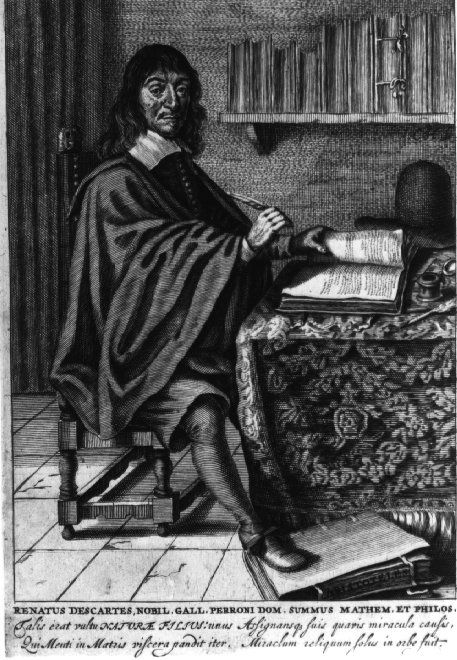
Descartes' Optics
Descartes' begins this passage by discussing the experience of walking with a stick, and using that stick to explore the sensations or shapes caused by objects that it touches. This is the beginning of a questioning of what one can know. Descartes recognizes that a normal man with sight might not be able to use the stick with great proficiency, but he then brings a blind man into the discussion and notices that a blind man with a stick almost seems to see with his hands. He calls that stick an "organ" or a "sixth sense" that the blind man seems to possess. Descartes then goes on to call into question one's ability to fully understand the things which our eyes see. In this discussion of optics, Descartes draws a comparison between a blind man's abilities to understand the shape and sensations of objects, and our ability to understand an object's color with our sight. This raises the question of our senses' ability to interpret the world around us with accuracy.
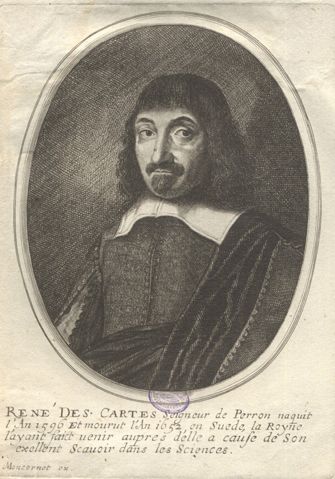
Descartes notices that a blind man seems to be able to understand the sensations or shapes of an object with a stick. He claims that a person without "long practice with it," might have difficulty feeling the objects out correctly. However, a blind man with much practice can almost experience the world through that stick, because he has adapted to the point where that stick almost serves as his eyes. It seems to Descartes that the stick is "some sixth sense given to [him] in place of sight." Descartes then draws a comparison between the blind man with a stick feeling an object and a person viewing an object through their eyes, particularly their ability to see color. Descartes first states that from this observation of the blind man...
More Modern Philosophy
essays:
Descartes' Meditations
... down the stick, you would be able to feel that the stick is in fact straight. Some argue that Descartes is not creating a paradox in the second verification via the sense of touch. He is not relying again on another ...
Descartes: Imagination
... on to at least part of Aristotle's notion of imagination. In Treatise on Man, Descartes explicitly locates both the "sensus communis" and the imagination on the surface of the pineal gland, upon which images both of sense and ...
Why does Berkeley consider himself the defender of common sense? Do you agree with this self-assessment?
... counter to common sense claim four). The philosophical view also draws a distinction between primary qualities (such as size, motion, and shape) and ... common man believes that he can trust his senses because he believes that sensation gives him direct access to the ...
Descarte's Meditation one
... an optical illusion, they are seeing something that is not really there, and therefore are being deceived by their sense of sight. But this is not enough to justify doubting all things, so Descartes offers ... that is not touched by the argument. The Evil Genius argument allows Descartes to logically ...
THE DUALIST DILEMMA. This essay is a critique of substance dualism, an ontology embodied by the likes of Rene Descartes. Specifically, the essay attacks several of Descartes own dualist principles.
... body to be separated. Integral to this claim by Descartes is his thought that difference exists between "the imagination and pure intellection," which he illustrates by reflecting on the properties of triangles versus the shapes of ... order to fully understand its link to dualism ...
Descartes' Dream Argument.
... state, Descartes believes they will be able to understand what he has to say more easily. In an effort to make his reader question his or her senses, Descartes brings ...
Interpretation and Summary of Descartes' 1st and 2 Meditations from "Meditations on First Philosophy".
... doubts, understands, affirms, denies, wills, refuses, and that also imagines and senses" (20). I, or self then cannot be proven to be anything more than just that, a thinking thing. Descartes has ...
Can Descartes' God be a deceiver?
... being to understand or acknowledge the intent behind the deception. Although this viewpoint is certainly that can not be fully rejected, it can also not be fully confirmed. So one must ask what else Descartes' God ...