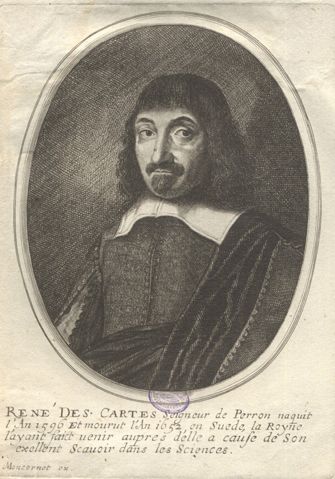
Descartes Programme of Doubt.
When studying the work of anybody I feel that it is necessary not only to have an understanding of the work they produce, but to fully comprehend we must also know what inspired them or encouraged them to undertake the challenges they did. In the case of Rene Descartes this point in my opinion, can not be understated. The environment, in which he lived and worked, had an enormous impact on his thought and that of his contemporaries. I feel therefore it is essential to begin this assignment by mentioning briefly some of the factors, which influenced his thinking.
Descartes was born in France in 1598. He lived and worked in a rapidly changing and turbulent world. France at this time was a country divided on religious grounds. Sectarian violence often occurred between the Huguenot and Catholic populations of the country. (1) Europe generally was in conflict. New ideas were coming to the fore at an alarming rate for some. The ideas of Aristotle concerning the natural world were challenged by the scientific community of the time. Men such as Copernicus, Kepler, Brahe and Galileo proposed new theories in the fields of science and mathematics. (2) Descartes himself broke conclusively with the Aristolian and Scholasticism of his time. The beliefs and ideas he proposed have had an enormous impact on philosophy from his day right to the present. For that reason he is often referred to as the "father of modern philosophy." (3)
At the beginning of Descartes career, education was based on the humanities and the use Aristotelian philosophy was almost exclusive. Descartes saw Aristotelian thought as very vague and inconclusive. On any given subject, you can have a multitude of possible opinions, all of which could be debated in favour of there truth. Descartes detested this uncertainty. For...
Reviews of: "Descartes Programme of Doubt."
:
More Modern Philosophy
essays:
Rene Descartes and a discription of his dream and evil demon conjectures, method of doubt, and clear and distinct testing. Also, the bad and good of his theory (opinion).
... Rene Descartes (1596-1650) was not only a philosopher but also a mathematician and scientist. As a philosopher, he used skepticism as a ... physical world I experience, truly exists. Also, if God did exists, and if God is perfect, as Descartes claims, then why does Atheism and such religious beliefs ...
The Biography of Rene Descartes
... even Aristotle. There is a problem with Descartes' reasoning of the existence of God. "Since Descartes will ... It discusses the universal method and its consequences. In The World (1634), he expresses his heliocentric views of the earth, but ...
The Use of Doubt and Skepticism by Descartes in Order to Defeat Doubt and Skepticism
... true. He could then build on the foundation of certainty. Descartes believed that first, one must not accept anything unless it is clear and distinct. He believed that next one should divide the problem into as many parts are necessary to ...
Existence of God. A look at Rene Descartes' theory
... have tried to answer this question, we shall look upon Rene Descartes' theory on the existence of God. In terms of believers ... perfect. From these premises, I believe that we have the grounds to speculate that the perceptions based on his finite faculties ...
Descartes proof of God. This examines Descartes' argument for the existence of God.
... deduces a rule--that the things that he sees as very clear and very distinct are all true. Descartes starts his proof by dividing "thought" into four categories--ideas (concepts), volitions (choices), emotions (desires), and judgments (beliefs). He then breaks down ...
Interpretation and Summary of Descartes' 1st and 2 Meditations from "Meditations on First Philosophy".
... the world. In the First Meditations of Rene Descartes Meditations ... the ground and begin again from the original foundations, if I wanted to establish anything firm and lasting in the sciences" (13). Descartes divides the ...
Title: Mind and Body: An interpretation on the works of Rene Descartes and Benedictus de Spinoza -Talks about "Dualism" and "Double Aspect Theory"
... . We as humans have a difficult time comprehending such an abstract idea as the mind, therefore making it even more difficult to put this view in perspective. Two philosophers who argue over this topic are Rene Descartes and Benedictus de Spinoza ...
Descartes philosophy of 'How much We Know'. How can you be sure as Descartes wanted to be about what you know?
... Descartes mentioned that all the knowledge he gained was false, and that's why he ignored it. Although, we do have a freedom of speech in our country ...
Well done
This was a good essay and some arguments and the way you presented them was very helpful and nice done. Overall it was a really good analytical summary and I enjoyed it very much.
1 out of 1 people found this comment useful.