How Did The Transcontinental Railroad Affect Western Expansion In The United States?
Thesis: The transcontinental railroad greatly increased Westward
expansion in the United States of America during the latter half
of the nineteenth century.
The history of the United States has been influenced by
England in many ways. In the second half of the 1800's, the
railroad, which was invented in England, had a major effect on
Western expansion in the United States.
'Railroads were born in England, a country with dense
populations, short distances between cities, and large
financial resources. In America there were different
circumstances, a sparse population in a huge country, large
stretches between cities, and only the smallest amounts of
money.' ('Railroad' 85)
The first American railroads started in the 1830's from the
Atlantic ports of Boston, New York City, Philadelphia,
Wilmington, Charleston, and Savannah (Douglas 23). Within twenty
years, four rail lines had crossed the Alleghenies to reach their
goal on `Western Waters' of the Great Lakes or the tributaries of
the Mississippi. Meanwhile, other lines had started West of the
Appalachian mountains, and by the mid-1850's Chicago, St. Louis,
and Memphis were connected to the East. Still other lines were
stretching Westward, beyond the Mississippi. An international
route connected New England and Montreal and another one crossed
Southern Ontario between Niagara, New York, and the Detroit
River.
During the 1850's, North and South routes were developed
both East and West of the Alleghenies. It was not until after
the Civil War, however, that a permanent railroad bridge was
constructed across the Ohio River. After the Civil War, the pace
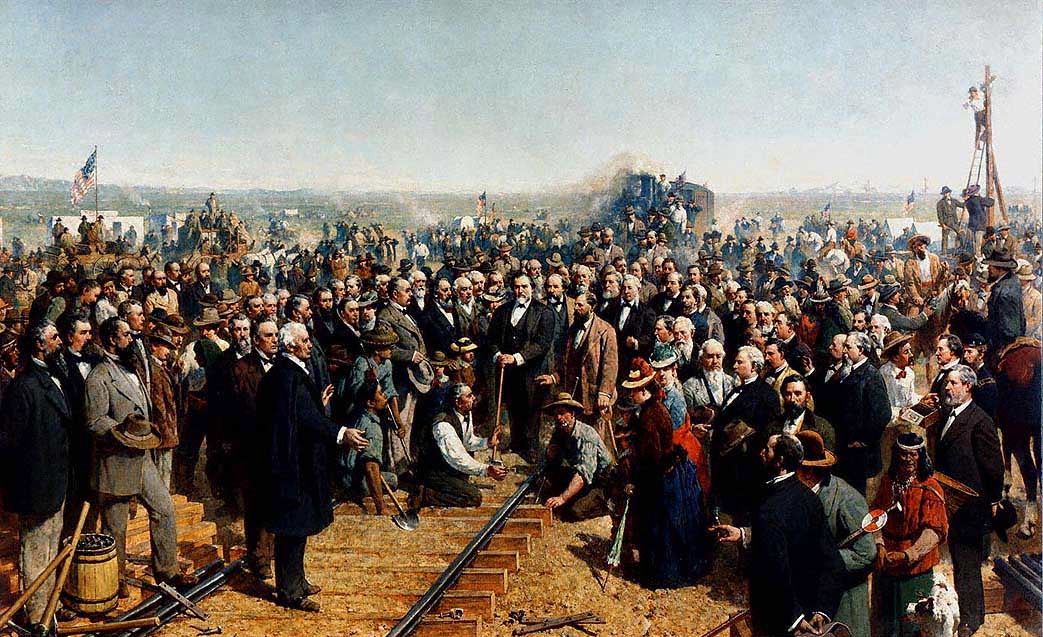
of railroad building increased. The Pacific railroads, the Union
Pacific building from Omaha, Nebraska, and the Central Pacific
building from Sacramento, California, had started to build a
transcontinental railroad during the war to help promote national
unity. They were joined at Promontory, Utah, on May 10, 1869,
More North American History
essays:
How the Dred Scott Decision was one of the Direct Causes of the Civil War.
... in the Civil War. Resources Used: 1. American Passages: A History of the United States , 2nd ... but the entire population of black Americans would not be recognized under the Constitution as people, or citizens with rights, no matter where they live in the United States. The other ...
This is on the period of jacksonian democracy and how they saw themselves as the guardians of the United States Constitution, political democracy, and individual liberty.
... for the people, only a select few may have seen that. During the Jacksonian reign, numerous advancements sped up the growth of the United States. A ...
Causes Of The American Civil War
... Reconstruction. Boston: Routledge, 1953. Book contains useful and authentic background, especially in the beginning chapters. Rhodes, James F. History of the United States from the Compromise of 1850. New York: Abrams ...
Were 1920's America an era of social and cultural rebellion or was it the result of mere exaggeration of the press?
... discuss the finances and the economical situation of the United States during a time that had proceeded World War I. At this time the United States had ...
"U.S. Immigration - 1875-1910" On Immigration into the U.S. and the Measures the U.S. took to limit immigration. One main focus is Chinese Immigration to the U.S.
... regardless of their drive, people have immigrated here since the beginning of the history of the United States and still continue to. Americans encouraged relatively free and open immigration during the eighteenth and early nineteenth centuries, and ...
The Significance of Prohibition on the Development of the American Mafia
... Constitution of the United States: 18th Amendment." 1994-2001 20 Oct. 2002 . Danzer, Gerald A., Ph.D., et al. The Americans. Evanston: McDougal Littell, 2000. GangRule: The History of Organized ...
Reasons the Articles of Confederation led to the ratification of the Constitution: Why did the Articles fail? Did the constitution solve the problems?
... for America to move forward and exist as we know it today. Works Cited and Resources Used: 1. American Passages: A History of the United States , 2nd ...
The Crisis Of The Union
... piece of legislation in the history of the United States produced so many immediate, threatening changes. The conflict over slavery in Kansas turned into violence, and the term ...