Difference Bonobo and Chimpanzee Essay
Aggressive behavior is typical of most primates. Gorillas, humans and chimpanzees kill members of their own species. The need for social and physical contact is also characteristic of most primates. Species that live in groups need to reconcile aggression. Social groups require some form of conflict resolution. Sexual behavior is one such mechanism to overwhelm aggression.
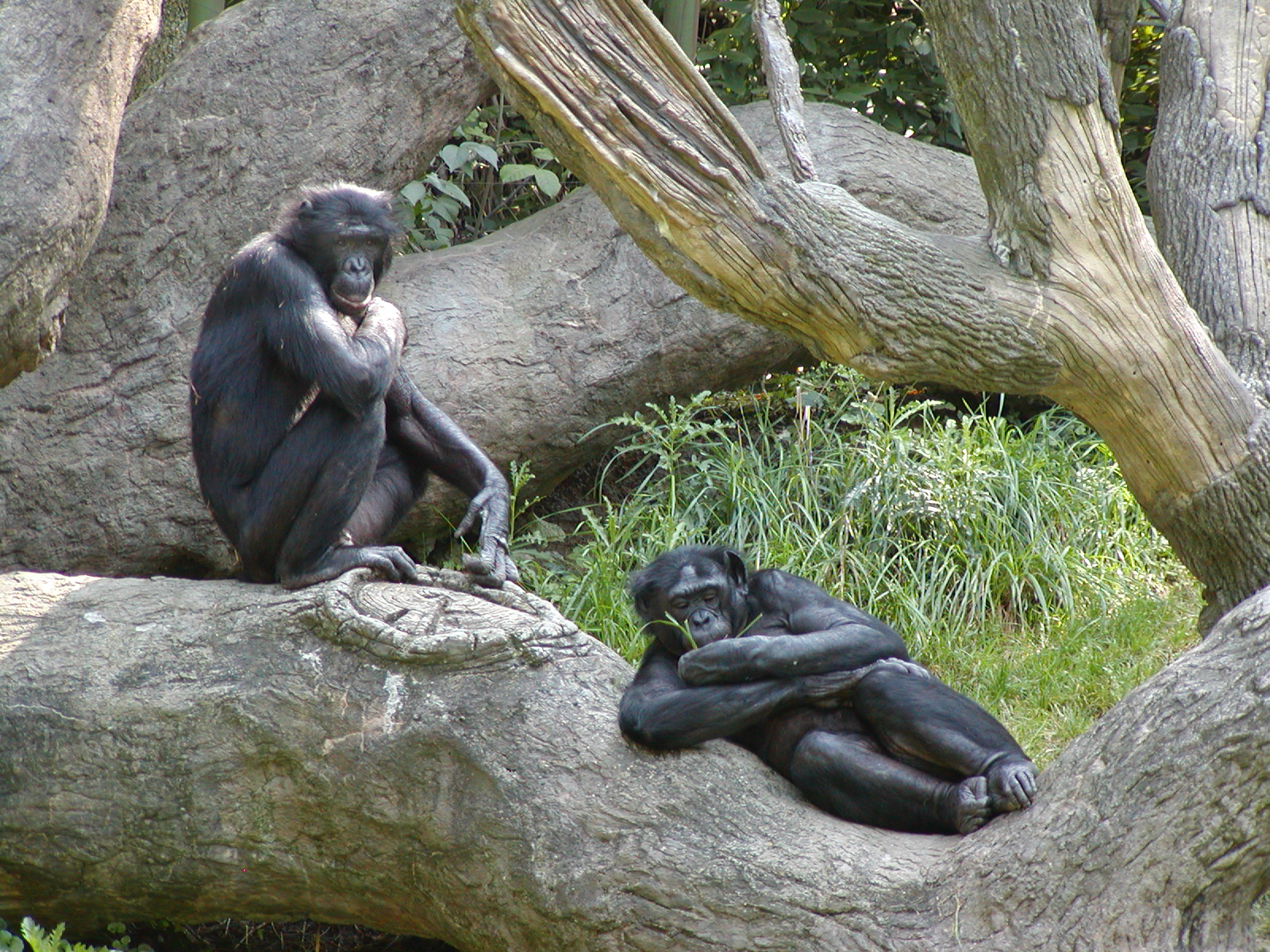
Bonobo sex life is divorced from reproduction and also serves the functions of pleasure and conflict resolution. Females are in a sexually attractively state most of the time, and almost continuously sexually active. Sexual activity is very frequent. Males, females and juveniles all engage in erotic activity. Age and gender are not sexual boundaries among the Bonobo. A typical sexual pattern is genital rubbing between adult females. Erotic contacts in bonobos includes oral sex, genital massage and intense tongue-kissing.
Whereas in most other species sexual behavior is a fairly distinct category, in the Bonobo it is part and parcel of social relations. Sex seems to cement Bonobo bonds. Females use sex to form alliances against males. Consequently males do not dominate females or coerce them sexually. Bonobo culture is female-centered, egalitarian and substitutes sex for aggression.

Bonobos live in groups of 50 to 120 animals. Bonobo society appears to be female-dominated. Male status is linked to that of his mother. Older females occupy the highest rank. The strongest social bonds are between females. Raising offspring is an exclusively female activity. In Bonobo society sexual excitement and aggression rates are higher at feeding times. Dominant males may delay sharing food with females who are not sexually disposed. Cofeeding takes place between intimates. Among Bonobos embracing, friendly touching and sexual contact rates jump after an aggressive incident. According to zoologist Frans de Waal, "The majority of mounts and mating occur in tense situations." "(C)onflict resolution is...
More Zoology
essays:
Homology and Analogy Essay: Animal Form and Function - Examples of Analogy and Homology of Morphological and Behavioural traits.
... separate groups (http://en.wikipedia.org, http://evolution.berkeley.edu/evolibrary/article/0_0_0/similarity_hs_07). Primates and Xenarthrans Primates e ... species to adapt to different environmental conditions and modes of life. By descent with modification species adapt to new environments by ...
Acting Fishy: Evolutionary Perspectives On Fish Behavior
... territory boundaries (Love, Cailliet 1979). Aggressive behavior was ...
The classification of Ophidia Serpentes. A classification essay on snakes. The essay mostly places them into 2 categories, venomous and nonvenomous
... aggressive than non-venomous snakes, and almost every venomous snake has a warning sign to ward off innocent creatures that may accidentally come in direct contact ... the world, and they can be separated into several different categories by; location, coloring, size, method of birth, and the way ...
The Killer Whale. taxonomy, ecology, evolutionary history, reproduction, distribution, morphological characteristics, behavioral characteristics, and conservation.
... The distinct eating behavior finds killer whales tossing around their prey as a sort of pre-meal game, effectively terrorizing the life out ... away (2). REPRODUCTIVE CHARACTERISTICS AND CARE OF YOUNG Females become sexually mature when they become 15-16 feet in length which ...
Orangutans
... even aggressive towards females and infants. Male orangutans' participation in social groups is limited to sexual 'consortship ... a tree made of boughs. Like the other great apes (chimpanzees and gorillas), orangutans are highly intelligent. Tests have indicated that their intelligence ...
This essays describes the life of a tiger. Very detailed explanation of physical characteristics, life style, habitat, and current statistics on the endangered species.
... will atrophy. Instincts will soften and blur. Neuroses and atypical behavior caused by boredom will multiply. The king will still be ... primarily solitary hunters. In order to operate efficiently as a group, tigers would either have to begin killing larger prey, or ...
Odonota: The Dragonfly. taxonomy, evolutionary history, ecology, distribution, morphological characteristics, behavioral characteristics, reproduction, and conservation.
... groups are that mayflies do not have a labium and they hold their wings straight up at rest like a damselfly. Mayflies also have caudal filaments which are tails at the end of the abdomen that help movement. Interesting behavioral ...
Predator/Prey relationships. In depth view of predator prey relationships. Covers mutualism, defense mechanisms, and coevolution.
... place between members of the same species. Many animals exhibit group behavior; worker bees serve the queen bee and wolves follow an ... and Therese A. Markow. 1995. Effect of Ectoparasitic Mites on Sexual Selection in a Sonoran Desert Fruit Fly. Evolution, 49: 660 ...