How different concentrations of acid affects the growth of the crest seed.
Key Stage 3 Science Investigation.
Aim: The aim is to find out the relationship between the concentration of acid and how it affects the growth of the crest seed.
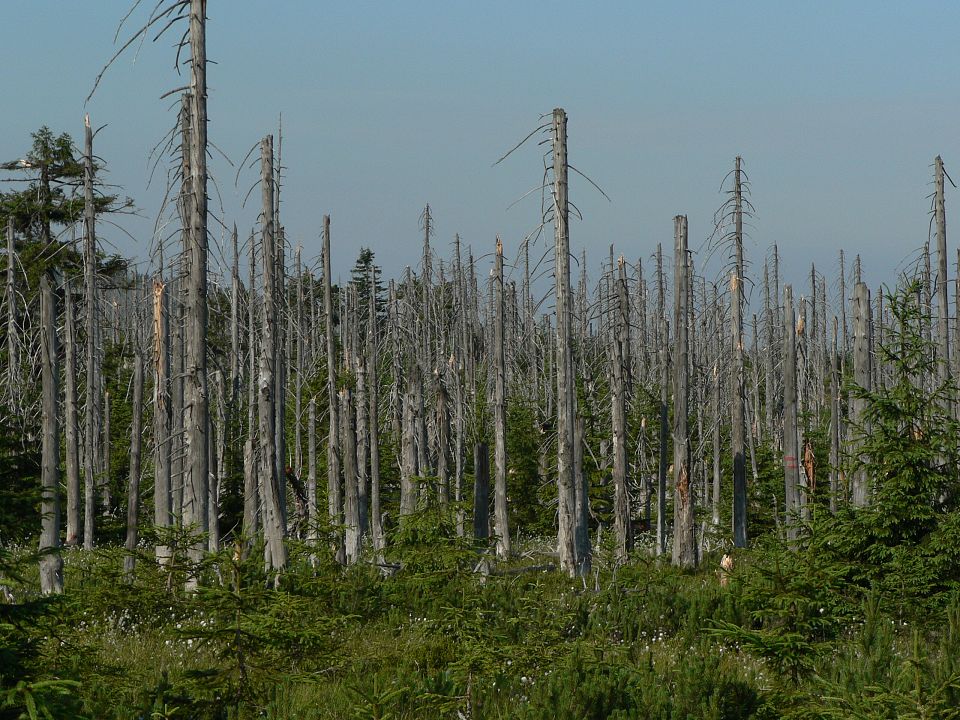
Theory: During the pollution topic, in acid rain, I found out that acid rain contains Sulphur Dioxide. This gas can kill plants. Acid rain can be caused by the burning of fossil fuels. The smoke from factories are carried into the air. It forms when oxides of Sulphur and Nitrogen combine with moisture in the atmosphere. These may be carried long distances before they are deposited by rain. Acid rain can cause a lot of damage. Many structures can be eroded, crops and trees can be killed and lakes can become lifeless. Plants are also damaged. The different concentrations of Sulphur can affect the surroundings and environment.
Variables: During the investigation there could be many variables. Some include the concentration of the acid. Also the room temperature could be a variable. Others include the amount of light and the soil.
During my test the variable I investigated was the concentration of the Sulphuric acid.
We had one tube, which contained water. The others contained a 0.025m, a 0.1m and a 1m concentration of acid. This was the variable.
Prediction: Using my theory I can predict that the crest seed in the water will grow the best. I also know the Sulphuric acid will affect the growth of the plants. This makes me think that the higher concentration of acid will not allow the crest seeds to germinate. My own theory is the lower the concentration of acid, the better the seeds will germinate.
Plan: During the investigation I worked in a group of 5. First we collected the equipment for the investigation. Then we collected the different concentrations of acid. We...
More Chemistry
essays:
GCSE Science Coursework - Investigating the factors that affect the reaction between sodiumthiosulphate and hydrochloric acid
... the factors that affect the reaction between sodiumthiosulphate and hydrochloric acid Aim: To investigate the differences in rate of reaction between sodiumthiosulphate and hydrochloric acid as the concentration of sodiumthiosulphate is either raised or lowered while keeping the total volume ...
The Greenhouse Effect
... the burning of fossil fuels such as coal, oil, and natural gas, carbon dioxide is increasing thus increasing the amplitude of the ... surface temperature of the earth would be about 59 Fahrenheit degrees lower than it is today. 'Long before civilization intervened , the thin blanket of gases ...
Reaction (rate) between magnesium ribbon and hydrochloric acid
... many variables that I can change, which are the temperature and concentration of the hydrochloric acid, and the mass and the surface area of the ... rate of reaction changes. I could also change the acid reactant to sulphuric acid or phosphoric acid to ...
Fossil Fuels
... us into the whole economy issue. If we run out of fossil fuels what will happen to the economy? Will it suffer? These ...
Catalase Lab Report
... and acidity will be held constant at a pH of 7. When acidity is the independent variable, temperature will be held constant at 22°C, and concentration will ... Examples of human errors could be not catching all the air bubbles, waiting too long or not long enough ...
Photochemical Smog
... occurrence of industrial smog. However, the burning of fossil fuels like gasoline can create another atmospheric pollution problem known as photochemical smog. Photochemical smog is a condition that develops when primary pollutants (oxides of nitrogen and ...
How concentration of acid affects the rate of reaction with magnesium ribbon.
... cm of Magnesium ribbon. 5. Take a temperature reading of the acid and then take a reading of the room temperature using ... the concentration get lower the more seconds it takes for the magnesium to dissolve. I did the temperature in 4 stages; only ...
An investigation into the factors affecting the rate of a reaction: The write up of an experiment using Sodium Thiosulphate and hydrochloric acid
... hydrochloric acid -->; sodium chloride + sulphur + sulphur dioxide+ Water Na2S2O3(aq) + 2HCl(aq) -> 2NaCl(aq) + S(s) + SO2(g) + H2O(l) I plan to change the concentration of the ... exact room temperature as it was outside of my control and without further experimentation into changes of temperature I ...