A Discussion on the Abundance of Osmolytes.
Discussion.
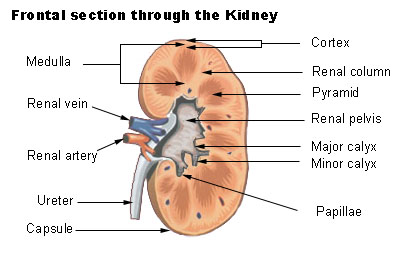
Abundance of osmolytes. The results of the HPLC sample demonstrate the concentrations of five key osmolytes in the papilla and cortical regions of the kidney nephron. On almost all of these occasions the concentration of each osmolyte is greater in the papilla than in the cortex. This is consistent with research by Schmolke et al, 1991, where the distribution of total organic osmolytes was found to increase progressively form the outer cortex in towards the inner medullary regions of the papilla. Burg et al., 1990 also found a significantly greater distribution of GPC, Betaine and Sorbitol in the inner medulla of rat kidneys compared to the cortex during both diuresis and anti-diuresis. These organic osmolytes in the papilla are used during high osmolality to maintain cell volume without increasing ionic strength.
Western blotting technique show there is approximately 39 kDa of aldose reductase in the samples shown. This appears to be in both the papilla and cortical samples.

Effect of Lithium. Whole animal data shows clearly the impact of lithium treatment on concentrating urine and the urine excreted increases more than four fold indicating severe polyuria. There is no difference in the Na and K concentration in serum. However, when the two subject groups consume the same amount of water and excrete the same amount of urine there is a marked reduction in these ion levels in urine and in the osmotic pressure of urine following lithium treatment.
It has been previously established that the polyuria and decreased ability to concentrate urine in lithium-treated patients is in part due to a down regulation of aquaporin water channels. The results of this study support this concept, the images of the medulla show a reduction the clear expression of (brown stained) water channels.
Consistent with previous studies (Rojeck et al, 2005)...
More Microbiology
essays:
Descriptions of the components of a plant cell.
... carbohydrates for long-term storage. MitochondionThis is a mitochondrion. The outer membrane is believed to be eukaryotic in origin. The inner membrane is, according to the endosymbiont theory, the cell membrane of an ancient prokaryote that became an endosymbiont. This ...
The Molecular Virulence of Legionnaires' Disease Bacterium.
... 60 cells and displayed host cell-killing associated with that of wild-type legionellae, when transformed with pMW741 and pMW743 (icmG in the same and opposite orientation to the promoter region, respectively ...
Anthrax This essay is simply entitled Anthrax. It is a brief description of the bacteria Anthrax and its effects on various aspects of life.
Anthrax is one of the oldest known diseases caused by the bacteria bacillus anthracis. One theory about this disease is that anthrax was the Fifth Plague of Egypt mentioned in The Bible. Casimir Davaine first saw these rod-shaped bacteria in 1850. In 1876, Robert Koch discovered that bacillus ...
Introduction to Microbiology (CP4089) - Experiment 4: Colony Count Methods: Viable Cell Number of Commercial Active Dried Yeasts
... . The difference in the volume might contain thousands of cells. There were also some potential for some volume to be carried over ... Accessed 21 June 2006] 6. Abedon, Stephen T., 1997.Diluting and Concentrating [online]. Mansfield, Ohio State University. Available from: http://www.mansfield. ...
Acquired Immunodeficiency Syndrome (AIDS)
... Genital infections... increase susceptibility to HIV infection by increasing the concentration of CD4 cells in genital secretions that can serve as targets for HIV ...
Studying Soil Bacteria. Microbiology Lab.
... sets of zig-zag lines. Each will carry bacteria at progressively lower concentrations. As the bacteria begin to grow, individual colonies of bacteria will be ... negative streptobacillus. They appeared to be joined in a central mass of cells with stands petruding. The strands appeared to be moving in a ...
The AIDS (Acquired Immune Deficiency Syndrome) Virus.
... Deficiency Syndrome) is a specific group of diseases that results from the suppression of the immune system (A group of cells, molecules, and organs that defend the body against invaders causing disease). The AIDS virus first involves the Human Immunodeficiency Virus ...
Determining viral specificity.
... may integrate into the host DNA, causing LYSOGENY, a permanently infected state. The indefinite persistence of phage genomes within bacterial cells in the absence of a productive infection but with the potential to produce progeny phage under certain circumstances is recognised ...