1.How does the Juvenile Justice system (or the Education System) define the 'norm' for mainstream youth? What does its treatment of young people (as opposed to its treatment of adults) say about our society's concepts of youth?
We live in a society in which the 'norm' is enforced by respected professions such as education and the law. This forms cultural knowledge and a perception of subjects such as young people which may not always be fair observations yet the fault does not merely lie in these professions. This assignment will aim to formulate how expectations of the behavior of young people have come to pass and have thus been fostered by institutions such as the Juvenile Justice system. Articulation of the consistency between the treatments of youth versus that of the adult will portray apparent reason and areas whereby another angle could be taken. The paper aspires to portray how youth are perceived in extremes of affection and fear by society.
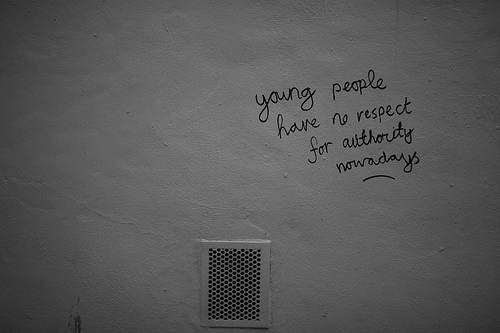 Young people have no respect for authority nowaday...
 Car belonging to the Florida Dept. of Juvenile Jus...
 English: Riverina Juvenile Justice Centre.
Moira Rayner wrote that 'there is an attitude problem in Australian Society. We have refused to take children seriously' (1990, pp.1); this statement may be found to be true in many senses. In a survey of how the media perceives Children, it was found that children are considered mostly as 'victims' of a cruel world, 'cute kids' and 'little devils' (O'Sullivan, 1998, pp.1). Although half of the typecasting was labeled negative, through the words alone, the image of youth may be distinguished as almost farcical. The problem of juvenile delinquency lies at the hands of ideologies that have been formulated through generations of moral upbringing. We learn how to bring up our children as moral human beings through our parents who, in turn, learnt from their parents, and so the story continues. The law simply sets the...
Great essay
pretty good essay, very well stated points and nice flow of argumentation. great use of the secondary sources as well. thanks so much for posting
0 out of 0 people found this comment useful.