How does the separation of powers in the US constitution both facilitate good government and check tyranny?
4.
The designers of the Constitution in the US implemented a framework of government that ensured the suppression of injustice and oppression, whereas at the same time, creating a climate ripe for good government.
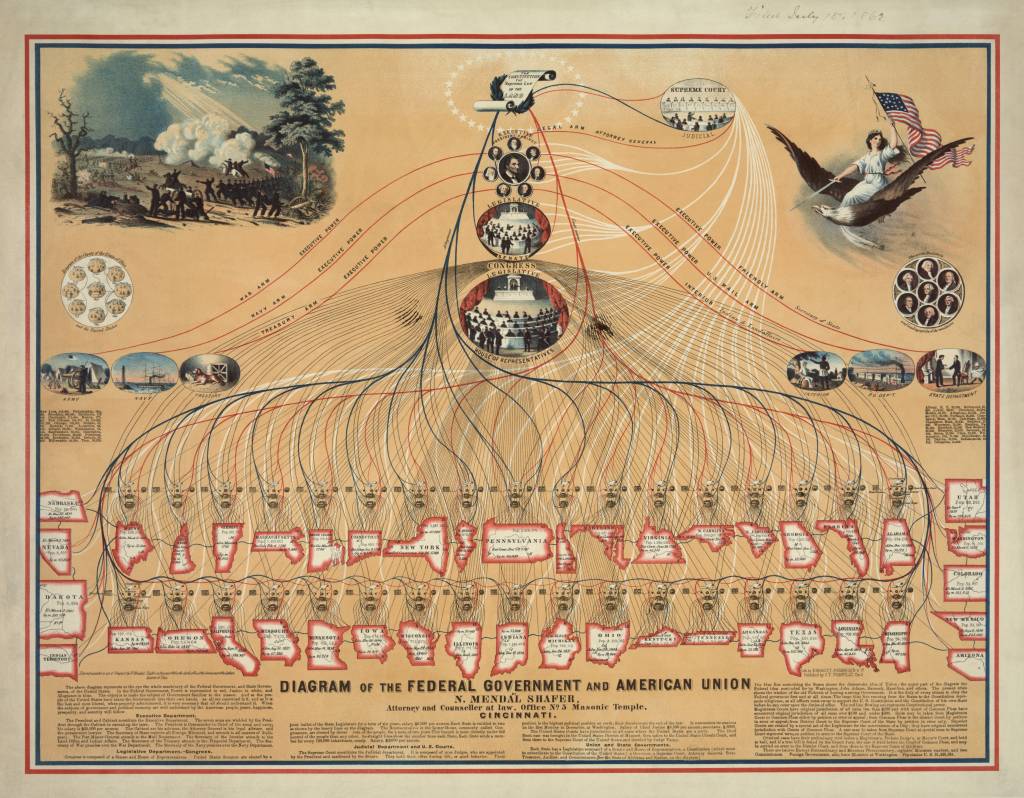
The fundamental basis of this system was and is federalism. In the turbulence following the Declaration of Independence in 1776, it was clear that the scattered American colonies had no vested interest in establishing a strong executive branch of leadership. The supreme power of George III and the oppression associated with his rule ensured a fear and dislike of power amongst the colonies, prompting the framers of the Constitution to create new limitations and separations of power. Tyranny was checked by the federalist system because it established 'two sovereigns ', dual federalism, instead of one. Both national and state power was limited by the independent creations of the national government and the state governments. Because of this separation, it meant that there would be no further chance of tyranny through a unitary government in the US. Indeed, for a century and a half, the state governments had the greater share of power, whilst the national government was strangled of economic power. 'The federalism of strong states and weak national government reigned until 1937, when the Supreme Court redefined "interstate commerce" to permit the national government to regulate local economic conditions '. Therefore, due to this separation of power, trade was regulated at a local level and the people were better represented than before, as 'federalism freed the states to make so many important policies according to the wishes of their own citizens '. This means that dual federalism allowed the facilitation of good government within the US during a turbulent period, where a powerful national government may have polarised and fragmented the country by implementing policies...
More Political Science
essays:
Analyze the critique of the Catholic Church presented by Machiavelli in "The Prince" and show how Machiavelli reveals the true nature of the Church and devises ways to counter them.
... in the affairs of the state and politics, the church had become greedy, power hungry, and hypocritical. The two problematic chapters in "The Prince ...
This essay is about globalization. The good, bad and how it affects the world.
... Regardless of the effect of globalization people will still have their languages and religion and is this not what constitutes much of our cultures? The spreading of cultures ...
The American Presidential System vs. The Canadian Parliamentary System
... separation of powers between executive, legislative, and judicial branches of government. The American system of government has three separate but equal branches of government: legislative, executive, and judicial. Together, these branches govern the country. The legislative branch of the federal ...
Analysis of the speach by José Manuel Barroso at the inauguration of the Academic Year 2004-2005, College of Europe, Bruges 23 November 2004
... independent supranatural economic association with powerful institutions, which might create some more problems regarding the separation of powers. In addition, the occurrence of some democratic deficit (mentioned above) in the role of the EU institutions makes the meaning of the Constitution ...
How and why does Locke explain the creation, value and protection of property?
... Political power of the state can have no right because this right is derived from the right of the individual man to protect himself and his property. Thus the executive and legislative powers used by civil government to ...
Che Guevara and a New Paradigm of Marxism This paper is regarding Che Guevara's separate brand of Marxism, ie: how he adpated Marxism to work in the Cuban jungles.
... for the establishment of a revolutionary power based on the masses support.₃ The Cuban revolution was without a doubt the result of the gradual action undertaken by radicals rather than a massive, spontaneous uprising. American politicians ...
In what ways and why are the Committees of the US Congress so much more Powerful than the Committees of the House of Commons?
... one of the principle reasons why bills are stopped at committee stage as different state members are seeking to protect their state's interests rather than protect national interests, this of course ...
How the 'social contract' described by Hobbs and Locke led to the formation of the United States and the citizens role in maintaining the social contract today.
... are not meeting our expectations in check with our vote. The same way the Constitution keeps in check the three branches of government. The majority of Americans do not vote; we need to address voter apathy. Most ...