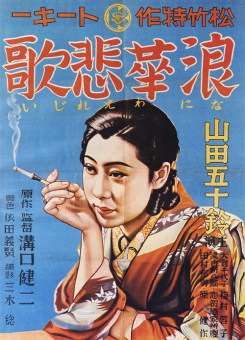
Early Japanese Films.
Cinema was first introduced to Japan in 1896 when the Kinetoscope, invented by Thomas Edison three years earlier, was imported to Kobe. The first public showing of a film was held on 25 November. This was soon followed by showings in Osaka, Tokyo and the rest of Japan. In February 1897, the Cinematographe, invented by the Lumiere brothers, was imported to Kobe. Due to technical difficulties concerning the installation of electrical equipment, the first showing could not be held until February 15 when it was shown in Osaka. However, on the 16th the theater was full of people eager to see the new invention.
During the first two decades after cinema was introduced to Japan, it was considered to be an object of curiosity and was billed as a rare Western invention. Although each film was only two or three minutes long, the show began with an introduction of the new invention and the film to be projected, and the live musical accompaniment made for an exciting event. It was rare that films were shown for more than a week at a time in any one hall. Afterwards they would be shown at locations in the surrounding countryside areas. As a result of this limited run, it was not practical to establish any permanent cinemas solely for the purpose of showing films.

One of the first Japanese companies that became involved in cinema was Yoshizawa. As early as the year 1902 it imported enough films from the West to allow for up to two months of showings at one location. This helped pave the way for the opening of Japan's first permanent cinema in October 1903. The Denkikan, an X-ray clinic in the Tokyo entertainment quarter of Asakusa, was equipped with projection facilities. This was followed by the opening of...
More Film History
essays:
The changes within the film industry 1990-2004
... Orange, New Jersey. Thomas Edison built the studio on the grounds of his laboratories, for he was the inventor of the first camera and projection equipment: the ... digital-cinema era. Just as sound was invented and color was invented...we ...
The changes within the film industry 1990-2004 (with works cited)
... Orange, New Jersey. Thomas Edison built the studio on the grounds of his laboratories, for he was the inventor of the first camera and projection equipment: the ... digital-cinema era. Just as sound was invented and color was invented...we ...
George Méliès
... to introduce himself to the Lumiere Brothers and was offered to buy one of their devices at 10,000 francs. The Lumieres refused to sell because of the most incorrect predictions of the future of the Cinema of ...
I'm a Reel Boy - Essay about the history and evolution of special and visual effects in the motion picture industry. Covers techniques from pyrotechnics to digital composites.
... and inventions related to motion and vision developed in the early to late 19th century foreran the birth of the motion picture industry. Early in 1893, Thomas Alva Edison built the world's first film ...
History of Italian Cinema
... their eccentricity and the fortune they spent. Sound Sound was introduced into Italian cinema after World War 1. Despite this, do to economic crisis ...
History of Hollywood
... States, Thomas Alva Edison was among the first to produce such a device, the kinetoscope, whose heavy-handed patent enforcement caused early filmmakers to look for alternatives.In 1908, Thomas Edison irate ...
History of Film
... pictures. Thomas Edison built on his idea by inventing the Kinetograph, which was the first practical moving picture camera. He also came out with the Kinetoscope, a ...
In what sense might Fritz Lang's "Metropolis" and Josef von Sternberg's "Der Blaue Engel" be considered 'modernist'.
... controlling sexuality, perhaps showing that women too, have ambition in this world of business. When Lola Lola is first introduced as a character, ... .Judy Pearsall ed, The New Oxford Dictionary of English (Oxford 2001), p1191 10.Thomas J Saunders, History in the Making: Weimar Cinema and National ...