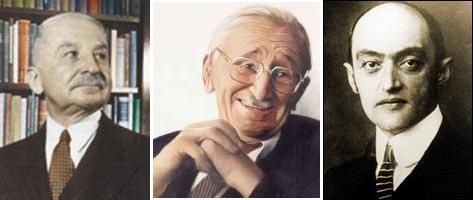
Economic biography of Jean Alois Schumpeter
Joseph Alois Schumpeter was an economist and a sociologist. He lived during the early 1900's, and had many books published in his lifetime. He was particularly well known for three works: The Theory of Economic Development (1912), Business cycles (1939) and Capitalism, Socialism, and Democracy (1942). He generally wrote from a socialist perspective but did not hesitate to acknowledge the positive aspects of all economic systems.
The Theory of Economic Development stated that entrepreneurs will eventually become obsolete and economic development will become mechanised. At the time of this book's publication it was entrepreneurs who bought about a majority of innovation. Schumpeter thought of innovation as not only technology, but also new processes, goods, markets, sources and organisations. Entrepreneurs bring new knowledge to the economy through experimenting (empirical). This is efficient compared to current rational methods. Rational development is simply using existing knowledge and expanding upon it, and therefore seems rather limited. Schumpeter sees this problem differently. He believes that with improvements in management techniques and technology, people/computers will soon be able to calculate quickly and almost exactly how to develop. Thus making development a simple rational routine. This will cause socialist economies (where the state owns resources and companies) to be generally as efficient as a capitalist economy (free enterprise is allowed and market forces affect production volume and prices with little government invention). This is due to the fact that socialism is a planned community, which according to Schumpeter is expected to flourish with the new 'mechanical' development techniques.
With innovation becoming a routine thing in the future, all companies would theoretically be able to produce a greater amount of new products. This would move the supply curve for new products to the right. Equilibrium of supply and demand (the demand curve has not moved) would move to...
Reviews of: "Economic biography of Jean Alois Schumpeter"
:
a well mannered and brief analysis of the subject with sources
More Economic History
essays:
The Economic Effect of September 11th on the Airline Industry.
... economists who say the aftershock of the attacks will most likely sink the economy into a recession. I do feel that the economic ...
Biography of Friedrich August von Hayek (1899-1992)
... economies. Socialism converted Hayek and many other economists of that time to "laissez-faire" economics where the market decides everything. The great issues of post-WWI Austria was inflation and business cycles. Hayek ...
How did the economic program of Alexander Hamilton help revitalize the American Economy?
... the process of revitalization because the agrarian and economic sectors would both be participation at the same level and therefore begin to revitalize and develop America ... small amount. The long term effect would led to a new capital city to be built on the banks of the Potomac ...
How did the economic program of Alexander Hamilton help revitalize the American Economy?
... the process of revitalization because the agrarian and economic sectors would both be participation at the same level and therefore begin to revitalize and develop America ... small amount. The long term effect would led to a new capital city to be built on the banks of the Potomac ...
The Economic Interpretation of the Constitution of the United States. by Charles A. Beard
... in the results. The small, non-slave farm owners, the debtors, and colonists of New York were in favor and in support of the Articles of Confederation because their economic interests were not represented in the Convention where the Constitution was ...
Industrialization and the Rise of Big Business: America's Transformation into an Economic Superpower
... be. Capitalism is an "economic system in which the means of production and distribution are privately or corporately owned and development is proportionate to the accumulation and reinvestment ...
Economic History : Asian Financial Crisis
... growth, and when realities became apparent, confidence levels fell and so did the capital foundations of growth. 'Crony capitalism is an economic system in ... optimal development. Investment in tradeable items could have and would have created greater growth in the short term and could ...
This essay describes the economic political cycles in the United States over the last 50 years in reference to Democratic and Republican parties
... during economic booms and recessions. If the U.S. economy were a steady economy, which did not have business cycles, recessions ... conservation, development of depressed regions, a wide-scale fight against poverty, control and prevention of crime and delinquency ...
Good
a well versed and detail essay on the subject.
0 out of 0 people found this comment useful.