GCSE SCIENCE COURSEWORK (CHEMISTRY)
PLANNING: Skill Area P
Write down the aim of your Investigation.
To investigate the effects of change in concentration on the rate of reaction between Sodium Thiosulphate and Hydrochloric Acid.
Briefly describe your Preliminary Experiment and include your results. Explain how these results have helped you plan your main experiment (p8b).
An increase in concentration will lead to an increase in the rate of reaction because there will be a greater number of particles per unit/cm3. The particles will be closer together and have greater chance of colliding and therefore reacting. The activation energy barrier is more likely to be overcome when particle with greater energy react therefore collisions are more likely to occur. This can be justified by relating to the Collision theory, which is that '...before we can get a chemical reaction, particles must crash together...' with enough energy. Molecules exceeding the activation energy collide together to initiate the reaction.
 Rusting can completely degrade iron. Note the galv...
 English: 30% hydrochloric acid
 It shows concentration of a product against time i...
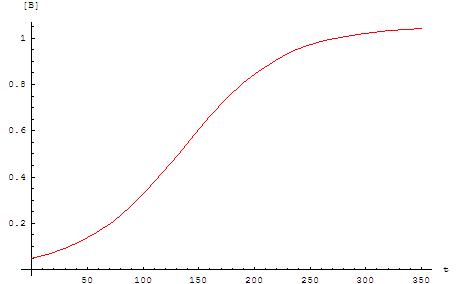
They must be also correctly orientated in order to successfully collide. This means that the graph drawn up in my analysis will have a negative correlation, because as one variable increases the other one decreases. In this case as concentration increases the time taken for the reaction to occur will decrease. The graph shown below is taken from my preliminary experiment's results and supports this argument.
Volume of
dilute HCl(cm3) Volume of 40g/dm3
Sodium Thiosulphate Volume of
Water(cm3) Time taken for Cross
to disappear(sec)
5 50 0 31
5 40 10 39
5 30 20 52
5 20 30 55
5 10 40 89
List all the apparatus that you now plan to use (diagrams should be included) (P4b).
Based upon my preliminary experiments I decided on using the following apparatus:
x1 stopwatch
x1 thermometer
x2 measuring cylinders
x1 conical flask
x1 beaker
x1 X board
x1 pair of goggles
x1 apron
240cm3 of hydrochloric acid
900cm3 of sodium thiosulphate
1500cm3 of distilled water
Describe the method you plan to use, include all safety precautions (p4a)
1. 110cm3 of sodium thiosulphate solution will be used each time, but at varying degrees of concentration. The first solution then, will compromise 10cm3 of 40g/dm3 sodium thiosulphate, which in a conical flask, and then 100cm3 of water will be added to complete the solution. 10cm3 of dilute hydrochloric acid will be poured into a separate measuring cylinder.
2. The flask is placed on the X board. The acid is poured into the flask which has the sodium thiosulphate solution in it.
3. As the hydrochloric acid mixes with the sodium thiosulphate and the water in the flask, the stopwatch is started. The flask is viewed from the top and then as the cross disappears the stopwatch is stopped and the time recorded.
4. These steps are to be repeated but the concentration of sodium thiosulphate will be varied. This will be done by mixing different volumes of the original sodium thiosulphate solution with water.
5. The whole procedure is repeated twice more and an average value calculated. The average will give a good summary of results for the experiment. It will also make the results more credible, removing any possibility of a coincidence and will assist in reaching a conclusion.
Safety:
-All the apparatus particularly acids and other solution will be kept away from the edge of the bench.
-Aprons will be needed to protect the skin and uniforms.
-Goggles will be used to protect the eyes.
Write down the factor you are going to vary and say how you will do this (P6b).
The factor, which is going to be varied, is the concentration of sodium thiosulphate. This will be done by adding various quantities of water to the solution to produce various concentrations.
Write down the factors you want to control or monitor (P6a).
The factors I am going to control are:
-temperature (room temperature)
-pressure (keep room pressure constant)
Make a prediction and explain it using scientific knowledge and understanding (P6a, P8a).
Vary concentration of sodium thiosulphate.
-The rate of a reaction varies according to concentration of reactants.
-An increase in concentration yields an increase in reaction rate, because more reactant molecules are present, therefore more collisions.
-The hypothesis is that as the concentration of sodium thiosulphate is increased, the reaction rate will also increase. (Because there will be more collisions between sodium thiosulphate and hydrochloric acid.)
Describe how you will ensure your results are as accurate, reliable and precise as possible (P8a).
In order for the findings to be valid the experiment must be a fair one:
1) The same standard will be used each time for judging when the X has disappeared.
2) It will be ensured that the amounts are measured as accurately as possible; the meniscus will be checked each time and the amount be determined from the base of the dip. All volumes will be measured from the same respective measuring cylinders.
3) Three experiments will be carried out to make it ensure the validity of results, to avoid coincidences, mistakes or anomalies.
4) The temperature and room pressure will be kept as constant as possible.
All of these precautions will serve to make my final results more reliable.
OBTAINING EVIDENCE: Skill area O
You must now record all your results clearly and accurately in a suitable format.
Table 1
Volume of
Water(cm3) Volume of 40g/dm3
Sodium Thiosulphate(cm3) Volume of
dilute HCl(cm3) Time taken for Cross
to disappear(sec)
100 10 10 338
90 20 10 256
80 30 10 184
70 40 10 122
60 50 10 73
50 60 10 33
40 70 10 18
Table 2
Volume of
Water(cm3) Volume of 40g/dm3
Sodium Thiosulphate(cm3) Volume of
dilute HCl(cm3) Time taken for Cross
to disappear(sec)
100 10 10 342
90 20 10 261
80 30 10 194
70 40 10 135
60 50 10 84
50 60 10 56
40 70 10 15
Table 3
Volume of
Water(cm3) Volume of 40g/dm3
Sodium Thiosulphate(cm3) Volume of
dilute HCl(cm3) Time taken for Cross
to disappear(sec)
100 10 10 351
90 20 10 235
80 30 10 159
70 40 10 131
60 50 10 74
50 60 10 36
40 70 10 11
Table of average results
Volume of Water(cm3) Volume of 40g/dm3
Sodium Thiosulphate(cm3) Volume of
dilute HCl(cm3) Time taken for Cross
to disappear(sec) The rate of reaction
100 10 10 344 2.9
90 20 10 251 4.0
80 30 10 179 5.6
70 40 10 129 7.8
60 50 10 77 13.0
50 60 10 42 23.8
40 70 10 15 66.7
ANALYSING YOUR EVIDENCE: Skill area A
Draw a graph to display your data (A4a&A6a). Use separate graph paper for this.
(on the graph paper)
Describe any trends and patterns in your results (A4b).
From looking at the curve of best fit for the average results. It is possible to conclude that the relationship between the concentration of Sodium Thiosulphate and rate of reaction is inversely proportional that as the concentration of Sodium Thiosulphate is increased, the time taken for the X to disappear significantly reduces. In other words: ConcentrationâÂÂ1/time
From looking at the curve of best fit for the values of rate of reaction, it is possible to conclude that the rate of reaction increases as the concentration of Sodium Thiosulphate increases. Increase of concentrate in the same volume means that more particles are present and therefore, more frequent collisions are likely to occur.
Explain what you have found out using scientific knowledge and understanding (A6b&A8a).
An increase in concentration leads to an increase in the rate of reaction because there are a greater number of particles per unit/cm3. The particles are closer together and have greater chance of colliding and therefore reacting. The activation energy barrier is more likely to be overcome when particle with greater energy react therefore collisions are more likely to occur. This can be justified by relating to the Collision theory.
How closely does your prediction match up? Explain your answer (A8b).
It was predicted that an increase in concentration will lead to an increase in the rate of reaction. Therefore concentration is inversely proportional to the time. A prediction matches up very closely.
For example,
In the average result, when the volume of sodium thiosulphate is 10cm3, the time taken is 344 sec. However, when the volume of sodium thiosulphate is 70 cm3, the time taken is only 15.
Therefore the time taken reduced by 95.6 %( the rate of reaction increased by 95.6) by increasing volume of the sodium thiosulphate by 60cm3.
A formula to get the percentage
100 ((x-y)/x)
x = longest time taken for reaction to occur
y = shortest time taken for reaction to occur
x-y = variation value
E.g. Using the data from the table of average results:
100 ((344-15)/344)
EVALUATING YOUR EVIDENCE: Skill area E
Describe any problems you had in carrying out your experiment (E4b).
The entire investigation was based on subjective opinion and for this reason the results were inevitably also subjective, for it was difficult to apply the same standard to judge when the cross disappeared.
What would you change if you could do the experiment again? Explain why you would make these changes (E4b).
The method of judging when the cross disappears will be changed, so the time taken to reaction can be recorded to a greater degree of accuracy. One way of doing this would be to use a colourimeter as better proof that the reaction has been completed.
How reliable are your results? Identify any odd results and explain what caused them (E4a&6a).
I consider the results to be reliable because they were recorded to the greatest degree of accuracy possible. Although no obvious anomalies can be identified, the three tests, whilst behaving according to similar trends, vary in results and in reaction times. This is due to the subjective nature of the experiment.
Do you have sufficient results to support your conclusion? (E6a)
The graph is sufficient to support the conclusion. A clear pattern has emerged from the data and this pattern was repeatable.
Give a detailed outline of any further work that could provide additional evidence for your conclusion. This should involve a different method to obtain results (E6b).
In order to provide additional evidence for my conclusion, I intend to embark on several things. First the amount quantity of data collected will be increased and this will be done in two ways: 1) By reducing the class widths; from 10ml at a time to 5ml.
2) By increasing the number of experiments carried out in absolute terms, in other words, time before was a limiting factor and to eliminate this, I shall carry out the experiment a greater number of times.
The above two can only serve to increase the validity of my conclusions.
Furthermore a colorimeter will be used to judge when the reaction has been completed. The solutions will then be judged according to the same standard. Although this will not greatly affect the overall result, it will no doubt only further ensure accuracy and therefore the significance of my findings.
Moreover I will compare my results with those of my peers and also use results and findings of previous scientific research in this field of study to further verify my conclusions.
Lastly, I intend to take the investigation one step further by not only identifying the effects of change in concentration on the rate of reaction but also to study the rate of reaction itself.