Globalisation is the process of increased integration between different economies of the world to create a unified global economy. Economists believe that this movement will lead to a more efficient allocation of resources as countries produce goods and services where they have a comparative advantage. For globalisation to work, it is necessary to promote free trade between nations to enable goods and services to flow between various economies.
"The future of China's economic development is bound up inextricably with the global economy" (Dr Augimeri). Through radical economic and political reforms introduced by President Deng in 1978, China has successfully transitioned from a planned economy to a more open, price mechanism determined economy. Only 1/3 of the economy is state owned with state enterprises falling from 78% in 1978 to 34% in 1994. Since its welcoming of global integration, China has enjoyed an annual average growth rate of 10% since 1978 and is currently ranked 7th largest economy in the world.
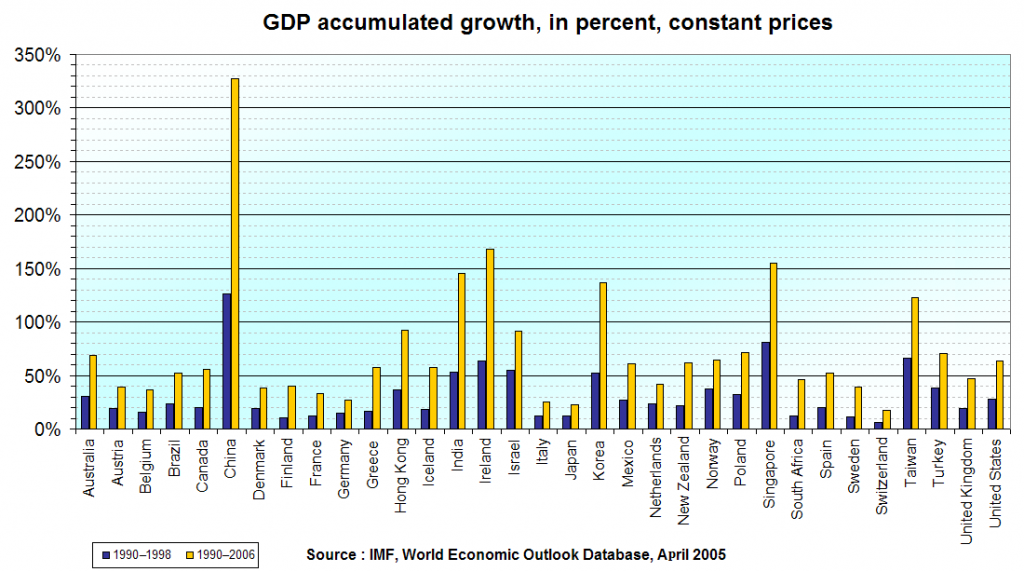 Gross domestic product growth in the advanced econ...
 English: Foreign direct investment, net inflows, I...
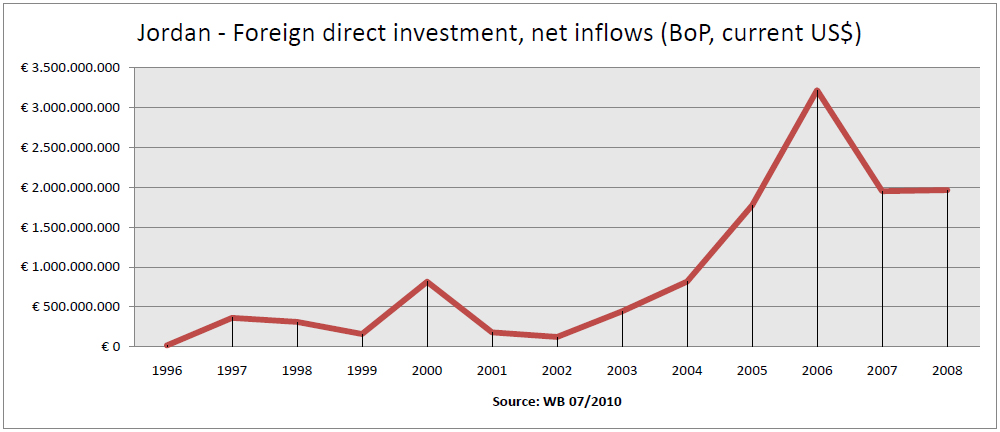 English: Foreign direct investment incoming in Jor...
Ironically, China remains a developing country as its GDP per capita of $5600 remains relatively low compared to the rest of the world and more than 26.1 million of the population still live in absolute poverty. China's success in the face of globalisation can be assessed in terms of their trade, foreign investment, financial flows, the international business cycle and labour movements.
The prominent effects of globalisation on China are their growth in foreign trade and FDIs. Globally, trade has dramatically increased from US$8.5 trillion (39.3% output) in 1990 to US$17.3 trillion (50.1% output) in 2003. China's economy has benefited significantly through globalisation and as the "manufacturer of the world", China depends on its large exports for growth. In 2002, China contributed 10% to global growth and 17% to global imports. China's emphasis on trade has seen its exports increase...